What Is Omnichannel Customer Service and Why It Matters
Ever tried to continue a conversation with a friend, but they have no memory of what you talked about yesterday? Frustrating, right? That’s exactly what it feels like for customers when their support experience is disjointed.
This is where omnichannel customer service comes in. It’s a simple but powerful idea: create one continuous, unified conversation with your customer that flows effortlessly across every single one of your channels. The customer's entire history and context travel with them, whether they move from an email to a live chat or send you a message on social media.
A Single Conversation Across Every Channel
The real magic behind what is omnichannel customer service is that it’s not just about being available on a bunch of different platforms. It's about weaving those platforms together into a single, intelligent customer story. Think of it less like a toolbox full of separate wrenches and screwdrivers, and more like a Swiss Army knife that has everything you need in one place.
This approach tackles one of the biggest headaches for customers. When support channels don't talk to each other, people are forced to repeat their problem over and over again. It’s a waste of their time and, frankly, it kills their trust in your brand. An omnichannel strategy gets rid of that friction completely by giving your support agents the full picture of every past interaction.
This infographic does a great job of showing how all these channels can connect to create that single, seamless conversation.
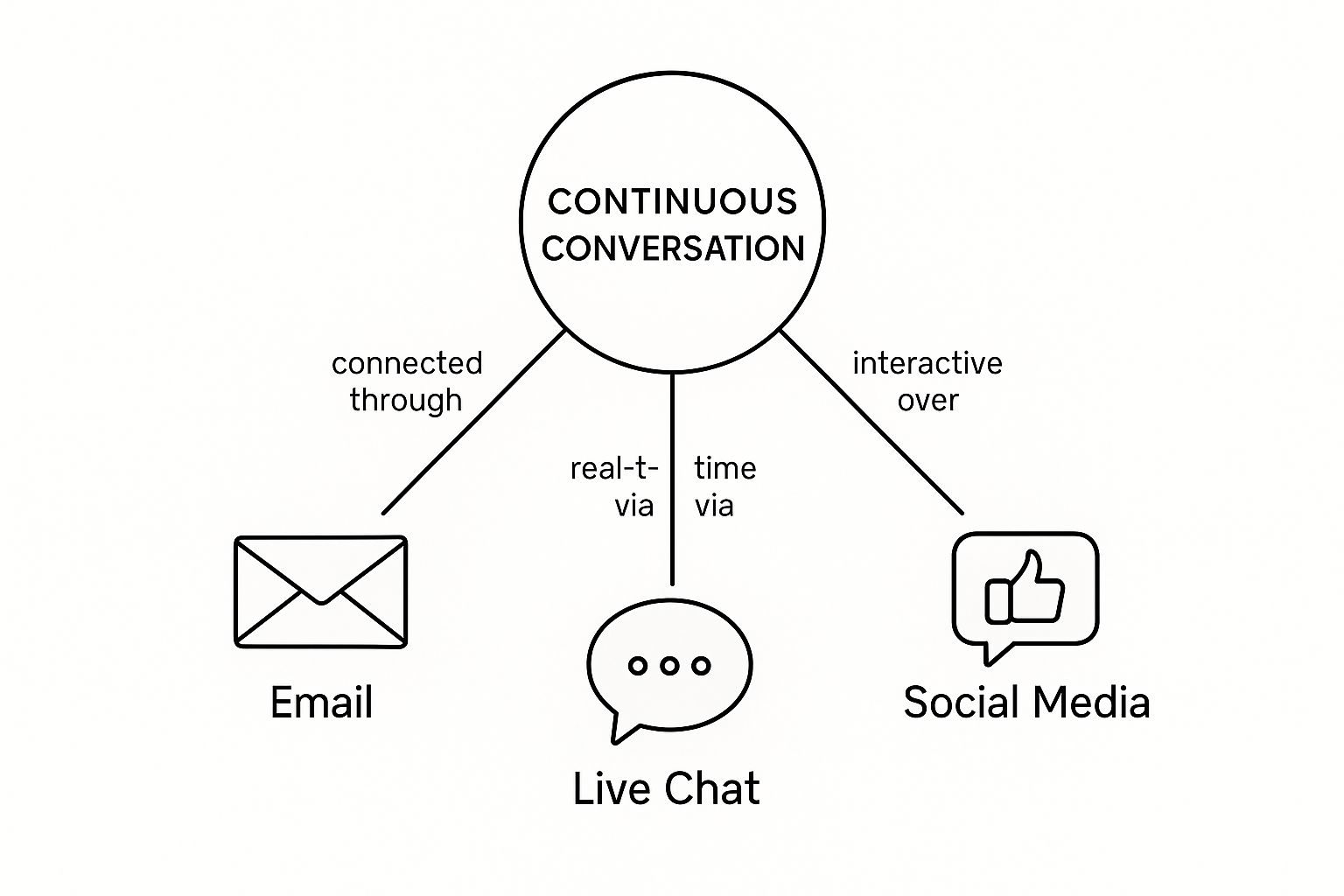
As you can see, the customer stays right at the center of the experience, and the conversation just keeps going, no matter how they choose to get in touch.
Omnichannel vs Multichannel A Quick Comparison
It's really important not to mix up omnichannel with its older cousin, multichannel. They sound similar, but they're worlds apart in practice. Multichannel just means you have a presence on different platforms. Omnichannel means all those platforms are connected and working in sync.
This isn't just semantics; it's a fundamental shift in mindset. It’s moving from a company-focused view ("Look how many channels we have!") to a truly customer-focused one ("How easy and connected can we make this for our customer?").
This table breaks down the key differences at a glance.
| Feature | Multichannel Service | Omnichannel Service |
|---|---|---|
| Customer Experience | Disconnected and siloed; customers often have to repeat information. | Seamless and consistent; conversations pick up where they left off. |
| Data Integration | Channels operate independently with separate data and context. | All channels are integrated, sharing a unified customer profile and history. |
| Agent Workflow | Agents have a limited view, seeing only the interaction on their specific channel. | Agents have a complete 360-degree view of the entire customer journey. |
At the end of the day, multichannel is all about the availability of your channels, while omnichannel is about the continuity of the conversation. That connected approach is what lets you deliver the kind of effortless, personal support that builds real loyalty. It’s a strategy designed not just to fix issues, but to create better, lasting relationships with your customers.
Why a Unified Experience Is Now Essential
In a market this crowded, a clunky, disconnected customer journey isn't just an annoyance—it's a fast track to losing business. Your customers expect conversations to flow seamlessly, no matter how they decide to reach out. The old way of treating each support channel like its own little island just doesn't cut it anymore. A unified experience isn't a "nice-to-have"; it's the new baseline for staying in the game.
Put yourself in your customer's shoes for a second. They might start a question on your website's live chat, send a follow-up email from their phone while on the go, and then call later for a quick resolution. If they have to repeat their story every single time, their frustration skyrockets. That kind of friction chips away at trust and makes them wonder why they chose you in the first place.

This is exactly where the argument for omnichannel customer service becomes impossible to ignore. It’s not just about better service; it’s about tying a smooth support strategy directly to your bottom line.
The Direct Impact on Customer Satisfaction
When support feels disjointed, customer satisfaction takes a nosedive. On the flip side, an integrated system makes people feel understood and valued. An omnichannel approach ensures the full context of their issue travels with them, letting your agents pick up the conversation right where it left off. That simple bit of continuity can turn a potentially frustrating experience into a surprisingly positive one.
The numbers don't lie. An omnichannel strategy can boost Customer Satisfaction (CSAT) scores to around 67%, while old-school multichannel service struggles to hit 28%. That’s more than double the happiness. It also leads to real financial gains, with companies using omnichannel support seeing up to 15% higher revenue and 35% greater customer loyalty. If you want to dig deeper, you can explore more insights on omnichannel statistics.
By unifying the customer experience, you’re not just solving a single problem; you're building a foundation of trust that encourages customers to stay with your brand for the long haul.
That boost in satisfaction is what builds stronger customer relationships, and strong relationships are the foundation of any business that lasts.
From Better Service to Stronger Loyalty
Real loyalty isn't won with flashy ads. It’s earned in those crucial moments when a customer needs help. A smooth, unified support experience is one of the most powerful ways to keep customers coming back. When people know they can get quick, effective help without a headache, they have no reason to even glance at your competitors.
Here’s how a unified experience builds that kind of loyalty:
- It Reduces Customer Effort: You make it easy to do business with you by getting rid of the need to repeat information.
- It Creates Personalization: When agents have a full view of a customer's history, they can offer solutions that feel personal and show you get their specific needs.
- It Builds Proactive Trust: Consistent, reliable service from every agent, every time, reinforces a customer's decision to trust your brand.
At the end of the day, investing in a unified customer experience is one of the smartest competitive moves a business can make. It changes the game from just closing tickets to building real relationships that lead to repeat business and great word-of-mouth. Committing to a seamless journey shows you value your customers' time and are invested in their success—and that’s how you turn them into lifelong fans.
The Building Blocks of a True Omnichannel Strategy
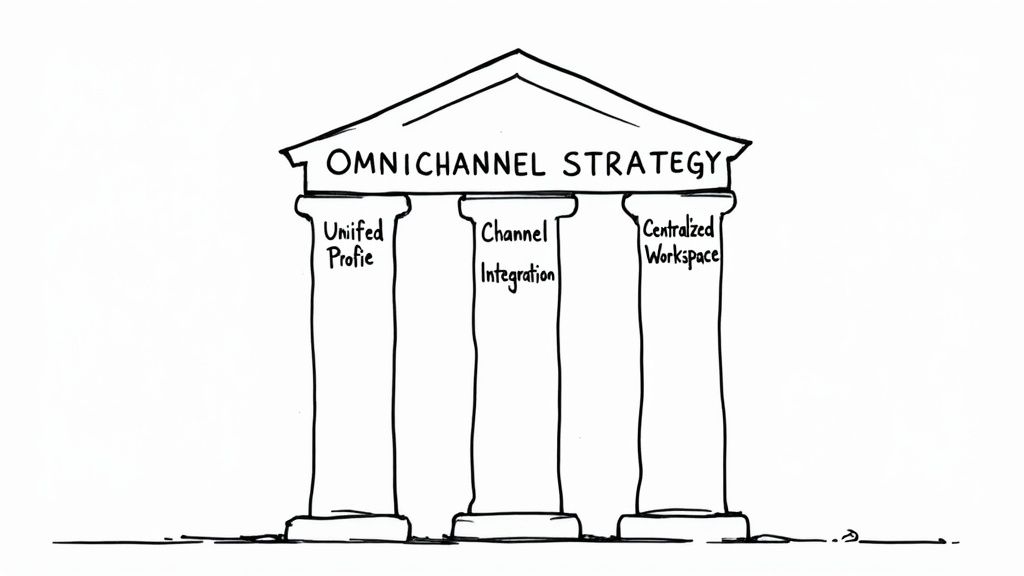
Creating a truly seamless customer experience isn’t something that happens by accident. It's carefully constructed, built on a foundation of specific parts all working together behind the scenes. Think of it like building a house—you can't just throw up walls and a roof and hope for the best. You need a solid blueprint and strong structural supports to hold everything together.
For an omnichannel strategy, these supports are what make every customer interaction feel smooth, personal, and efficient. Without them, even your best intentions can lead to a clunky, disjointed experience that leaves everyone—your customers and your support team—frustrated. Let's break down the three essential pillars that form the backbone of any great system.
The Unified Customer Profile
First up, and arguably the most important, is the unified customer profile. This is your single source of truth for every single customer. It’s a living, breathing record that pulls together every interaction, every purchase, and every bit of data into one easy-to-access place.
Let’s say a customer, Sarah, browses a product on your website, adds it to her cart, and then gets distracted. Later, she asks a question about that same product on your social media page. The next day, she calls your support line to finally make the purchase.
With a unified profile, the agent answering her call instantly sees her entire story: the product she looked at, the cart she abandoned, and the question she asked online. They have the full picture, which means they can give her immediate, relevant help without making her repeat a single thing. It’s the difference between talking to a complete stranger and an old friend who already gets what you need.
Deep Channel Integration
Next, you need deep channel integration. This is the technological glue that binds all of your communication platforms—email, live chat, phone, social media—into one cohesive system. It’s what makes that effortless flow of conversation possible.
This goes way beyond just having a bunch of different ways for customers to contact you. It's about ensuring the context of a conversation travels with the customer, no matter where they go. To create a truly unified experience, it's essential to invest in robust Customer Communication Management (CCM) software.
An omnichannel system without deep integration is like a relay race where the runners never pass the baton. Each one starts from scratch, and the team is guaranteed to lose.
When your channels are properly connected, a customer can start a chat on their laptop and pick it right back up via SMS on their phone later that day. Your agent sees it all as one continuous thread. This simple connection prevents the massive frustration that 56% of customers feel when they have to explain their issue over and over again. If you're curious about how different tools achieve this, you might find our live chat software comparison helpful.
The Centralized Agent Workspace
Finally, all this connected data and conversation history needs a home. That's where the centralized agent workspace comes in. It's the command center where your support team handles every customer interaction from a single screen.
Instead of flipping between a dozen tabs for email, social media DMs, and chat logs, agents get one unified dashboard that tells the full customer story. This single view empowers them to provide support that is faster, smarter, and far more empathetic.
A centralized workspace gives your agents everything they need:
- Complete Conversation History: They can see every past interaction, no matter which channel it happened on.
- Customer Data at a Glance: Purchase history, personal preferences, and old support tickets are right there.
- Improved Efficiency: With every tool in one place, agents resolve issues much quicker, which cuts down wait times and lets them help more people.
These three pillars—a unified profile, integrated channels, and a centralized workspace—aren’t just nice-to-have features. They are the absolute foundation for delivering the kind of service that customers now expect. Together, they turn your support from a series of separate, transactional moments into a single, ongoing, and positive customer relationship.
How to Meet Customers in Their Preferred Channels
A great omnichannel strategy isn't about being on every single platform. That’s a recipe for burnout. It’s about being good on the channels your customers actually use.
Think of it like a fisherman. You don't just randomly cast your line into every pond, lake, and stream you pass. You go where you know the fish are biting. The same idea applies to customer support—you need to show up where your customers are.
These days, people bounce between channels without a second thought. They might see your ad on Instagram, pop over to your website to ask a question on live chat, and then wait for an email with their order confirmation. The goal is to make that entire journey feel like one smooth, connected conversation.
Identifying Your Core Communication Channels
So, where do you start? Before you can connect anything, you need to know which channels matter most to your customers. And please, don't guess.
Look at your own data. Where are people already trying to reach you? Are your social media DMs constantly pinging with support questions? Is your website’s live chat widget always busy? Your customers are already showing you where they want to talk.
For most companies, the answer is a mix of digital channels. Data from B2C marketers shows a heavy reliance on Email (82.4%), Social Media (66.7%), and Mobile Websites (58%). The trend is clear: people want to connect online. You can dig deeper into these numbers in this in-depth analysis of omnichannel trends.
By focusing your energy on these core channels, you’re putting your resources where they’ll actually make a difference to your customers.
The Rise of Social Media and Direct Messaging
Email is still a workhorse for customer service, but the move toward quick, conversational support is impossible to ignore. Social media has grown from a simple marketing outpost into a full-blown support hub. Customers now expect to get real help inside the apps they already have open all day.
This is especially true for younger generations. Between 2022 and 2023 alone, there was a 27% jump in customers using DMs for service inquiries. Today, one in four people from Gen Z, Millennials, and Gen X actually prefer sliding into your DMs for help.
This means just having a profile isn't enough anymore. Your team needs to be ready to handle real, complex support issues through direct messages, treating them with the same care and professionalism as a phone call or email.
This is where an integrated system really proves its worth. It lets your agents manage a conversation that started on social media with all the same tools and customer history they'd have for any other channel.
Creating a Seamless Cross-Channel Experience
Ultimately, you want to make it completely painless for a customer to switch from one channel to another. The story of their problem needs to travel with them, so they never have to repeat themselves. That's the hallmark of a true omnichannel setup.
Here’s a classic example:
- A customer DMs you on Instagram asking about their order status.
- Your agent, working from a unified inbox, sees the message. They know they need to send a secure link with order details, which isn't ideal for Instagram.
- Without missing a beat, the agent transitions the conversation to email, sending the link while keeping the entire context from the original Instagram chat.
That smooth handoff turns a potentially clunky interaction into a great one. It tells the customer you respect their time and have your act together. When you master the channels your customers prefer and tie them all into one smart workflow, you stop offering disconnected touchpoints and start delivering a single, satisfying experience.
How AI Supercharges Your Omnichannel Support

Think of your omnichannel strategy as a high-performance engine. If that's the case, then Artificial Intelligence (AI) is the supercharger, giving it a massive boost in power and speed. AI tools are completely changing how businesses deliver seamless, intelligent support, elevating a good experience to an unforgettable one.
They work tirelessly behind the scenes, making every customer interaction quicker, smarter, and more personal. Imagine a chatbot that does more than just spit out canned responses. We're talking about an AI that can actually resolve common issues 24/7, freeing up your human agents to tackle the complex, high-value problems that truly need their expertise. AI isn't here to replace your team; it's here to make them better.
Automating the Small Stuff for Big Gains in Efficiency
Right away, one of the biggest wins with AI is its knack for handling all those repetitive, time-sucking questions. Think about all the time spent on "Where's my order?" or "How do I update my address?" An AI assistant can handle those in a flash.
This kind of automation is a huge relief for your team's productivity. Instead of getting buried under a mountain of routine tickets, your agents can focus on building real relationships and solving the unique challenges that customers face. It makes the job more efficient and more fulfilling. If you're ready to get started, digging into the basics of AI customer service automation is the perfect first step.
The results speak for themselves. An incredible 90% of Customer Experience (CX) leaders say they see a positive return on their investment after bringing AI tools on board. And it's not just leaders—79% of support agents agree that AI co-pilots help them provide faster, better service.
Giving Your Agents Real-Time Superpowers
AI's value goes way beyond just automating simple tasks. It acts as an intelligent co-pilot for your human agents, feeding them the exact information they need to nail the solution on the very first try.
Here’s a quick look at how AI gives your team an edge in real time:
- Instant Customer History: AI can pull up a customer's entire journey in seconds—past purchases, old support tickets, recent website visits—and give the agent a neat summary.
- Smart Reply Suggestions: Based on the conversation, AI can suggest accurate, on-brand responses, keeping your service quality consistent across the board.
- Effortless Knowledge Search: No more manually digging through help articles. Agents can get instant answers from your knowledge base, delivered right inside their workspace.
This kind of intelligent backup turns every agent into a seasoned expert who has the full story at their fingertips. It's not just about connecting channels anymore; it's about connecting them with intelligence.
AI is like a silent partner for your support team. It crunches data in the background to surface the perfect piece of information at the exact moment an agent needs it, taking the guesswork out of the equation so they can focus on empathy and creative problem-solving.
Getting Ahead of Problems with Predictive Support
This is where things get really exciting. AI allows you to shift from a reactive "wait-for-the-problem" model to proactive, preventative support. By analyzing customer data, AI algorithms can spot patterns and predict potential issues before they even bubble up.
For instance, if the system flags a customer who has been clicking around the same FAQ page for ten minutes, it could trigger a proactive chat offering to help. Or, if a shipping delay is detected for a specific batch of orders, AI can automatically notify every affected customer with a new ETA.
This proactive outreach shows customers you're on their side, building trust and stopping frustration in its tracks. It's the ultimate customer-first approach, made possible by smart technology.
Your Roadmap to Implementing Omnichannel Support
Making the move to a fully integrated omnichannel model can feel like a massive undertaking. But if you break it down into clear, manageable steps, it's a completely achievable goal. This roadmap will walk you through it, focusing on a practical, step-by-step approach to building a support system that truly revolves around your customers. The journey doesn't start with tech—it starts with understanding the people you serve.
The first, and most important, step is to map your customer journey. Before you can smooth out the bumps in the road, you have to know where they are. Trace every possible path a customer might take, from that first question on your website’s live chat to a follow-up phone call a week later. Pinpoint exactly where conversations fall apart, where customers are forced to repeat themselves, and where your internal teams aren't talking to each other.
Choose Your Integrated Technology Stack
Once you have that crystal-clear map of your customer's experience, you can start picking the technology to support it. The whole point is to create a single, unified view of every customer. That means choosing platforms that communicate with each other effortlessly, creating one central hub for every interaction.
Your tech stack needs to pull together key systems like your CRM, helpdesk software, and all your communication channels into one cohesive workspace. This integration is what gives your agents the full context of a customer's history, no matter how they reach out. When planning your omnichannel strategy, a big piece of the puzzle is making sure new tools play nice with your current setup. For those exploring AI, you can find great insights into how AI solutions integrate with existing systems.
Train Your Team for a Unified Mindset
Of course, technology is only half the battle. Your team needs to be trained to think and act with a unified, customer-first mindset. This goes way beyond just learning new software; it's a fundamental shift in culture.
Center your training around a few key areas:
- Emphasize context: Coach agents to look at the entire customer story before they even think about responding, using all that unified data right at their fingertips.
- Encourage collaboration: It's time to break down the walls between departments. A sales question can easily become a support issue, and your team needs to be able to pass the baton seamlessly.
- Empower agents: Give your team the freedom to solve problems without being tied to rigid scripts. Trust them to use their judgment to get the best possible outcome for the customer.
A successful omnichannel implementation depends on people as much as platforms. An empowered, well-trained team can turn a good system into an exceptional customer experience.
Launch a Pilot Program to Test and Refine
Finally, don't try to boil the ocean. Start small with a pilot program to test your new approach on a limited scale. Maybe you select a specific customer segment or just a couple of your most popular channels to kick things off.
This lets you gather real-world feedback and iron out the wrinkles before a company-wide rollout. Use this phase to keep an eye on key metrics like first-contact resolution and customer satisfaction scores. More importantly, listen closely to what both your customers and your agents have to say. This iterative approach ensures that by the time you go live everywhere, your omnichannel strategy is already polished and ready for success.
Got Questions? We’ve Got Answers.
Jumping into an omnichannel strategy can bring up a few questions. Let's tackle some of the most common ones to clear things up.
Omnichannel vs. Multichannel: What’s the Real Difference?
Think of multichannel as a set of separate, one-way streets. Your customer can take the email street or the live chat street, but the two roads never meet. If they switch streets, they have to start their journey all over again.
Omnichannel, on the other hand, is like a smart, interconnected highway system. A customer can get on using the live chat ramp, merge onto the phone call lane, and their entire trip history—every turn and stop—moves with them. It’s all one continuous journey, not a bunch of disconnected trips.
What's the Biggest Win for a Small Business?
In a word? Retention. An omnichannel approach makes your business feel personal and incredibly put-together, which is a massive trust-builder.
When customers feel heard and don't have to repeat themselves, they are 89% more likely to stay loyal. For a small business, holding onto the customers you already have is much cheaper and more effective than chasing new ones. It’s a game-changer for steady, sustainable growth.
What's the Toughest Part of Getting Started?
The biggest hurdle is almost always data integration. Getting all your different tools—your CRM, helpdesk software, and messaging apps—to talk to each other in real-time is no small feat. But nailing this is essential. It’s the technical backbone that gives your team that all-important single view of the customer.
Ready to build a customer experience that feels effortless? With Yoonoo, you can create a smart chatbot that learns from your website and delivers instant, accurate answers across all your channels. It's the first step to unifying your support. Start building for free and see how simple it can be.