What Is Customer Experience Management?

Customer experience management (CEM) is all about intentionally designing and fine-tuning every single interaction a person has with your brand. Think of it as a proactive game plan for shaping how people see you, earning their trust, and keeping them around for the long haul. Instead of just putting out fires, CEM is about creating great experiences from the get-go.
Moving Beyond Customer Service
Imagine you're hosting a party. You wouldn't just throw some chips in a bowl and call it a day, right? You’d curate a great playlist, set the mood with the right lighting, and make sure everyone feels included and has a fantastic time. That's the essence of customer experience management.
This infographic breaks down how a business, much like a great host, pulls together all the different pieces to create an environment customers love.

As you can see, CEM isn’t just one department's responsibility. It's about orchestrating everything—from marketing and sales to the support desk—to build a journey that feels consistently positive and intentional. It’s a company-wide mission.
A Strategic Business Function
Traditional customer service is often reactive; it's about fixing problems after they've already happened. CEM, on the other hand, is a proactive strategy that looks at the big picture. It’s about mapping out the entire customer journey, from the first time they hear your name to years after their first purchase. The goal is to build a company that people actually like doing business with.
To better understand this shift, let's compare the two approaches side-by-side.
CEM Core Focus Areas At A Glance
| Aspect | Traditional Customer Service | Customer Experience Management (CEM) |
|---|---|---|
| Focus | Reactive (problem-solving) | Proactive (journey design) |
| Scope | Specific interactions (e.g., a support call) | The entire customer lifecycle |
| Goal | Resolve issues and close tickets | Build loyalty and create brand advocates |
| Ownership | A single department (e.g., Support) | Company-wide responsibility |
| Metrics | Ticket resolution time, call volume | Net Promoter Score (NPS), Customer Lifetime Value (CLV) |
This table shows how CEM elevates the conversation from simply fixing what's broken to building something valuable from the very start.
The business world is taking notice. The global CEM market is on track to explode from USD 16.60 billion to a massive USD 84.68 billion by 2035. This isn't just a trend; it's a fundamental shift in how successful companies operate. The tools that make this possible—the software and platforms for personalization and analytics—are expected to claim over 81% of that growing market. You can learn more about the future of the CEM market and its trajectory.
Customer experience management covers every single touchpoint. It’s the usability of your website, the tone of your social media, the helpfulness of your emails, and even the feeling of unboxing your product.
At its heart, CEM is about building an emotional connection. It’s what turns a one-time buyer into a loyal fan who tells their friends about you. It transforms simple transactions into real relationships by focusing on how customers feel at every step. This is how you build a business that not only survives but is genuinely loved.
The Three Pillars Of A Strong CEM Strategy
A great customer experience isn't an accident. It's built on a solid foundation, held up by three pillars that have to work together: People, Process, and Technology.
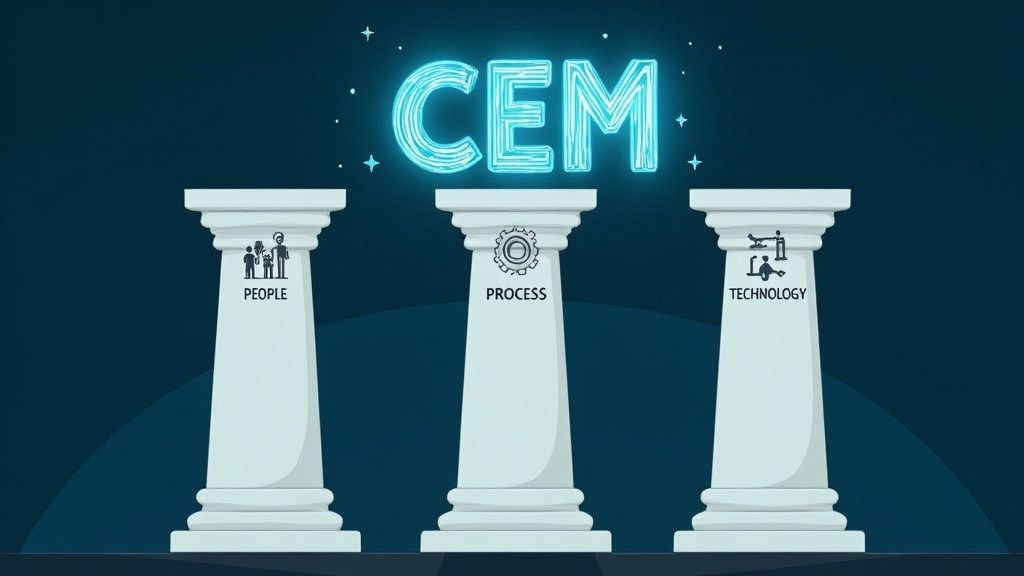
Think about it like building a house. You need skilled builders (People), a solid blueprint (Process), and the right power tools (Technology). If one of those is shaky, the whole structure is at risk. It’s the exact same principle for managing your customer experience.
People: The Heartbeat of Your Business
This is all about creating a customer-first culture. It means everyone, from the CEO down to the newest support agent, understands their role in making customers happy. A well-trained, motivated team that feels empowered to solve problems is your single greatest asset.
Process: The Map to a Great Experience
Your process is the blueprint for every customer's journey. By mapping out all the touchpoints—from their first click on your website to a follow-up email after a purchase—you can spot pain points and find moments to surprise and delight them. A clear process creates a consistent, reliable experience that feels effortless for the customer.
To get this right, it helps to explore different customer experience optimization strategies that can help you fine-tune these workflows.
A great team will struggle with broken processes, and powerful technology is useless without an empowered team to operate it. Success lies in the seamless integration of all three.
Technology: The Tools That Make It Happen
Finally, technology gives you the tools to bring your strategy to life and scale it effectively. Things like CRM systems, analytics software, and AI chatbots give your team the power to deliver personalized and efficient service.
This has never been more important. With over 3 billion online consumers globally, companies have had to completely rethink the customer journey. It's why 72% of customers now expect an immediate response when they reach out, and 64% say they'll spend more with a business that provides great service.
When your People, Process, and Technology are all in sync, you create a powerful engine for building real, lasting customer loyalty.
Why Mastering Customer Experience Matters
Let's get down to brass tacks: why should you actually care about customer experience management? It's easy to dismiss it as a "soft" part of business, but the reality is that a strong CEM strategy is one of the most powerful engines for growth you have. It directly connects how your customers feel to how your business performs.
Simply put, investing in your customer's journey is one of the smartest financial decisions you can make. The results aren't just feel-good stories; they're tangible, measurable outcomes that show up on the bottom line.
It Sparks Fierce Customer Loyalty
A great experience is what makes people stick around. When customers feel like you actually get them and value their business, they stop seeing you as just another option and start seeing you as a partner. That's the secret sauce.
This connection turns a one-time buyer into a lifelong fan who will not only keep coming back but also tell their friends about you. The data backs this up: 74% of customers stay loyal when they feel a company truly understands their needs. That's what CEM is all about—building relationships that last.
It Builds an Unbeatable Brand Reputation
You can spend a fortune on advertising, but nothing beats good old-fashioned word-of-mouth. A stellar reputation built on consistently positive experiences is a magnet for new customers, and it costs you a lot less than running ads.
Every happy customer effectively becomes a mini-marketer for your brand. This creates a powerful competitive edge that's incredibly hard for others to copy because it’s built on genuine trust, not just a flashy campaign.
When an organization empowers customers with information... it can increase customer trust. This trust can be the deciding factor in a first-time purchase and encourage repeat business.
It Directly Increases Revenue
It's a simple formula: happy customers spend more money. They come back for more, they're open to trying your new products, and their overall lifetime value shoots up. In fact, 77% of customers are willing to pay more for a great, personalized experience.
On top of that, managing the customer journey well just makes your business run better. For example, using AI in your CEM strategy can deliver a 25% or greater lift in revenue or cost savings. It automates the small stuff and centralizes your data, freeing up your team while making service even better. This is proof that CEM isn't just a cost center—it's a profit driver.
How To Measure Customer Experience Success
If you want to get better at something, you have to keep score. The same goes for your customer experience. You simply can't improve what you aren't measuring.
Tracking your customer experience management performance is the only way to know what's truly working, and it doesn't have to be some overly complex process. By focusing on a few key numbers, you can get a surprisingly clear picture of your customer relationships.
These metrics aren't just abstract data points. They tell a story about how people feel when they interact with your business, giving you the insight you need to make smart, strategic changes.
Core Metrics for CEM Performance
To get a well-rounded view, most businesses lean on three core metrics. Each one shines a light on a different, but equally vital, piece of the puzzle.
- Net Promoter Score (NPS): This is your loyalty barometer. It answers the question, "Are we building a brand that people want to rave about?" by asking customers how likely they are to recommend you.
- Customer Satisfaction (CSAT): Think of this as an in-the-moment snapshot of happiness. You typically ask for a CSAT score right after a specific interaction, like a support chat, to see how you did on that single touchpoint.
- Customer Effort Score (CES): This metric tells you how easy—or difficult—it is for customers to get things done with your company. A low-effort experience is a massive driver of loyalty, so this number is a big deal.
The best customer experience strategies are built on a simple foundation: continuous listening. These metrics are your ears, turning customer feelings into real data that can guide your next move.
Now, let's break down these metrics into a quick, easy-to-reference table.
Key CEM Metrics Explained
| Metric | What It Measures | Example Question |
|---|---|---|
| Net Promoter Score (NPS) | Overall brand loyalty and advocacy. | "On a scale of 0-10, how likely are you to recommend our company to a friend or colleague?" |
| Customer Satisfaction (CSAT) | Short-term happiness with a specific interaction. | "How satisfied were you with your support experience today?" |
| Customer Effort Score (CES) | The ease of a customer's experience. | "How easy was it to resolve your issue today?" |
Tracking these consistently helps you understand the health of your customer relationships at a glance.
This focus on data-driven improvement is precisely why the global CEM market, valued at USD 12.04 billion, is expected to skyrocket to USD 32.87 billion by 2030. In fact, tools that analyze customer feedback now account for 39% of the analytics market, which shows just how serious companies are getting about listening. You can find more details on this trend over at Grand View Research.
By regularly collecting and acting on this feedback, you can spot problems before they escalate, celebrate what your team is doing right, and build a business that people genuinely love. For a closer look, explore our guide on other valuable customer satisfaction measurement methods.
The Role Of AI In Modern Customer Experience
Technology has completely changed the game for customer experience, and artificial intelligence is at the heart of that shift. AI tools aren't some far-off concept anymore; they're a hands-on, practical part of managing the customer journey today. They work right alongside your human team to make things faster, smarter, and more personal.

Think about the classic support experience. A customer has a simple question but gets stuck in a long phone queue waiting for help. Now, an AI chatbot can jump in and give them an accurate answer, 24/7, solving the problem in seconds.
That kind of instant availability is huge, but what AI can do goes much deeper. It handles all the repetitive questions, which frees up your human agents to tackle the complex, sensitive issues where their expertise really shines. If you want to dive deeper into this, check out our guide on AI customer service automation.
Augmenting The Human Touch
The point of using AI in customer experience isn't to replace your people—it's to make them better. By taking over the routine stuff, AI gives your team the breathing room to build real relationships with customers who need a bit more attention. It's the perfect partnership between efficiency and empathy.
AI enables a level of personalization and speed that was previously impossible to scale. It anticipates customer needs, offers proactive solutions, and ensures every interaction feels relevant and helpful.
For example, smart tools can look at a customer's history to suggest products they’ll actually love or provide support that feels one-step-ahead. As modern customer experience management leans more on tech, understanding how context-aware tools for service efficiency can improve performance is essential.
At the end of the day, weaving AI into your strategy means you can give better support to more people, faster than ever before. It elevates the entire experience, making it a win-win for both your customers and your team.
Your First Steps In Customer Experience Management
Getting started with customer experience management can feel like a huge undertaking, but it doesn't have to be. You don't need to reinvent your entire business overnight. In reality, the best strategies are built on small, deliberate steps that create momentum.
Think of it less as a massive project and more as a new way of operating. We'll break it down into three core areas that will give you immediate insights and lay a solid groundwork for everything that follows.
Your Actionable Starting Plan
To kick things off, you just need to focus on three simple actions: listen, understand, and empower. These steps are designed to score some early wins and get your entire team thinking about the customer in everything they do.
-
Start Listening Actively: You can't fix a problem you don't know you have. The easiest way to start is to just ask for feedback. Use a simple survey tool to check in with customers after a purchase or a support chat. Asking for a Net Promoter Score (NPS) or Customer Satisfaction (CSAT) score opens a direct line to the voice of the customer.
-
Map One Key Journey: Don’t try to map out every single customer touchpoint from the get-go. You'll get overwhelmed. Instead, pick one critical journey—like the first-time buying process or new user onboarding—and sketch out every step. This will immediately show you where customers are getting stuck and where a tiny tweak could make a world of difference.
-
Empower Your Team: Great customer service isn't just one department's responsibility; it's everyone's job. Get things rolling with a quick weekly huddle where someone shares a great piece of customer feedback or a success story. Empowering your employees to solve customer problems on the spot is probably the most powerful CEM tool you have.
The goal is not perfection, but progress. A series of small, thoughtful improvements will always outperform a grand, perfect plan that never gets started.
By taking these three steps, you'll start building a company that truly listens, learns, and adapts to what its customers need. And that's what effective CEM is all about.
Frequently Asked Questions About CEM
Jumping into customer experience management (CEM) can feel a little overwhelming, and a few common questions always pop up. Let's clear those up so you can get started with confidence.
What Is The Difference Between CEM And Customer Service?
This is a great question, and the answer is all about being reactive versus proactive.
Think of customer service as the firefighter. It's an essential team that jumps in to solve specific problems when they happen—a customer calls with an issue, sends a frustrated email, or needs help with a return. It's a single, important piece of the puzzle.
CEM, on the other hand, is the architect of the entire building. It's a company-wide strategy focused on designing the entire customer journey from the very first ad they see to the follow-up email they get months after a purchase. The goal is to create a seamless, positive experience from start to finish, preventing fires before they even start.
What Is The First Step For A Small Business?
Don't overcomplicate it. The best first step is to simply start listening. You don't need a huge, expensive platform right away.
Start small. Send a simple feedback survey after a customer makes a purchase. Ask them how things went.
The most crucial part of customer experience management is understanding how your customers truly feel. Simple tools like Net Promoter Score (NPS) or Customer Satisfaction (CSAT) surveys can give you immediate, powerful insights to show you where to focus your energy.
How Can I Justify The Investment In CEM?
When you need to get buy-in, shift the conversation from cost to outcome. Good CEM isn't just an expense; it's a powerful engine for revenue and loyalty.
Connect your proposed investment directly to the results that matter to the business.
- More Loyalty: Customers who have a great experience don't just come back—they become advocates. They stick around longer and spend more over their lifetime.
- Higher Revenue: It's been proven time and again: people are willing to pay more for a better, smoother experience.
- Lower Costs: When you proactively solve problems and improve the journey, you drastically reduce the number of expensive, time-consuming support calls and tickets.
By framing CEM around these bottom-line impacts, you can show that you're not just asking for a budget—you're investing in the long-term, sustainable growth of the company.
Ready to provide instant, intelligent support and improve your customer experience? See how Yoonoo can deploy an AI chatbot on your site in just five minutes. Get started at https://yoonoo.ai.