What Is AI Automation?
So, what exactly is AI automation?
Think of it this way: traditional automation is the hard-working muscle, and AI automation is the brain that guides it. While standard automation is great at following a strict set of pre-programmed rules, AI automation can think, learn, and adapt all on its own. It's the difference between a system that just does and one that understands.
A Smarter Kind Of Automation
At its heart, automation has always been about getting things done more efficiently. Your coffee maker set to brew at 7 AM is a perfect example of simple automation. It follows that one command perfectly, day in and day out. But it can't adjust if you wake up early or decide you're in the mood for a stronger cup. It's a one-trick pony.
This is exactly where AI changes the game. Instead of just mindlessly following a script, AI automation looks at data, spots patterns, and makes intelligent decisions. It turns a simple, repetitive system into something dynamic and responsive.
The Smart GPS Analogy
Here’s a simple way to picture the difference. Traditional automation is like a basic calculator. It's fantastic for crunching the exact numbers you give it, but that's where its usefulness ends. It can't suggest a better formula or notice a flaw in your logic.
AI automation, on the other hand, is like a modern GPS app on your phone. It doesn't just hand you a single, rigid route. Instead, it’s constantly working for you:
- It checks real-time traffic data from thousands of other drivers on the road.
- It learns your favorite shortcuts and driving habits over time.
- It adapts instantly, finding a faster way around if an accident suddenly blocks your path.
That ability to analyze, learn, and adapt in real-time is what makes AI automation so powerful. It’s what truly sets it apart from the older, rule-based systems.
To make this even clearer, let's break down the key differences.
Traditional Automation vs. AI Automation At A Glance
This table provides a quick comparison to highlight the fundamental differences between basic automation and AI-powered automation, helping you grasp the unique capabilities AI brings to the table.
| Feature | Traditional Automation | AI Automation |
|---|---|---|
| Core Function | Follows pre-defined rules ("if this, then that"). | Makes decisions based on data, patterns, and context. |
| Flexibility | Rigid. Fails when encountering unexpected scenarios. | Adaptive. Learns from new data and handles variability. |
| Data Handling | Processes structured, predictable data. | Can understand and process unstructured data (text, images). |
| Decision-Making | None. Simply executes programmed instructions. | Can make complex, human-like judgments and predictions. |
| Example | An email auto-responder sending a generic "we got your message" reply. | A chatbot that understands a customer's question and provides a specific, helpful answer. |
As you can see, the leap from traditional to AI automation isn't just an upgrade; it's a completely different approach to getting work done.
More Than Just Following Orders
The big shift here is moving from simply executing tasks to actually understanding the context behind them. This intelligence allows AI systems to handle complex work that used to require a person's judgment. It’s not just about doing things faster; it’s about doing them smarter.
By learning from past data and live inputs, AI-driven systems can anticipate needs, predict outcomes, and continuously improve their own processes without someone constantly having to step in.
The economic impact is already huge. The global industrial automation market is a great example, with its value projected to hit approximately $226.8 billion in 2025. Much of this growth comes from pairing AI with smart manufacturing, a trend that boosts both precision and efficiency. You can find more insights on the automation market's growth in recent industry reports. We're moving far beyond just checking boxes on a to-do list and into a world of building self-improving, intelligent operations.
A Look Inside How AI Automation Works
So, how does this all actually work? While the technology behind AI automation can feel a bit like magic, the process itself is surprisingly straightforward. It's built on a logical, three-step cycle that repeats continuously.
A great way to think about it is like a smart home thermostat. It first senses the room's temperature (that's the data input). Then, it thinks about your settings and whether it's too hot or cold (the intelligent analysis). Finally, it acts by turning on the heat or AC (the automated output).
That same sense-think-act logic applies to even the most complex business systems. The whole operation is just a continuous loop of taking in information, making a smart decision, and then doing something about it.
This visual gives you a great overview of how that flow works, from the initial data coming in to the final action going out.
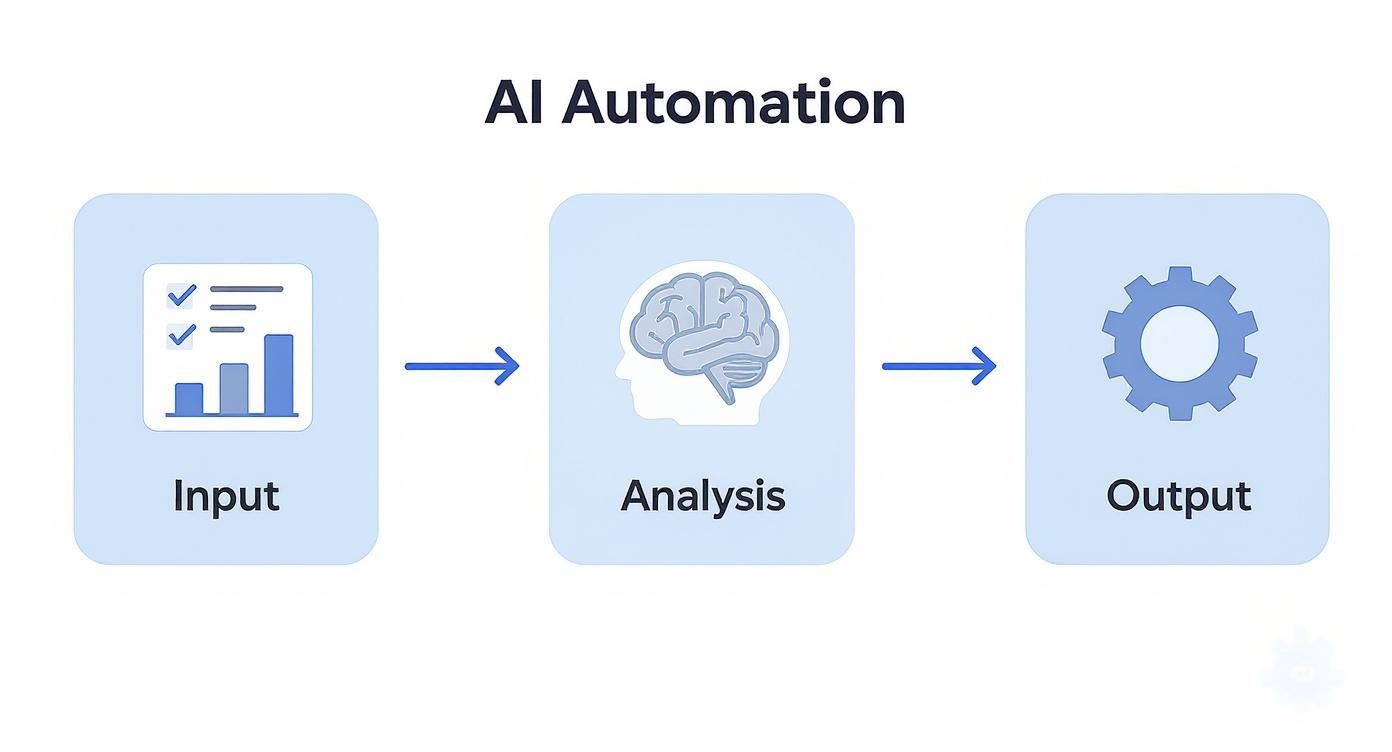
As you can see, the real power is in that middle step—the "thinking" part—where the system applies intelligence to raw information before it takes any action.
The Three Stages Of Intelligent Automation
Let's walk through each stage with a real-world example: an AI system built to manage customer support emails.
-
Data Input: It all starts with data. This could be anything—customer emails, chat transcripts, sales numbers, or even website clicks. For our example, the system gets an email from a customer asking, "Where is my order?" The text in that email is the raw data input.
-
Intelligent Analysis: This is where the "AI" really comes into play. The system doesn't just see a jumble of words; it uses specific technologies to figure out what the customer wants. Natural Language Processing (NLP) helps the AI understand the human language, identifying the core question. Meanwhile, Machine Learning (ML) algorithms kick in, comparing this request to thousands of past ones to determine the best way to respond.
-
Automated Output: After the analysis is done, the system acts. It connects to the company's order management system, finds the tracking information for that specific customer, and generates a friendly, personalized reply. The final output is an email that says something like, "Hi Jane, your order is on its way and should arrive tomorrow!" and includes the tracking link.
This simple cycle turns a slow, manual task into a smart, hands-off workflow that runs in seconds. The system didn't just follow a rigid script; it understood the request, figured out the solution, and responded all on its own.
The Technologies That Power The Process
Behind this three-step process are a few core technologies that do the heavy lifting. You don’t need to be a developer to get the gist of how they work.
-
Machine Learning (ML): Think of ML as the system's brain. It's what allows the software to learn from data and get better over time without a human having to reprogram it. An ML model can learn to spot a fake online review, for instance, by analyzing the patterns in thousands of real and fraudulent ones.
-
Natural Language Processing (NLP): This is a branch of AI that gives machines the power to read, understand, and respond to human language. It’s the secret sauce behind chatbots, spam filters, and voice assistants like Siri or Alexa.
These are the fundamental building blocks of almost any AI automation system. To get a more detailed look at how these parts fit together, you can explore how AI powered workflow automation functions at a deeper level. By blending these technologies, companies can create systems that don't just check boxes—they actually solve problems.
The Real-World Benefits Of Using AI Automation

Beyond the technical jargon, what really matters is why so many businesses are jumping on the AI automation train. It's not about chasing the latest trend. It’s about getting real, measurable results that completely change how work gets done.
One of the first things you'll notice is a huge boost in efficiency. Think about it: AI systems can work 24/7 without getting tired or making mistakes, juggling thousands of tasks at once. This non-stop productivity leads directly to lower costs and much faster operations.
Unlocking Greater Accuracy And Precision
Let's face it, human error is unavoidable in any manual job, and sometimes those mistakes can be expensive. AI automation systems, on the other hand, do the same task the same way every single time with incredible consistency. This is a game-changer in fields where a tiny mistake can have big consequences.
- In finance: AI algorithms can spot a fraudulent credit card transaction in the blink of an eye, picking up on weird patterns a human analyst would almost certainly miss.
- In healthcare: AI tools can help doctors by analyzing medical scans to find early signs of disease with amazing accuracy, which can be critical for life-saving diagnoses.
This kind of precision reduces risk and helps maintain a higher standard of quality, whether on a factory floor or during a customer support chat. You can learn more about how this applies to customer experience in our guide on AI customer service automation.
Empowering Smarter Decision-Making
Maybe the biggest win of all is how AI helps people make smarter, data-backed decisions. Most companies are sitting on a mountain of data they never use. AI automation is brilliant at digging through that data to find hidden gems and predict what’s coming next.
For instance, an e-commerce store can use AI to look at a shopper's click history, past buys, and even how they move their mouse to suggest products they're very likely to purchase.
This shifts a business from just reacting to problems to thinking ahead. It lets you anticipate what your customers will want and spot market opportunities before your competitors do. It's no wonder there's so much money pouring into this space. The global AI in industrial automation market, currently valued at USD 20.2 billion, is projected to rocket to USD 111.8 billion by 2034, all thanks to AI’s knack for improving processes with smart insights. You can read more about the growth of AI in the industrial automation market.
AI Automation Examples You See Every Day

The idea of AI automation might sound like something out of a sci-fi movie, but you probably use it several times a day without a second thought. This isn't just technology for high-tech labs; it's already a part of our daily lives, quietly making things easier and safer.
AI automation is the invisible force behind many of the conveniences we now take for granted, from getting instant help from a website to keeping your bank account secure.
Let's break down a few real-world examples you'll definitely recognize.
Instant Customer Service Chatbots
Ever landed on a website and a little chat window pops up asking if you need help? More often than not, that’s an AI chatbot. Instead of putting you on hold for a human agent, these bots deliver instant answers.
Businesses get swamped with customer questions, and answering them all quickly is a huge challenge. AI chatbots solve this by using Natural Language Processing (NLP) to figure out what you're asking. From there, the bot searches its database for the best answer or points you in the right direction.
This simple setup gets common questions answered in seconds. It also frees up the human support team to focus on the tricky problems that really need their attention.
Smarter Fraud Detection In Finance
Another place you’ll find AI automation is in your wallet. Every single time you use your credit card, AI is standing guard. It would be impossible for banks to manually check every transaction, so they rely on AI to act as a 24/7 security detail for your account.
It’s a pretty slick process:
- It Learns Your Habits: The AI system gets to know your spending patterns—the stores you frequent, your average purchase amount, and even the time of day you usually shop.
- It Spots Anything Unusual: If a charge suddenly appears that doesn't match your profile, like a huge purchase made in another country, the AI immediately flags it.
- It Takes Action: The system can automatically block the suspicious charge and shoot you a text or email to ask if it was really you.
This all happens in the blink of an eye, protecting you from fraud and saving banks from massive losses, all without a person needing to lift a finger for the initial alert.
Advanced Diagnostics In Healthcare
AI automation is also having a huge effect on medicine, especially when it comes to reading medical images like X-rays, CT scans, and MRIs. Radiologists have to look at an incredible number of scans, and it’s a job where one missed detail can change a life.
AI models are trained on millions of medical scans, learning to identify subtle patterns that may indicate the early stages of diseases like cancer.
Think of these AI systems as an expert assistant for doctors. They can highlight potential problem areas on a scan, drawing the radiologist's attention to something that needs a closer look. This doesn't replace the doctor's judgment; it enhances it, leading to quicker and more precise diagnoses.
By automating the first pass, this technology lets medical experts focus their skills where they matter most. These are just a handful of the many business process automation examples that are reshaping how industries operate.
Of course. Here is the rewritten section, designed to sound natural and human-written while meeting all your requirements.
Navigating The Challenges And Ethical Questions
As promising as AI automation is, it's not a magic wand. Anyone telling you it's a simple plug-and-play solution isn't giving you the full picture. Getting it right means facing some real-world hurdles and asking some tough ethical questions.
First off, let's talk about the price tag. The initial investment can be steep. You're not just buying software; you're paying for the infrastructure, the development, and the experts needed to integrate it all. For smaller businesses trying to keep up, this cost can be a significant barrier.
Then there's the talent gap. These systems need smart people to build, run, and maintain them. They don't manage themselves. This has kicked off a massive search for professionals who actually understand AI, and there just aren't enough of them to go around.
Addressing The Human Element
It’s impossible to talk about automation without talking about jobs. People are understandably worried about being replaced by machines, and it's a valid concern as AI takes over more routine tasks.
The real goal shouldn't be to replace people, but to augment them. Think of AI as a tool that frees up your team from repetitive work so they can focus on what humans do best: creativity, strategy, and complex problem-solving.
This isn't just wishful thinking; it's a massive shift in the workforce. By 2025, it's estimated that 97 million people worldwide will be working in roles that tie directly into AI. With 83% of companies making AI a top priority, the demand is exploding. You can get a deeper look at these figures and more in this report on global AI market trends. It’s all about helping employees adapt and learn new skills for this new reality.
Ensuring Fairness And Security
There are a couple of other big elephants in the room: fairness and security. An AI is only as good as the data it's trained on. If you feed it biased data, you're going to get biased results. That's a huge problem when AI is used for things like hiring decisions or approving loans.
And as we hand over more control to automated systems, we're also making ourselves bigger targets for security threats. Protecting sensitive customer and company data has to be a non-negotiable part of the plan.
Ultimately, successful AI automation isn't just about the tech. It’s about building it on a foundation of ethical principles and robust security, ensuring it works for everyone, safely and fairly.
The Future Of AI Automation Is Already Here
It’s easy to think of AI automation as something pulled from a science fiction movie, a concept for the distant future. But that future isn’t on the horizon—it’s already here. This technology is actively reshaping how businesses operate and how we get things done every single day.
Looking at what's coming next, the pace is only picking up. Two major trends are leading the charge.
Hyperautomation: The Next Level of Efficiency
First, there's hyperautomation. Think of it as a strategic move to automate not just one or two tasks, but nearly every business process possible. Companies are now layering multiple AI, machine learning, and automation tools together to tackle everything from simple data entry to complex, long-running operations. It’s about creating a fully optimized, interconnected system.
Generative AI: From Repetition to Creation
At the same time, generative AI is completely changing the game. This isn't about just automating repetitive work anymore; we're now automating creativity and complex problem-solving. This kind of AI can come up with new ideas, write functional code, and even create product designs—tasks that, until very recently, were purely in the human domain.
The core takeaway is one of opportunity. Understanding AI automation is the first step toward unlocking its immense potential for business innovation and personal career growth.
This is your cue to start adapting. Getting a handle on these changes is the first step to not just surviving, but to thrive in the age of AI and automation. Leaning into this shift is how we'll all build a smarter, more efficient future.
Frequently Asked Questions
To wrap things up, let's tackle a few questions that often come up when people first start exploring AI automation. Getting clear answers to these can make a world of difference in understanding its real-world impact.
We've put together some quick answers to the most common queries we hear.
| Question | Answer |
|---|---|
| What is the main difference between AI and automation? | The simplest difference is that traditional automation follows predefined rules, while AI can learn and make decisions. Automation is about doing tasks the same way every time; AI is about adapting and finding better ways to do them. |
| Will AI automation replace human jobs? | While it will automate certain repetitive tasks, AI automation is more likely to change jobs rather than eliminate them entirely. It creates new roles focused on managing AI systems and allows humans to focus on more strategic, creative, and complex problem-solving work. |
| Is AI automation expensive to implement? | The initial cost can be a significant investment, but many businesses find that the long-term savings in efficiency, accuracy, and productivity provide a strong return on investment. The cost can also vary greatly depending on the scale and complexity of the solution. |
Hopefully, that clears up a few things. The key takeaway is that AI automation isn't just about replacing manual work; it's about making our work smarter and freeing up people to do what they do best: think critically and creatively.
Ready to see how simple AI automation can be for your business? Yoonoo lets you build a smart AI chatbot in just five minutes, no coding required. Start improving your customer communication today.