Website Engagement Tools: Boost Conversions & Retention
Imagine walking into a physical store. A helpful salesperson greets you, interactive displays catch your eye, and you can easily ask for what you need. Website engagement tools are the digital version of that experience. They are specialized apps—like chatbots, pop-ups, and surveys—designed to turn a passive browser into an active participant.
Their whole purpose is to start conversations, get feedback, and gently guide visitors toward making a decision.
Why Website Engagement Tools Are a Must-Have

Think about it: without these tools, your website is just a silent, one-way brochure. People show up, look around, and leave without a word. Every one of those silent exits is a missed chance to connect, understand what someone needs, and move your business forward. Engagement tools close that gap, turning your site from a monologue into a dialogue.
These aren't just flashy gadgets. They're fundamental for creating a lively user experience that convinces people to stick around and take the next step. By actively engaging your visitors, you can see a real impact on your key metrics and build a loyal following over time.
From Passive Visitors to Active Participants
At their core, these tools are all about prompting action. Instead of just hoping someone stumbles upon your contact page, a live chat widget can pop up and ask, "How can I help you today?" That simple question opens a direct line of communication and makes the entire experience feel more personal and helpful.
Other tools work by grabbing attention at just the right moment.
- Surveys and Polls: These are perfect for gathering direct feedback and making visitors feel like their opinion actually matters.
- Pop-ups: Used strategically, they can present a timely discount or offer that stops someone from bouncing off your site.
- Quizzes: They offer a fun way for users to discover personalized product recommendations or find content that's right for them.
By making a website interactive, you’re not just showing information; you’re creating an experience. This shift from passive consumption to active participation is what separates a good website from a great one.
The Booming Market for Engagement
The hunger for better user experiences is driving some serious growth. The global web analytics market, which is closely tied to website engagement tools, was valued at around $5.37 billion and is expected to skyrocket to $20.09 billion by 2032. This isn't a fluke; it shows that businesses are done with static websites and are willing to invest in tech that actually creates a connection. You can read more about this trend at Fortune Business Insights.
Interactive media is a big piece of this puzzle. To get a better feel for it, it's worth understanding the basics of What is Interactive Video and how it can create memorable moments for users. By adding these kinds of tools, you're building a smarter, more responsive online presence that delivers real results.
Alright, let's break down the main types of engagement tools you'll find out there.
Think of it like building a team for your website. You wouldn't hire a team of ten salespeople and no one for customer support, right? The same logic applies here. You need a mix of tools, each with a specific job, to create a well-rounded and effective experience for your visitors.
This way, you've got the right player ready for every part of the user's journey, from the moment they land on your site to the final click to buy. Let's look at the key categories.
Communication Tools: Your Digital Front Desk
First up, you have your communication tools. These are your digital receptionists and customer service reps, ready to help visitors the second they have a question. Their main job is to offer instant answers and guidance, cutting down on frustration and building a little trust right from the start.
- Live Chat: This is your direct line, connecting a visitor with a real person on your team. It's fantastic for tackling complex problems, answering detailed product questions, and adding that human touch that makes people feel confident about buying from you.
- AI Chatbots: These are your 24/7 automated helpers. They can handle all the common questions, book meetings, or even help qualify new leads. A good chatbot can handle up to 80% of routine questions, which frees up your human team to focus on the trickier stuff.
Basically, these tools turn your website from a silent brochure into an active conversation.
Feedback Tools: Your On-Site Research Team
Next, we have feedback tools. Think of these as your in-house research and development team. Their entire purpose is to gather priceless insights straight from the source: your audience. Instead of guessing what people want, these tools let you just ask.
By actively asking for feedback, you’re doing more than just collecting data. You're starting a conversation that shows customers you actually care about what they think. It's a surprisingly powerful way to build loyalty.
The most common feedback tools you'll see are:
- Surveys and Polls: Perfect for checking customer satisfaction, gathering testimonials, or even floating new product ideas to see what sticks.
- Feedback Widgets: You've probably seen these—a simple button that says something like, "Got feedback?" or "How can we improve?" It gives people an easy way to share their thoughts without being disruptive.
Conversion Tools: Your Digital Sales Staff
Conversion tools are your website's sales associates. Their one and only goal is to gently nudge visitors toward taking a specific action. That could be anything from making a purchase to signing up for a newsletter or downloading a guide. They create timely prompts that can give your conversion rates a serious boost.
These tools are all about grabbing attention at just the right moment. For instance, an exit-intent pop-up that offers a 10% discount just as someone is about to leave your site can be the exact push they need to finish their purchase. To see what else is out there, you can explore some of the top conversion rate optimization tools and get more ideas.
Analytics Tools: Your In-Store Analysts
Finally, you have analytics tools. These are your behind-the-scenes analysts, showing you exactly how people are interacting with your site. They give you a visual picture of user behavior, revealing what's working and, more importantly, what's not.
- Heatmaps: These create a visual map showing where users click, move their cursors, and scroll. It’s a super quick way to see which parts of your page are getting the most attention.
- Session Recordings: Ever wanted to look over a user's shoulder? Session recordings let you watch anonymized videos of real user journeys. It’s the best way to spot where people are getting stuck or confused.
To give you a clearer picture of how these all fit together, here’s a quick breakdown.
Comparing Different Types of Website Engagement Tools
This table lays out the core job and ideal scenario for each tool category, helping you see where each one shines.
| Tool Category | Primary Function | Best Use Case |
|---|---|---|
| Communication | Provide instant, real-time assistance and guidance. | Answering customer questions, resolving support issues, and guiding users through a purchase. |
| Feedback | Collect qualitative and quantitative insights from users. | Understanding customer satisfaction, gathering product ideas, and identifying user pain points. |
| Conversion | Prompt visitors to take a specific, desired action. | Increasing sales, generating leads, growing email lists, and reducing cart abandonment. |
| Analytics | Track and visualize how users interact with the site. | Identifying usability issues, optimizing page layouts, and understanding the user journey. |
By using a smart mix of these different tools, you build a complete system that listens to, responds to, and adapts to your users. When you’re ready to take things a step further, many of these can be paired with powerful website personalization tools to create experiences that are even more relevant to each individual visitor.
The Powerful Benefits of Using Engagement Tools
Putting website engagement tools on your site isn't just about adding a few bells and whistles. It's a smart business move that sends positive ripples across everything you do. Think of it this way: every time a visitor gets a quick answer from a chatbot or fills out a simple survey, that's a small victory. These little wins stack up fast, making a real difference to your most important business goals.
This map shows you exactly how different types of tools create tangible, positive results for your business.
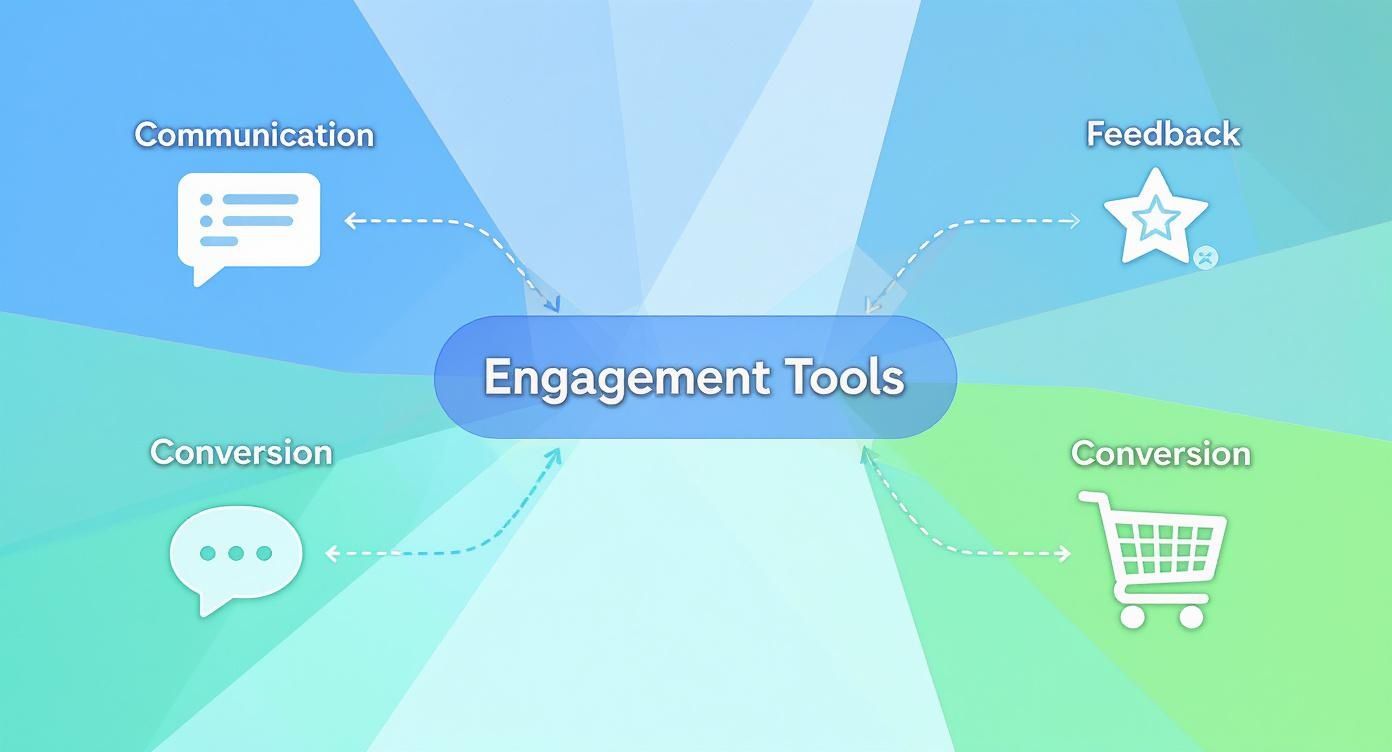
As you can see, tools for communication, feedback, and conversion all play a part in making your online presence more effective and profitable. Each one tackles a different stage of the customer journey, giving you a well-rounded strategy for keeping people engaged.
Reduce Bounce Rates and Increase Session Time
One of the first things you'll see is a drop in your bounce rate. When someone lands on your page and is immediately met with something interactive—like a quick poll or a helpful chatbot—they have a reason to stay. That one small interaction can turn a passive browser into an active participant, naturally increasing the average time they spend on your site.
Instead of a visitor landing, getting confused, and leaving, an engagement tool acts as a friendly guide. It offers a helping hand, keeping them on your site long enough to discover the value you offer.
This extra time spent on your pages sends a strong signal to search engines that your content is valuable, which can give your SEO a nice little bump, too.
Boost Conversion Rates and Drive Revenue
At the end of the day, you want to turn visitors into customers, and this is where website engagement tools really deliver. They create perfectly timed opportunities to nudge people toward making a purchase. An exit-intent pop-up offering a last-minute discount can save a sale, while a live chat agent can clear up a final product question that's holding someone back.
The results can be staggering. Take the SaaS company ArchiveSocial, for instance. They used a conversion optimization tool to tweak the placement of their calls-to-action. That simple adjustment led to an incredible 101.68% increase in clicks on their homepage forms. It’s a perfect example of how a small change can produce massive returns. You can discover more insights about their successful strategy.
Build Stronger Customer Relationships
Beyond the numbers, these tools are essential for building lasting loyalty. When you actively ask for feedback or provide instant help, you're sending a clear message: you care about your customers and their experience. This shifts the dynamic from a one-off transaction to a genuine, ongoing relationship.
- Gather Invaluable Feedback: Use surveys to find out what people love and where you can improve. This lets you make decisions based on what your customers actually want.
- Foster Brand Loyalty: Every positive interaction builds trust. A customer who gets great support through live chat is much more likely to come back and tell their friends about you.
How to Choose the Right Engagement Tools
With what feels like a million different website engagement tools out there, picking one can be a real headache. But here’s the secret: you’re not looking for the single "best" tool. You’re looking for the right tool for your specific challenge.
Think of it like this: a doctor doesn't just hand out prescriptions randomly. They first figure out what's wrong. You need to do the same for your website.
So, start with one simple question: What’s the biggest engagement problem I’m facing right now? Is it people ditching their shopping carts? Are you getting zero customer feedback? Or maybe your blog posts aren't bringing in any new leads? Once you nail down the main issue, your search for a solution becomes much clearer.
Align Tools with Your Business Goals
Your business goals should be your North Star here. A tool that works wonders for an e-commerce shop might be completely useless for a software company. Figure out your main objective first, and then look for a tool designed to get you there.
Let's break it down with a few common scenarios:
-
Goal: Generate More Leads. Your go-to tools will be pop-ups asking for an email, fun quizzes that need an email to reveal the results, or chatbots that can chat with visitors and see if they're a good fit.
-
Goal: Improve Customer Support. Live chat and AI chatbots are your best friends here. They give people instant answers and take a huge load off your support team.
-
Goal: Reduce Cart Abandonment. You'll want to look at exit-intent pop-ups. These pop up with a last-minute discount right when someone is about to leave your site, often saving the sale.
-
Goal: Gather User Feedback. This is where on-page surveys, quick polls, and feedback widgets shine. They are built to do one thing well: collect insights directly from your users.
Choosing a tool without a clear goal is like buying a hammer when you don't know what you need to build. You might have a great tool, but it won’t help you get the job done.
Evaluate Budget and Technical Requirements
Okay, so you’ve got a goal. Now it’s time for a reality check on cost and complexity. Many tools offer different pricing levels, often including a free plan with basic features. These are perfect for dipping your toes in the water.
Don't go all-in on an expensive plan until you've seen that the tool actually works for you. Just as important, be honest about your team's technical comfort level. A lot of modern tools are super easy to use, but some need a bit more technical know-how to set up or connect with your other systems. Pick something your team can actually use without needing a developer on speed dial.
At the end of the day, the best website engagement tools are the ones that fix your biggest problems, fit your budget, and don't require a computer science degree to operate. When you figure out your needs first, you can invest in a solution that delivers real results.
Once you have a tool up and running, the next step is knowing if it's actually working. For more on that, check out our guide on how to measure customer engagement to track your success.
Real-World Examples of Effective Website Engagement
It’s one thing to talk about website engagement tools in theory, but seeing them in action is where it all clicks. Let's look at how real companies are using these tools to solve everyday problems and get some impressive results. Think of these as quick case studies—practical blueprints you can borrow from.
By digging into the "why" behind each strategy, you'll start to see how a specific tool can help you hit your own goals, whether you’re trying to stop losing sales, find better leads, or just build a real connection with your audience.
E-commerce Tackles Cart Abandonment
For any online store, the abandoned cart is the stuff of nightmares. A customer finds what they want, fills their cart, heads to checkout... and then they're gone. An online fashion retailer was struggling with this exact issue, watching nearly 70% of carts get left behind. They had to find a way to win back that revenue without being annoying.
- The Problem: Way too many shoppers were abandoning their carts at checkout.
- The Tool: An exit-intent pop-up.
- The Strategy: Just as a user’s mouse moved to leave the page, a pop-up appeared offering a 15% discount code and free shipping if they completed their purchase right then and there.
- The Result: This simple move helped them recover 18% of abandoned carts, giving their monthly revenue a serious lift. It was a perfectly timed nudge that turned a lost sale into a win.
This tactic works so well because it directly tackles the two main reasons people bail: unexpected shipping costs and second thoughts about the price. It's a relevant offer that shows up at the exact moment of hesitation.
SaaS Boosts Qualified Leads with Live Chat
A B2B software company was getting good traffic to its key pages, but not enough people were taking the next step to request a demo. They could tell visitors were interested, but something was holding them back. They realized they needed to be there to answer critical questions right in that moment of decision.
"Proactive engagement at the right moment can be the difference between a curious visitor and a high-quality lead. By offering help before they have to ask, you remove friction and build immediate trust."
To close that gap, they set up a proactive live chat system.
- The Problem: Low conversion rates on their demo request page.
- The Tool: Proactive Live Chat.
- The Strategy: If someone spent more than 30 seconds on the pricing or demo page, a chat window would automatically pop up. A real person would ask something helpful, like, "Have any questions about how we compare to other solutions?"
- The Result: This targeted approach boosted their qualified demo sign-ups by a whopping 34%. Being available at that crucial point helped them clarify their value and guide prospects right into the sales pipeline.
A Blog Crowdsources Content with Surveys
A popular cooking blog wanted to keep its content fresh and exciting for its readers. Instead of just guessing what to post next, they decided to go straight to the source and ask their audience. The trick was finding a way to do it without disrupting the user experience.
- The Problem: Running out of fresh content ideas that they knew their audience would love.
- The Tool: Embedded on-page surveys.
- The Strategy: At the end of their most popular recipe posts, they added a simple one-question survey: "What type of recipe should we create next?" It had a few multiple-choice options and a fill-in-the-blank for other ideas.
- The Result: They got thousands of responses, which gave them a clear content plan for the next three months. Even better, engagement on the new, reader-requested posts was 50% higher than their old average. They weren't just creating content; they were co-creating it with their community.
Got Questions About Website Engagement Tools?
Jumping into website engagement tools always stirs up a few questions. That's a good thing. It means you're thinking strategically about how new tech will actually work on your site. Let's tackle some of the most common ones so you can move forward with confidence.
Getting these details sorted out upfront is the difference between just adding widgets and building a real plan to connect with your audience.
Can I Use Multiple Website Engagement Tools at Once?
Not only can you, but you probably should. Think of these tools like a well-oiled pit crew—each member has a specific job, and they work together to get the car back on the track. A smart strategy uses a few different tools that complement each other.
For example, you might have a live chat widget sitting in the corner for anyone needing instant help, a subtle pop-up offering a discount to capture an email address, and a quick survey on the checkout page to get feedback.
The trick is to make it a coordinated effort, not a chaotic mess. You don't want three different things popping up and screaming for attention the second someone lands on your page. Map out the customer’s journey and place each tool where it makes the most sense.
The goal is a coordinated effort, not a chaotic one. A strategic mix of tools ensures you're engaging visitors at every stage of their journey, from their first click to their final purchase.
When your tools don't step on each other's toes, you create a smooth, genuinely helpful experience for your visitors.
How Do I Know if My Engagement Tools Are Actually Working?
This is the big one, right? Success isn't a single number; it's tied directly to the job you hired each tool to do. Before you even launch a tool, you need to decide what a "win" looks like for it.
Here’s how that might break down in the real world:
- For a lead capture pop-up: The main number to watch is its conversion rate. Out of every 100 people who see it, how many actually sign up? That's your bottom line.
- For a live chat system: Keep an eye on customer satisfaction scores (are people happy with the help they get?) and average response times (are you leaving them hanging?).
- For a feedback survey: The completion rate tells you a lot. If people are starting it but not finishing, you know you need to make some tweaks.
Beyond these specific metrics, you should also watch your site's overall health in your main analytics platform. After adding a new tool, are people sticking around longer? Is your bounce rate going down? Are more people buying? These are the ultimate signs that your engagement strategy is paying off.
Are Website Engagement Tools Expensive?
The cost is all over the map, which is great because it means there’s something for every budget. You don’t have to break the bank to get started.
Many companies offer "freemium" plans with all the basic features you need to get your feet wet. This is the perfect way to try a tool out without any financial risk.
Once you’re ready to level up, paid plans can range from about $10 a month for a simple tool to hundreds or even thousands for sophisticated, enterprise-level platforms. Those bigger packages usually come with advanced AI, powerful integrations, and super-detailed analytics. The key is to figure out your budget and your absolute must-have features first, then shop around for the best fit.
Will These Tools Slow Down My Website?
That's a very real and important concern. A slow site is a visitor’s worst enemy and can tank your search rankings. The good news is that most modern, well-built website engagement tools are designed with speed in mind.
They’re typically built using something called asynchronous loading. In simple terms, this means the tool’s code loads separately from the rest of your website content. Your page won't be held hostage waiting for a chat widget to appear. Before you commit to any tool, it’s always smart to check out recent reviews and see if anyone mentions performance issues.
Ready to transform your website from a static page into an interactive hub? With Yoonoo, you can launch a smart AI chatbot in just five minutes—no coding needed. Start having better conversations with your customers today and see what a difference it makes. Build your free chatbot now.