Real-Time Agent Assistance Explained

Think of real-time agent assistance as a smart co-pilot for your customer service team. It’s a technology that uses AI to listen in on live customer conversations—whether on the phone or via chat—and instantly feeds agents the exact information they need. No more putting customers on hold to track down an answer.
This tech gives your agents the tools to deliver faster, more accurate, and far more confident support right in the moment.
Your Agent's New Smart Co-Pilot

Picture a brand-new support agent on a tough call. Instead of panicking and fumbling through a clunky knowledge base, they have an expert whispering the perfect solution in their ear, right when they need it most. That’s what real-time agent assistance feels like in practice. It's not about replacing your people; it's about amplifying their skills with intelligent, on-the-fly support.
While an agent is talking with a customer, the AI system works quietly in the background. It listens to the conversation, figures out what the customer is asking for, and pushes the most critical information directly to the agent's screen.
How It Lifts Your Team Up
This kind of instant support completely changes the game for agents by taking the guesswork and friction out of their day. They no longer have to juggle a dozen open tabs or desperately search for product specs while a customer's patience wears thin. The system just delivers what’s needed, when it's needed.
Here’s a quick look at what a real-time agent assistance platform can do:
- Surface Knowledge: It automatically finds and displays the right help articles, FAQs, and product guides based on what the customer is talking about.
- Guide Processes: It provides simple, step-by-step instructions for complicated tasks, like how to process a tricky return or troubleshoot a technical glitch.
- Ensure Compliance: It can prompt agents with mandatory scripts or regulatory disclosures, which is crucial in industries like finance and healthcare.
By putting the right information at their fingertips, these platforms solve one of the biggest headaches for agents: information overload. When they aren't bogged down searching for answers, they have more mental energy to focus on what really matters—connecting with the customer and solving their problem.
Ultimately, real-time assistance creates a much more consistent, high-quality customer experience across the board. It helps every single agent—from the rookie to the seasoned pro—perform like your absolute best expert. The result? Faster resolutions, happier customers, and a support team that truly shines.
How the Technology Actually Works
Real-time agent assistance can feel like a bit of magic, but it's really just a smart combination of three core technologies working together. The best way to think about it is as a system with "ears," a "brain," and a "memory," all designed to act as an intelligent co-pilot for your agents. It cuts through the chaos of hunting for information so your team can focus on what they do best: helping customers.
From the moment a conversation begins, the system is on the job. It actively listens in, analyzing the back-and-forth to turn spoken words and typed messages into data it can act on in a split second.
The Power of Listening with NLP
The "ears" of the system are all thanks to Natural Language Processing (NLP). This is what lets the AI understand what people are actually saying, not just the keywords they use. It figures out the customer's real intent, pinpoints the problem they're having, and can even pick up on their emotional state, like frustration or confusion.
For instance, NLP can tell the difference between a customer saying, "My bill is wrong," and "I don't understand my bill." Those two statements need very different answers. NLP ensures the system guides the agent down the right path for each one, making the whole interaction far more accurate and helpful.
The Brain That Learns with Machine Learning
Next up is the "brain," which is powered by Machine Learning (ML). This part takes all the information gathered by the NLP and learns from every single interaction. This isn't a static, set-it-and-forget-it tool; it gets smarter over time.
With every call or chat, the ML models get better at predicting what a customer needs and suggesting the best possible response. This constant learning loop means the advice your agents receive gets sharper, faster, and more relevant every single day, which directly improves their performance.
The market is definitely taking notice of this power. The global market for this technology is projected to jump from $4.4 billion in 2024 to an incredible $124.6 billion by 2034. That kind of growth shows just how essential these tools are becoming for any business that wants to deliver top-tier customer service. You can explore more data on this expanding market to see the full picture.
The Memory and Nerves That Connect Everything
Finally, you have the "memory" and central nervous system. This is where the platform integrates seamlessly with the tools you already use, like your Customer Relationship Management (CRM) software and internal knowledge base. This connection is what makes the assistance truly personal and aware of the customer's context.
By plugging into your CRM, the AI instantly has access to the customer's entire history—their past purchases, previous support tickets, and any other notes. This allows it to offer guidance that’s perfectly suited to that specific customer's journey.
This visual shows the direct impact these integrated technologies can have on the metrics that matter most to support teams.
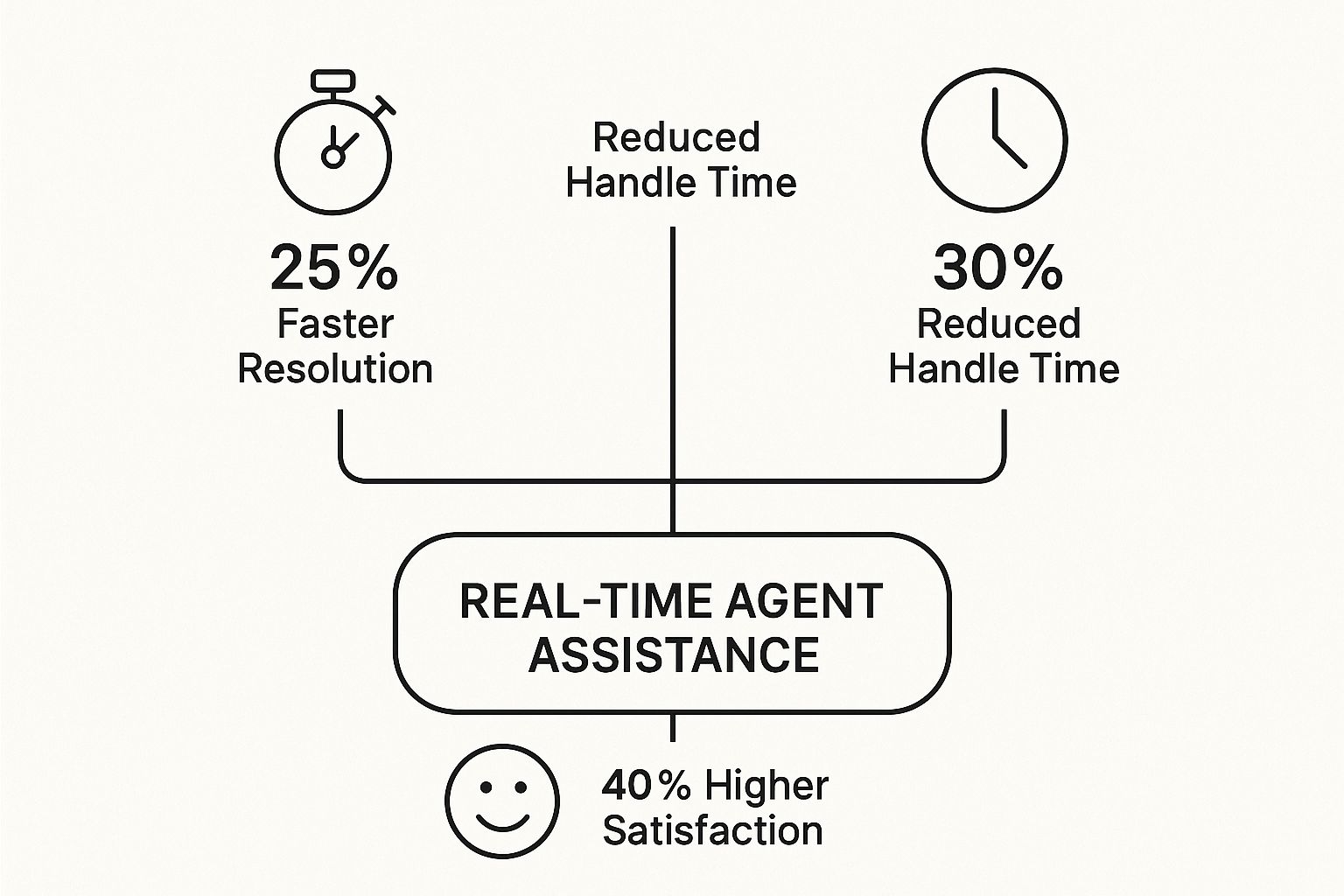
As you can see, the numbers don't lie. The technology is clearly linked to faster resolutions and happier customers, proving how these components come together to deliver real business results.
The Benefits for Your Agents and Customers

When you introduce real-time agent assistance, something powerful happens. It creates a positive ripple effect that touches everyone, improving daily life for your support team and elevating the service your customers receive. This isn't just about tweaking a few metrics; it’s a fundamental shift that creates a true win-win.
Think about it from your agent's perspective. The biggest, most immediate change is the massive reduction in mental gymnastics. No more frantically toggling between screens, digging through dense knowledge bases, or putting a customer on hold to find an answer.
Instead, the right information just appears when they need it. This on-demand support turns high-stress moments into confident, controlled conversations and helps build an incredible amount of confidence, whether it's a new hire on their first call or a seasoned pro tackling a curveball question.
Empowering Your Support Agents
When agents feel supported and have the right tools, their job satisfaction soars. This directly translates to less stress, lower burnout, and reduced turnover—a huge win for any contact center's bottom line.
- Faster Onboarding: New hires get up to speed in a fraction of the usual time. The system guides them through processes that once took weeks to master, with some companies reporting a drop in ramp-up time by up to 50%.
- Reduced Stress: By letting the tech handle the information retrieval, agents can dedicate their full attention to what humans do best: listening, empathizing, and building real connections with customers.
- Increased Confidence: Having a smart assistant is like having a safety net. It ensures agents provide accurate and compliant answers every single time, which does wonders for their performance and morale.
This shift transforms the agent's role from a frantic information hunter to a skilled problem solver. When the system handles the "what," agents can focus on the "how"—delivering empathetic and effective service.
Creating Happier, More Loyal Customers
All that newfound agent efficiency and confidence directly spills over into the customer experience. When agents feel empowered, customers feel it, too. They get their problems solved faster, more accurately, and with less effort, which is really the gold standard of great service.
Customers value speed and consistency above almost everything else. In fact, studies show that 73% of consumers say that valuing their time is the most important thing a company can do to provide good service. Real-time agent assistance hits this nail right on the head.
This technology also pairs beautifully with other tools. For instance, while a chatbot might handle the initial contact, real-time assistance ensures a seamless handoff to a human agent who is already armed with all the right information. You can explore more on how to set up an effective AI customer support chatbot in our related guide.
The proof is in the numbers. Let’s look at how performance metrics typically change when real-time assistance is added to the mix.
Impact of Real-Time Agent Assistance on Key Metrics
| Metric | Without Real-Time Assistance | With Real-Time Assistance |
|---|---|---|
| Average Handle Time (AHT) | Agents manually search for information, leading to longer calls and wait times. | Instant access to knowledge reduces AHT by 15-30% on average. |
| First-Contact Resolution (FCR) | Lack of immediate information can lead to escalations or callbacks. | FCR rates can jump by 20-40% as agents have the right answers on the first try. |
| New Agent Onboarding | Weeks or months of training are needed to reach full proficiency. | Ramp-up time can be cut by as much as 50%, getting agents productive faster. |
| Customer Satisfaction (CSAT) | Inconsistent answers and long waits lead to frustration and lower scores. | Faster, more accurate resolutions consistently lead to higher CSAT scores. |
| Agent Turnover | High stress and cognitive load contribute to burnout and high turnover. | Reduced stress and increased confidence improve job satisfaction and retention. |
As the table shows, the improvements are clear and measurable across the board. The impact on key customer-facing metrics is undeniable:
- Faster Resolutions: Average Handle Time (AHT) can decrease by 15-30% as agents find answers instantly.
- Improved First-Contact Resolution (FCR): With access to the right information on the first try, FCR rates often increase by 20-40%.
- Consistent Service: Customers receive the same high-quality, accurate information regardless of which agent they speak to, building trust in your brand.
Ultimately, by supporting your agents, you are directly investing in your customer relationships. Happier, more effective agents deliver the kind of effortless and satisfying support that turns one-time customers into lifelong advocates for your business.
Seeing Agent Assistance in Action
Theory is one thing, but seeing how this technology works in the wild is where it really clicks. Real-time agent assistance isn't some generic, one-size-fits-all tool. Think of it more like a specialized co-pilot, uniquely equipped for the challenges of a specific industry. Its real magic is in serving up the exact right piece of information, right when your agent needs it most.
Let's dive into a few different business worlds to see what this looks like day-to-day. Each example shows how the right assistance can solve tough problems, smooth out clunky processes, and give agents the confidence to shine.
Financial Services: Nailing Compliance and Accuracy
In the world of finance, everything is regulated. One wrong word or missed disclosure can lead to huge problems. It’s not just about being helpful; it’s about staying on the right side of the law.
Imagine a mortgage advisor on a call. The client starts asking tricky questions about their loan terms. As the conversation happens, the assistance tool picks up on keywords related to regulations, like the Truth in Lending Act. Instantly, a checklist pops up on the advisor's screen, making sure they cover every mandatory disclosure. When the client asks about interest rates, the system pulls up the latest figures and pre-approved talking points. No guesswork needed.
- Actionable Guidance: The system feeds the agent the exact scripts they need for compliance statements.
- Data Accuracy: It pulls live interest rates and product information, cutting out the risk of human error.
- Risk Reduction: It sends an alert if a required step is missed before the call ends.
This kind of real-time backup makes sure every conversation is not just productive, but fully compliant. It’s a safety net for both the customer and the business.
Retail: Turning Problems into Sales
Okay, now let's switch gears to retail. A customer calls an online clothing store, frustrated because the jacket they want is sold out in their size. Normally, this is a dead end. The agent apologizes, the customer is disappointed, and a sale is lost.
With real-time assistance, that same conversation can go a completely different way. The moment the agent confirms the jacket is out of stock, the AI is already suggesting other options. It might pull up a similar style from a new collection or even check the inventory of a physical store nearby.
The system turns a potential dead end into a valuable sales opportunity. Instead of just solving a problem, the agent actively guides the customer toward a satisfying purchase.
Better yet, it can show the agent the live stock levels for every recommendation, so they don’t accidentally promise something that isn’t actually there. It's a simple, proactive way to improve the customer’s experience and drive more revenue.
Tech Support: Solving Tough Problems Faster
Finally, picture a tech support agent trying to help someone with a really obscure software bug. Without help, this usually means putting the customer on a long hold while the agent frantically digs through a massive knowledge base, hoping to find the right article. It’s slow and frustrating for everyone.
With an AI co-pilot, the whole experience changes. The system listens as the customer describes the issue, recognizes specific error codes or symptoms, and immediately surfaces the right troubleshooting guide on the agent's screen. It lays out the entire process step-by-step, complete with screenshots and commands to copy.
This guided workflow keeps the agent on the right track, which can slash call times and boost first-contact resolution by as much as 40%. The customer gets a fast, accurate fix, and the agent feels like a hero, ready to tackle even the gnarliest technical issues.
How to Implement Your First Agent Assist Platform

Bringing a new tool into your team’s daily routine can feel like a massive undertaking, but a smart, structured approach changes everything. Implementing real-time agent assistance isn't about just flipping a switch; it's about carefully building a foundation for your team to succeed. The most important work actually starts long before you install any software.
The very first, most critical step? Figure out exactly what you want to achieve. Are you trying to slash average handle times? Or is boosting your first-call resolution (FCR) rate the main prize? Setting clear, measurable goals from day one will steer every other decision you make down the line.
Laying the Groundwork for Success
With your goals locked in, it’s time to look at both the tech and the people. A smooth rollout needs both sides of the coin—the technical and the human—to work together. The software is only half the battle; getting your team excited and on board is just as crucial.
-
Define Success Metrics: Begin with the end in mind. Pinpoint the specific key performance indicators (KPIs) you want to move, whether that's cutting down agent training time or seeing a jump in customer satisfaction (CSAT) scores.
-
Ensure Technical Integration: Your new platform has to play nice with your current systems. You’ll need to confirm it can easily connect to your CRM and knowledge base to automatically pull up customer history and relevant support articles.
-
Secure Agent Buy-In: This one is huge. Position the tool as a helpful sidekick, not a robotic boss looking over their shoulder. Show your agents how it will genuinely reduce their stress and help them win, turning them from frantic information hunters into confident problem-solvers.
A common mistake is getting lost in the technology and forgetting about the people who will use it all day, every day. Your agents are the real key to a successful implementation, and their buy-in isn't just nice to have—it's essential.
The move toward agentic AI is happening fast. By the end of 2025, it's expected that nearly 80% of organizations will be using AI agents in some form. This isn't just a trend; it's driven by real results. A whopping 62% of enterprises have reported a return on their investment of over 100%, which shows just how much of an impact it can have on operations.
Launching with a Pilot Program
Instead of a "big bang" launch across the entire company, start small with a pilot program. Pick a handful of agents to test-drive the platform in a controlled setting. This approach lets you iron out any wrinkles and collect honest, valuable feedback before going all-in.
Use this pilot to prove the concept and show the platform's value with hard data. Once you have clear results demonstrating improvements in your target KPIs, you’ll have a compelling story to share with the rest of the company. Even for smaller teams, this principle holds true; our guide on choosing a chatbot for small business shows how to apply this thinking. Just remember that great training during this phase is key—focus on practical, hands-on sessions that show agents exactly how the tool makes their jobs easier.
Picking the right real-time agent assistance platform isn't just another software purchase. It's a serious investment in your team's performance and, ultimately, your customers' happiness. The market is flooded with options, and it's easy to get bogged down by flashy feature lists. The key is to cut through that noise and find a tool that genuinely helps your agents, rather than making their jobs more complicated.
The platform you choose should feel like a natural part of your team's workflow. Think of it less like a tool and more like a trusted partner for every agent—one that’s intuitive, powerful, and built to solve the real challenges they face every day.
Core Features You Cannot Ignore
When you start comparing platforms, there are a few capabilities that are absolutely non-negotiable. These are the make-or-break elements that determine whether a tool is genuinely helpful or just another frustrating login.
- Highly Accurate AI Models: The AI has to get it right. If it constantly misinterprets what a customer is saying or offers up irrelevant advice, it just creates more work for your agents. That completely defeats the purpose.
- An Intuitive Agent Interface: The dashboard your agents see must be clean, simple, and easy to understand at a glance. The goal is to reduce their mental workload, not add to it with a cluttered, confusing screen.
- Powerful Analytics and Reporting: A great platform does more than just help in the moment. It should also give you clear, actionable insights into team performance, highlighting trends and showing you exactly where coaching is needed most.
The right platform works quietly in the background, making your agents look like superstars. It should feel less like a tool they have to use and more like a trusted co-pilot that helps them navigate every conversation with confidence.
Integration and Support are Crucial
Beyond the core features, two other things are absolutely critical for success: how well the platform integrates with your existing systems and the quality of support you get from the vendor. A tool that can’t plug into your CRM or knowledge base will always be working in a silo, which severely limits its value.
And let's be honest, a vendor that disappears the moment you sign the contract is a nightmare. You're looking for a partner, not just a product. Platforms like Yoonoo, for instance, are designed for easy integration, ensuring the technology aligns with your business goals from day one.
There's a reason the market for these tools is exploding. AI agents are on track to become mainstream in 2025, with the market expected to grow from $5.43 billion in 2024 to a whopping $7.92 billion in 2025. You can discover more insights about AI agent statistics to see just how fast this is moving. Making a smart choice now is about setting your team up for success in a world that's changing fast.
Got Questions About Real-Time Agent Assistance?
When you’re looking at bringing in new tech, a few key questions always come up. It's only natural. Leaders want to know how it will actually affect their team, what it takes to get it running, and what kind of results they can expect.
Let's get the big one out of the way first: Will this AI replace my agents?
The short answer is no. This isn't about replacing people. Think of it more like giving every agent a brilliant co-pilot. The AI handles the grunt work—digging up information, finding the right procedure—so your agents can focus on what they do best: connecting with customers and solving complex problems.
How Long Does It Take to Get Rolling?
"Okay," you might be thinking, "but how long will this take to implement?" It's a fair question, and the answer is probably faster than you think.
Getting a platform like Yoonoo up and running is often a matter of weeks, not months. The initial setup and integration are designed to be straightforward, so you can launch a pilot program quickly and start seeing an impact right away.
The real goal here isn't just to install a piece of software. It’s to give your agents a tool that makes them better at their jobs—more confident, more efficient, and more successful in every single conversation.
How Do I Know It's Actually Working?
This is where the rubber meets the road. How do you measure the return on your investment (ROI)? The good news is you can track its success using the metrics you’re already familiar with.
To see the value it’s bringing, keep a close eye on these three KPIs:
- Average Handle Time (AHT): This should drop noticeably. When agents can find answers instantly instead of putting customers on hold to search, calls get shorter.
- First Contact Resolution (FCR): Expect this number to climb. With the right information at their fingertips, agents can solve more problems on the very first try.
- Customer Satisfaction (CSAT): Happier agents and faster, more effective service almost always lead to happier customers and higher satisfaction scores.
Ready to give your team the support they need to truly shine? With Yoonoo, you can give every agent a smart assistant that provides instant, real-time guidance. Get started with Yoonoo today and see the difference for yourself.