Build Your No Code Chatbot Platform Today

So, what exactly is a no-code chatbot platform?
At its core, it's a tool that lets you build and launch automated conversational bots without having to write a single line of code. Think of it as a visual workshop for creating digital assistants. You get to use drag-and-drop interfaces and ready-made templates instead of getting bogged down in complex programming languages. It's all about making powerful AI automation accessible to everyone, not just developers.
What Is a No Code Chatbot Platform Anyway
Imagine trying to build a sophisticated LEGO model, but instead of just getting a pile of raw plastic, you get a full kit. This kit has all the specialized bricks—the wheels, the windows, the unique connectors—and a clear, visual guide showing you exactly how to snap them together.
That's the perfect analogy for a no-code chatbot platform. It gives you all the pre-built conversational "bricks" you need, like conversation starters, user input forms, and calendar integrations. You just click them into place to build a conversation.
This approach tears down the traditional barriers to building technology. Suddenly, you don't need a team of expensive developers. Business owners, marketers, and customer support leads can step in and design the exact AI assistants they need. The whole point is to empower the people who actually understand the customer to build the conversation flows.
The Three Pillars of No Code Chatbots
When you boil it down, a no-code chatbot platform really stands on three simple but powerful ideas. These three elements are what make the whole process so fast, intuitive, and effective, especially for people who aren't coders.
This infographic breaks down those fundamental components perfectly.
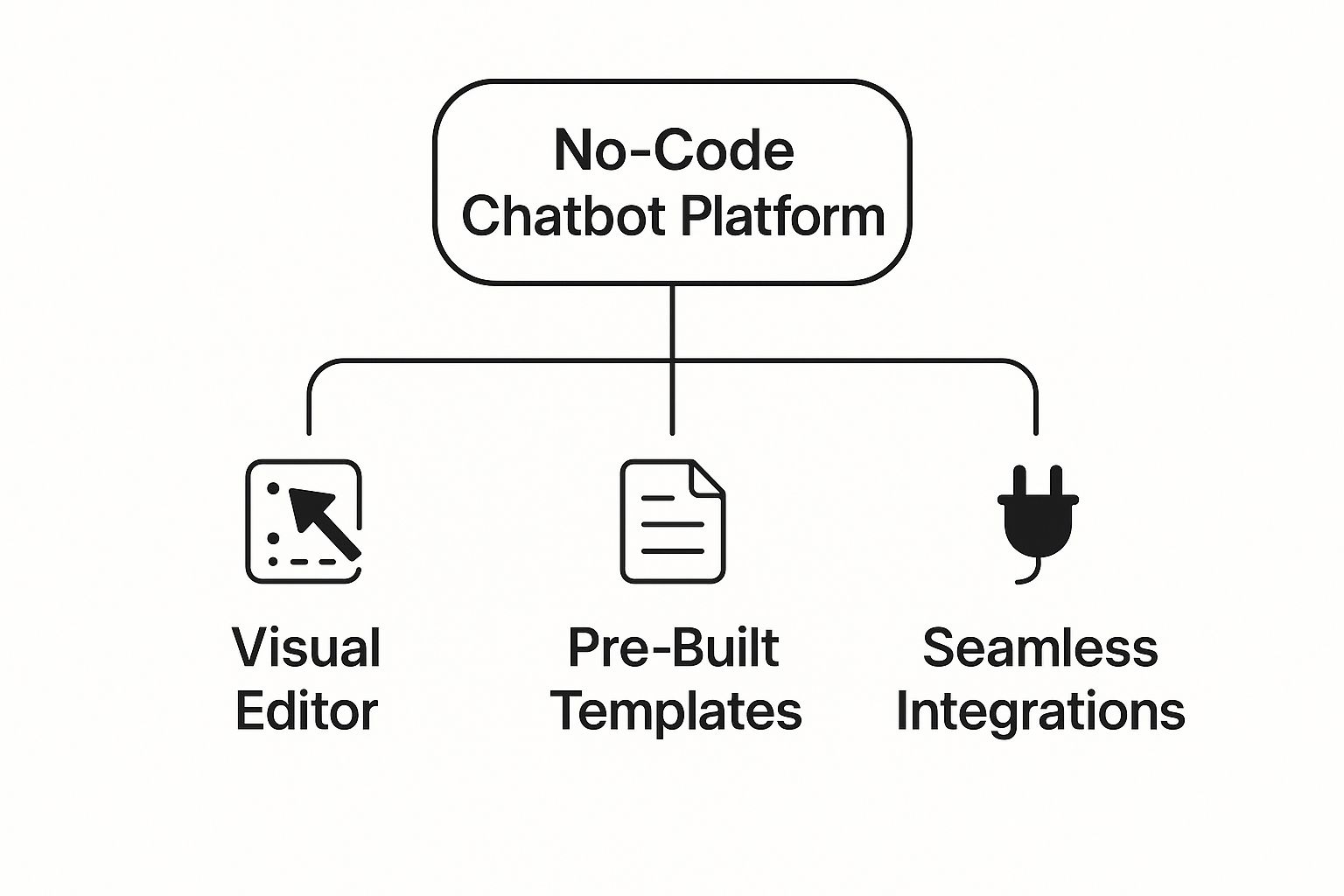
As you can see, the real magic happens when you combine a user-friendly editor with pre-built components and seamless integrations.
These platforms are quickly moving from "nice-to-have" novelties to essential business tools. The numbers don't lie: the market for no-code AI platforms was valued at USD 5.84 billion in 2024 and is expected to explode to USD 36.50 billion by 2032. This isn't just a trend; it's a massive shift toward making AI something any business can build and use. You can dive deeper into the no-code AI market growth data to see just how fast this space is moving.
A no-code chatbot platform isn't about making code simpler; it's about removing it entirely. It turns your business logic directly into a working, automated conversation, bringing ideas to life in an instant.
Ultimately, this technology is all about accessibility and speed. It lets you:
- Launch faster: Get a working chatbot live in a matter of hours or days, not weeks or months.
- Reduce costs: Sidestep the hefty expense of hiring a dedicated development team.
- Iterate quickly: Allow your marketing and support teams to tweak conversations on the fly based on real customer feedback.
This puts the power to automate and engage right where it belongs: in the hands of the people on the front lines of your business.
No Code vs Traditional Chatbot Development
To really get a feel for the difference, it helps to see a side-by-side comparison. Building a chatbot the old-fashioned way with code is a completely different world from using a modern no-code platform.
Here's a quick look at how the two approaches stack up.
| Aspect | No Code Chatbot Platform | Traditional Coding |
|---|---|---|
| Technical Skill | No coding required; visual drag-and-drop interface. | Requires proficiency in programming languages like Python or Java. |
| Speed to Market | Extremely fast. Can deploy a bot in hours or days. | Much slower. Development can take weeks or months. |
| Cost | Lower upfront cost, typically a subscription model. | High initial cost for hiring developers or an agency. |
| Flexibility | Great for most business needs, but limited by platform features. | Highly flexible and fully customizable for complex, unique tasks. |
| Maintenance | Handled by the platform provider. Simple to update and manage. | Requires ongoing developer support for updates, bug fixes, and changes. |
As the table shows, no-code is all about speed, simplicity, and empowering your existing team. While traditional coding offers limitless customization, it comes with a much higher price tag in both time and money.
Why a No-Code Approach Changes Everything

Using a no-code chatbot platform isn't just about making a technical task easier. It's a complete shift in who gets to build, innovate, and solve problems in your business. It means you stop relying solely on developers and start empowering the people who actually talk to your customers every day.
This whole approach tears down the old walls of time, cost, and complexity. Forget about development cycles that drag on for months. Now, your team can design, build, and launch a working chatbot in just a few days—sometimes even hours. The cost model flips, too, from expensive, one-off developer fees to simple, predictable subscriptions.
Putting the Power in the Right Hands
The biggest change, though, is cultural. When your marketing, sales, and support teams can build their own automated tools, good ideas start flowing much faster. After all, they’re the ones on the front lines, hearing what frustrates customers and knowing exactly what a helpful conversation sounds like.
A no-code platform gives them the power to act on those insights right away. Is a new question trending with customers? The support team can add a new answer to the bot in minutes. Does marketing want to try a new way to capture leads? They can build it themselves without getting stuck in a developer's to-do list.
By placing the power to build directly into the hands of domain experts, businesses can create more relevant, effective, and agile customer experiences. This closes the gap between customer insight and practical implementation.
This is a huge reason the global no-code chatbot market is exploding. The technology gives small and medium-sized businesses a fighting chance by letting them automate nearly 70% of customer support conversations without hiring expensive developers.
And this shift doesn't just feel good—it directly impacts your efficiency and your bottom line.
Real-World Business Benefits of Going No-Code
At its core, a no-code chatbot platform gives small businesses powerful marketing automation for small businesses, letting them connect with customers 24/7. The benefits are easy to see and measure:
- Massive Cost Savings: You no longer need to hire specialized coders, which dramatically cuts down on what you spend on development and upkeep.
- Launch at Lightning Speed: An idea for a new chat conversation can go from a sketch on a napkin to a live feature in a tiny fraction of the time it takes to custom-code it.
- Stay Quick on Your Feet: Your team can tweak chatbot conversations based on how they're performing in real time, constantly making things better without hitting technical walls.
- Smarter Use of Your Team: By letting bots handle the simple, repetitive questions, you free up your human agents to focus on the complex, high-value conversations that really need their expertise.
Ultimately, going no-code turns a chatbot from a complicated IT project into a flexible business tool that anyone on your team can use to boost growth and make customers happier.
Must-Have Features in Your Chatbot Platform
Let's be honest, not all no-code chatbot platforms are built the same. When you start looking around, it's easy to get bogged down by marketing hype. To make a smart choice, you need to look past the promises and focus on the core features that will actually help your business.
Think of it this way: picking the right platform is like choosing the right set of tools for a workshop. The right one makes building things a breeze, while the wrong one just leads to headaches and half-finished projects. Here’s a breakdown of the absolute non-negotiables.
The Core Building Blocks of a Great Platform
At the heart of any no-code chatbot platform is its conversation builder. This is where the magic happens, and where you’ll spend most of your time. So, it has to be good. A visual, drag-and-drop editor isn't just a nice-to-have; it's essential. It turns the complicated task of mapping out a conversation into something as simple as sketching a flowchart.
Beyond that, here are the other critical pieces you need:
-
Seamless Integrations: A chatbot that can’t talk to your other software is basically a glorified FAQ page. You need a platform that connects effortlessly with the tools you already rely on, like your CRM (HubSpot, Salesforce), helpdesk (Zendesk), and marketing software. This is what allows your bot to do the heavy lifting—pulling customer history, creating support tickets, or adding new leads to your pipeline automatically.
-
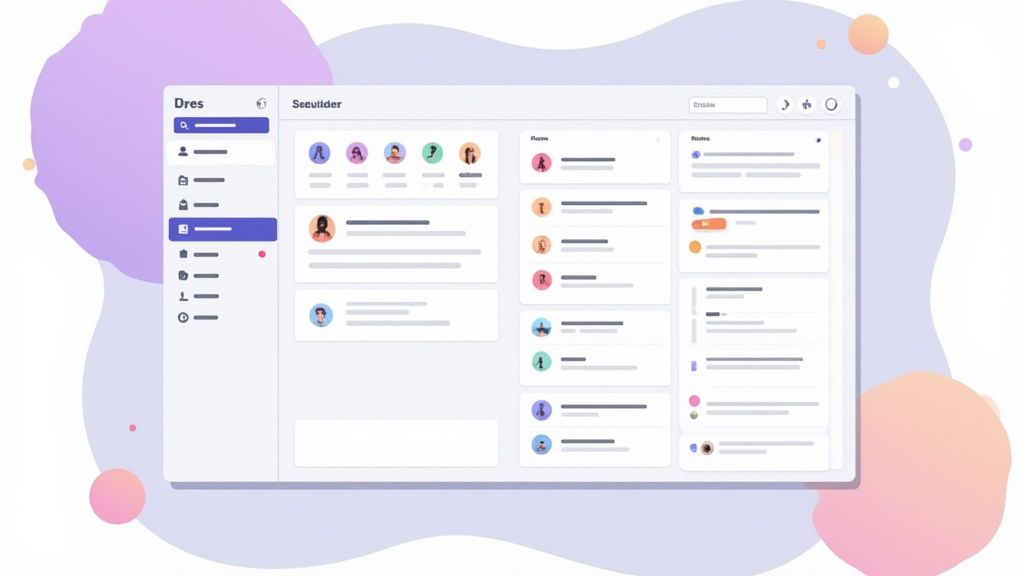
Robust Analytics and Reporting: How can you tell if your chatbot is actually working? You can't, not without data. A solid analytics dashboard is your eyes and ears, showing you exactly what’s going on. It should give you clear insights into user engagement, how many people complete a conversation, and what questions they ask most often. This information is pure gold for making your bot better over time.
A chatbot without analytics is like driving with your eyes closed. You need data to see what’s working, spot where people are getting stuck, and fine-tune the conversation for better results.
Features That Drive Engagement and Scalability
Once you've got the basics covered, you can look for the features that separate a pretty good platform from a truly great one. These are the tools that help you create better customer experiences and allow you to grow without hitting a wall.
First up is multi-channel support. Your customers are everywhere—your website, sure, but also on WhatsApp, Facebook Messenger, and Instagram. A flexible platform lets you design your bot once and then deploy it across all the channels your audience actually uses. This gives customers a consistent, helpful experience no matter where they find you.
Finally, don't underestimate the power of pre-built templates. A good library of templates for common jobs like lead generation, answering FAQs, or booking appointments can be a massive time-saver. Instead of starting from scratch, you get a proven foundation you can customize and launch in a fraction of the time.
See No Code Chatbots in Action
It’s one thing to talk about a no-code chatbot platform in theory, but seeing these tools in the real world is where it all clicks. So, let's move past the technical specs and look at how businesses are using no-code bots every single day to make a real difference.
These aren't just futuristic ideas; they're practical solutions that help companies work smarter and grow faster. The proof is in the numbers. The entire chatbot market is valued at a staggering USD 7.76 billion in 2024, and it's easy to see why. Reports show that chatbots save businesses up to USD 11 billion and nearly 2.5 billion work hours every single year just by handling simple conversations. You can dig into the global chatbot market growth on Grandview Research to see the full picture.
Streamlining Customer Support 24/7
Picture this: your support team is buried under a mountain of the same questions. "Where's my package?" "What's your return policy?" "How do I reset my password?" These are important questions, for sure, but they’re also a massive time-sink.
A no-code chatbot can step in and instantly handle over 75% of these common requests. It connects to your knowledge base or order system and gives customers the right answer, right away, no matter the time of day. This frees up your human agents to focus on the tricky problems that actually require a human touch. It’s a classic win-win, and you can learn more in our guide on how to build an AI customer support chatbot.
A no-code chatbot acts like a tireless first line of defense, filtering and solving common issues so your human experts can focus on the conversations that matter most. It’s not about replacing people; it’s about making them better at their jobs.
Driving Sales and Qualifying Leads
Now, think about having a sales assistant that never sleeps. A potential customer lands on your website at 2 AM. Your sales team is fast asleep, but the chatbot is wide awake and ready to help.
It can ask smart, simple questions to figure out what the visitor needs:
- "Are you looking for a solution for yourself or for a team?"
- "What's the biggest challenge you're hoping to solve?"
- "Want me to set up a quick demo so you can see how it works?"
Based on their answers, the bot can spot a hot lead and even book a meeting right on a salesperson's calendar. It works around the clock to make sure you never miss an opportunity, turning casual website visitors into genuine sales leads.
Boosting Marketing Engagement
Beyond support and sales, no-code chatbots are a marketer's best friend. Instead of a boring, static contact form, you could build an interactive product finder that helps customers discover exactly what they're looking for.
Or imagine a fun quiz that not only keeps visitors engaged but also gathers valuable contact info. These kinds of interactive experiences make your brand more memorable and fun to interact with, turning a simple visit into a real connection.
How to Choose the Right Platform for You
With so many options out there, picking the perfect no-code chatbot platform can feel a bit overwhelming. The secret is to start by asking one simple question: What's the main job I need this chatbot to do?
Your answer is your compass. Are you trying to capture more sales leads? Cut down on customer support tickets? Or maybe just keep visitors engaged on your website? Pinpointing this primary goal makes every other decision a whole lot easier.
For instance, if lead generation is your top priority, you'll want to look for platforms that play nicely with your CRM. On the other hand, if you’re focused on improving customer service, you’ll need a bot that can tap into your knowledge base and seamlessly hand off conversations to a human agent when needed.
Key Evaluation Criteria
Once you have your goal in mind, you can start sizing up the contenders. I always tell people to focus on four essential pillars. Think of these as the must-haves for making a smart choice that will pay off down the road.
- Ease of Use: How intuitive is the platform? A truly no-code tool should feel natural right from the get-go. Look for a visual, drag-and-drop builder that anyone on your team can pick up without a steep learning curve.
- Scalability: Can this platform keep up as your business grows? You need a solution that won't hold you back. Check if it can handle more conversations, let you build more bots, or expand to new channels as your needs change.
- Pricing Model: Is the cost structure straightforward and fair? Steer clear of platforms with confusing pricing or hidden fees. A transparent, usage-based model is often best because you only pay for what you actually use.
- Customer Support: What happens when you get stuck? Fast, helpful support is a lifesaver. You want to know that if something goes wrong, you can get a knowledgeable person to help you sort it out quickly.
It's also a good idea to see how these chatbots fit into the bigger picture. Many of the top marketing automation platforms have their own chat features, so understanding the landscape helps.
The best platform isn't the one with the most bells and whistles. It's the one that solves your specific problem in the simplest, most effective way.
Before you commit, it’s a great idea to make a checklist to keep your evaluation organized.
Platform Selection Checklist
Use this simple table to compare your top choices. It helps you stay focused on what truly matters for your business.
| Evaluation Criteria | Question to Ask | Your Notes |
|---|---|---|
| Main Goal Alignment | Does this platform directly help me achieve my primary objective? | |
| User Interface | Is the builder easy for non-technical users to understand and operate? | |
| Integration Power | Can it connect seamlessly with the other tools I already use (CRM, etc.)? | |
| Growth Potential | Will this tool support my business in one year? Three years? | |
| Pricing Transparency | Do I clearly understand what I'm paying for and when costs might increase? | |
| Support Quality | What are the support channels (email, chat, phone) and what are the response times? |
After you've done your homework, there's one last, crucial step.
Never, ever skip the free trial. Getting your hands dirty is the only way to get a real feel for a platform’s strengths and weaknesses. It's the ultimate test to see if a tool is a good fit for your team and your goals. To help with your research, you can also explore our detailed guide on the best AI customer service tools to see how different solutions stack up.
Meet Yoonoo: Your No-Code Chatbot, Made Simple
Theory is great, but putting it into practice is what really counts. That’s where Yoonoo comes in. It’s designed to take all the powerful ideas we've talked about and turn them into a real, working tool that helps you have smarter conversations with your customers, no coding required.
At the heart of Yoonoo is a visual builder that makes mapping out conversations feel more like drawing a flowchart than programming. This means your team can skip the technical headaches and focus entirely on what matters: creating helpful, engaging customer experiences.
Connect and Improve Without the Hassle
One of the standout features is its one-click integrations. Yoonoo easily connects with the business tools you already use every day, whether it's your CRM or your marketing platform. Your chatbot won't be a siloed piece of tech; it'll become a natural part of your existing workflow.
This is what you see when you log in—a clean, straightforward dashboard for keeping an eye on your chatbot’s performance.
The analytics dashboard gives you insights you can actually use. You can see exactly how people are interacting with your bot, spot what's working, and find clear opportunities to make it even better.
Yoonoo was built on a simple idea: powerful automation shouldn’t be complicated. It should be a tool that anyone can use to build better customer relationships, one conversation at a time.
When you choose Yoonoo, you’re not just getting software. You’re getting a practical way to solve modern business challenges. You can launch a sophisticated chatbot in no time, see the impact it’s having with real data, and keep making it smarter.
Yoonoo is built for businesses that need to move quickly and see real results. By getting rid of the technical hurdles and focusing on the features that actually make a difference, it becomes the clear choice for any company ready to embrace intelligent automation.
Answering Your Top Questions About No-Code Chatbots
Even with all the benefits laid out, it’s completely normal to have some questions before jumping into a no-code chatbot platform. This is a big change in how you can run your business, after all. So, let's tackle some of the most common things people ask to help clear things up.
Think of this as the practical, "how does this actually work for me?" part of the conversation. Getting these details right is what makes a tool a perfect fit for your team.
How Much Technical Skill Do I Really Need?
Honestly? None. If you can use everyday software like Google Docs or even just set up a social media profile, you're more than ready to build a really effective chatbot. The whole point of a no-code chatbot platform is its visual, drag-and-drop builder.
You won't be writing a single line of code. Instead, you'll be connecting visual blocks and typing out what you want the bot to say. The entire system is designed from the ground up to take coding out of the equation, putting the power to build and manage bots directly into your hands.
Can a No-Code Chatbot Handle Complex Conversations?
Yes, they absolutely can. These aren't the simple, rigid bots of the past. Today's no-code platforms are powered by sophisticated AI and Natural Language Processing (NLP), which helps them understand what your customers are actually asking for, not just the exact keywords they use.
While you won't be building a sci-fi super-intelligence, these platforms are more than capable of handling complex customer service inquiries, detailed lead qualification processes, and personalized marketing interactions that require multiple steps and context.
They can follow intricate conversation paths and adjust on the fly based on what a user says, making them surprisingly powerful for a wide range of business needs.
How Does a Chatbot Integrate with My CRM?
This is where things get really good, because the process is designed to be incredibly simple. The best platforms come with pre-built, one-click integrations for hundreds of tools you already use, like Salesforce, HubSpot, or Zendesk.
Setting it up is usually a guided process. You just log in to your chatbot dashboard, find your tool, and authorize the connection. Once they’re linked, your bot can start working for you automatically:
- Pull customer details from your CRM to make conversations personal.
- Create new leads in your system the moment they're captured.
- Update support tickets without anyone on your team lifting a finger.
Is It Secure for Handling Customer Data?
Security is non-negotiable, and any reputable no-code chatbot platform makes it a top priority. These providers rely on industry-standard security protocols, like strong data encryption for information both in transit and at rest, to keep everything protected.
They also stay on top of major data privacy regulations like GDPR. When you're looking at different options, always check out their security and privacy policies. A provider you can trust will be open and clear about how they protect your business and your customers' data.
Ready to see how simple and powerful a no-code chatbot can be? With Yoonoo, you can build an intelligent AI assistant in minutes, not months. Start your free trial and transform your customer communication today by visiting https://yoonoo.ai.