How to Reduce Customer Churn

When it comes to keeping customers, it all really boils down to three things: engaging with them before they have a problem, providing great support when they do, and making them feel like you actually know who they are. If you can nail these, you stop playing defense and start building retention right into your growth plan, turning customers on the fence into your biggest fans.
Why Churn Is More Than Just a Number
Before we get into the "how-to," let's be honest about what churn really costs you. It’s not just a lost account on a spreadsheet. It’s a quiet killer of revenue, morale, and your company's future. When a customer walks away, you're not just losing their monthly payment. You're losing all future upsells, the incredible power of their word-of-mouth recommendations, and the kind of feedback that helps you get better.
This constant drain puts you on a treadmill, forcing your team to work tirelessly just to replace who you've lost. It’s like trying to fill a leaky bucket—no matter how much water you pour in, you never seem to make progress. The financial hit isn’t a straight line, either. It snowballs, making steady growth feel almost impossible.
The Compounding Effect of Monthly Churn
A small monthly churn rate might not look so bad, but it can do massive damage over a year. That seemingly tiny 5% monthly churn doesn't add up to a 60% loss at the end of the year. Because of compounding, you're actually losing nearly half your customers. Suddenly, every new sale feels less like a win and more like a desperate patch on a leaking ship.
Some industries feel this more than others. The wholesale sector, for example, can see churn rates as high as 56% because it's so easy for customers to switch suppliers. Even in consumer goods, where churn can hit 40%, a lot of it comes down to changing consumer habits. You can explore more industry churn benchmarks on CustomerGauge.com to see where you stand.
To really see how this works, take a look at the table below. It shows how quickly a small monthly churn rate balloons into a major annual problem.
The Real Annual Impact of Monthly Churn
| Monthly Churn Rate | Equivalent Annual Customer Loss |
|---|---|
| 1% | 11.4% |
| 3% | 30.6% |
| 5% | 46.0% |
| 8% | 63.0% |
| 10% | 71.8% |
As you can see, even a rate that seems manageable month-to-month can lead to losing over half your customer base in a year.
The infographic below paints an even clearer picture of how quickly these small numbers escalate.
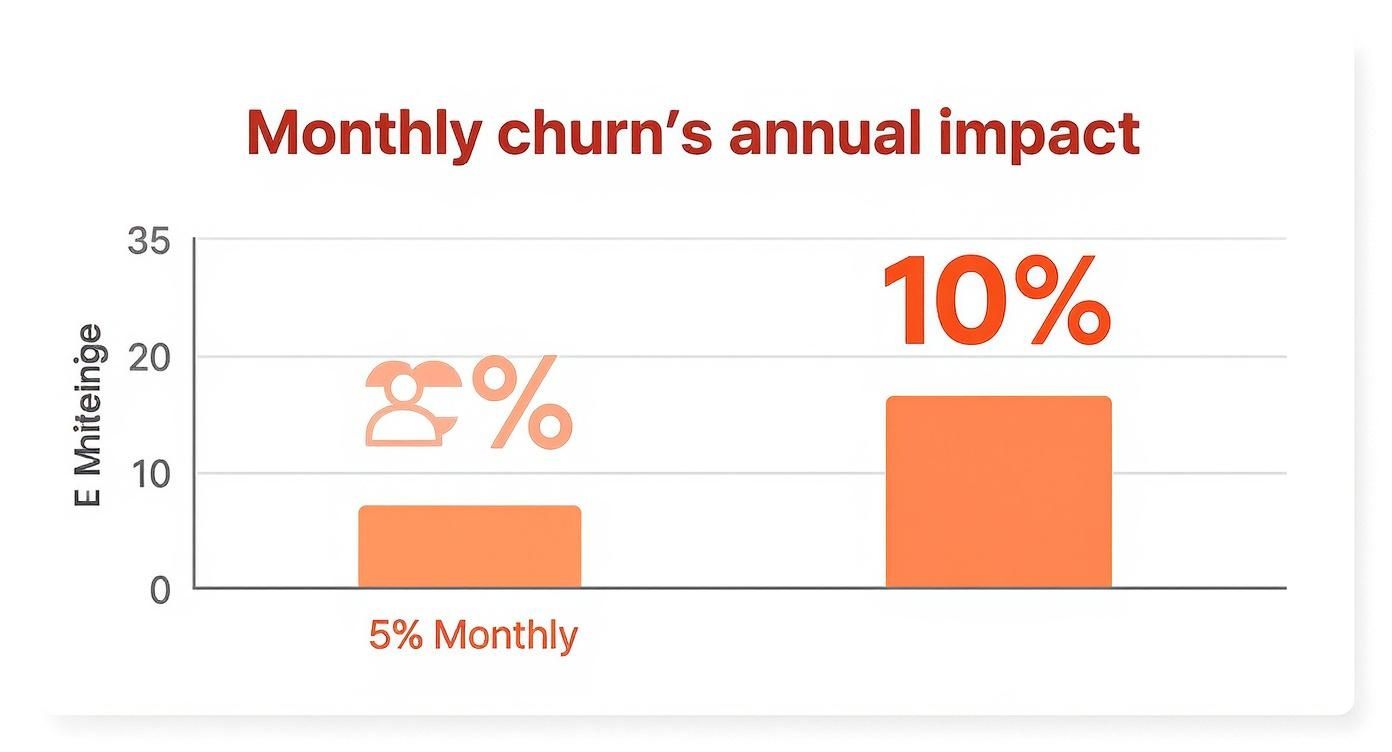
As the chart shows, a 5% monthly churn wipes out nearly half your customers every year. A 10% rate? For most businesses, that's simply not sustainable.
Moving Beyond the Obvious
The conversation has to go deeper than just "churn is bad." We all know that. The real work is in understanding why it's happening and how it affects every part of your business.
When you reframe churn not as a failure but as a source of feedback, every lost customer becomes a lesson. This shift in perspective is the first step toward building a business that is naturally resistant to attrition.
Once you truly grasp the financial and cultural costs, it’s much easier to invest in the right retention strategies. This guide is built around those three core ideas we started with:
- Proactive Engagement: Building relationships so strong that leaving doesn't even cross a customer's mind.
- Responsive Support: Turning frustrating moments into opportunities to prove you care and build loyalty.
- Personalized Experiences: Making every customer feel seen, heard, and valued.
These aren't just buzzwords; they're the pillars for building a business that doesn't just survive—it thrives. Let's get into the specifics.
Finding the Real Reasons Customers Leave
You can’t fix a problem you don’t understand. To really tackle churn, you have to become a bit of a detective and dig into why people are actually leaving. The generic "it was too expensive" option on an exit survey rarely tells the whole story. The real goal is to get past those surface-level answers and figure out what’s truly driving your customers away.
This means looking at both the hard numbers (quantitative data) and the human stories (qualitative data). When you bring these two together, that's where the magic happens. You start to see the complete picture of your customer experience, warts and all.
Uncover Patterns in Your Support Tickets
Think of your customer support queue as a goldmine. Seriously. These aren't just tickets to be closed out; they're a live feed of your customers' biggest frustrations and where your product is causing friction. By analyzing these trends, you can spot the recurring problems that are quietly pushing people to the door.
Start by tagging and categorizing your support tickets. Are you constantly seeing complaints about a certain feature? Is billing a common source of confusion? Maybe a recent update led to a flood of tickets about a buggy integration. This isn't just about putting out fires. It’s about spotting the systemic flaws causing widespread burnout. For example, if 20% of your support requests in a month are all about the same feature, that's a massive red flag you can't ignore.
Segment Your Churned Customers
Not all churn is created equal. Lumping all your lost customers into one big bucket is a surefire way to miss critical patterns. By segmenting your churned users based on shared traits, you can move from vague guesses to sharp, actionable insights.
Try grouping former customers by different criteria:
- Onboarding Cohort: Did users who joined in February churn way more than those from March? That could point to a broken onboarding flow or a bad bug you introduced that month.
- Feature Usage: Are the people leaving the ones who never adopted that one "sticky" feature? This is a huge clue that they never saw the core value of your product.
- Subscription Plan: Is your "Pro" plan bleeding customers while your "Basic" plan is stable? The perceived value might not line up with the higher price point.
- Customer Size: Are small businesses churning for different reasons than your enterprise clients?
This kind of analysis can be a game-changer. I once worked with a SaaS company that discovered users who failed to connect a specific third-party app in their first week had a 70% higher churn rate. That single insight led them to completely overhaul their setup guide. It just goes to show how critical a smooth start is, which is why we always stress the importance of customer onboarding best practices.
Conduct Meaningful Exit Interviews
Data tells you what is happening, but only people can tell you why. A good exit interview gives you unfiltered feedback that you’ll never get from a multiple-choice survey. The trick is to make it a genuine conversation, not an interrogation.
Forget the simple "Why did you leave?" question. Go deeper with open-ended prompts:
- "What was the main problem you were hoping our product would solve for you in the first place?"
- "Can you think of a specific moment when you realized our solution might not be the right fit?"
- "If you had a magic wand and could change one thing about our service, what would it be?"
The goal of an exit interview isn't to win back that one customer. It's to learn a lesson you can use to save the next hundred.
And remember, your main job here is to listen. The first reason a customer gives for leaving is often just the tip of the iceberg. By listening carefully and asking thoughtful follow-up questions, you can uncover the real issues. They might say they left over price, but as you talk, you find out the real problem was that a key feature was too confusing, so they couldn't justify the cost. Now that's something you can fix.
Tracking the Right Retention Metrics
If you want to get a real handle on customer churn, you have to stop guessing and start measuring. It's easy to get lost in a sea of data, but honestly, only a handful of key retention metrics truly tell the story of your customer relationships. Focusing on these core numbers is how you cut through the noise and get a clear, actionable picture of your business's health.
Think of these metrics as your business's vital signs. One number on its own might not seem alarming, but when you look at them together, you can spot problems long before they become emergencies. Let's break down the metrics I always keep on my dashboard.
Customer Churn Rate
This is the most obvious place to start. Your Customer Churn Rate is simply the percentage of customers who stopped doing business with you over a set period. It's your baseline for understanding how many people you're losing.
But—and this is a big but—relying on this metric alone is a huge mistake. It treats every single customer the same, whether they're a tiny account on a basic plan or a massive enterprise client. That's why you need to pair it with the next metric.
Revenue Churn
Revenue Churn is where the real story often lies. It tracks the percentage of monthly recurring revenue (MRR) you lose from existing customers. This metric gives you a much clearer financial picture because it highlights the value of the customers who are leaving.
Here’s a real-world example: let's say your customer churn is a seemingly healthy 2%. Sounds pretty good, right? But if your revenue churn is 15%, it means you're losing your most valuable, highest-paying customers. Even though the number of departures is small, the financial hit is massive. Revenue churn often reveals the painful truth.
A low customer churn rate can easily mask a high revenue churn rate, creating a false sense of security. You have to track both to see if you're losing your most valuable accounts.
Customer Lifetime Value
Next up is Customer Lifetime Value (CLV). This metric predicts the total revenue your business can expect from a single customer over the entire course of your relationship. A high CLV is a fantastic sign—it points to strong customer loyalty, product satisfaction, and a healthy business model.
When your CLV is on the rise, it means customers are sticking around longer and spending more. A declining CLV, however, is a major red flag. It’s a clear signal that customers are leaving sooner than they used to, which hits your long-term profitability hard.
Net Promoter Score
Finally, we have the Net Promoter Score (NPS). This one measures customer loyalty by asking one simple question: "On a scale of 0-10, how likely are you to recommend us to a friend or colleague?" Based on their answers, customers fall into three buckets:
- Promoters (9-10): These are your brand advocates. They love what you do and are actively helping you grow.
- Passives (7-8): They're satisfied but not enthusiastic. These customers are often at risk of being swayed by a competitor.
- Detractors (0-6): These are unhappy customers. They're at high risk of churning and could potentially damage your brand through negative word-of-mouth.
Keeping an eye on your NPS helps you gauge customer sentiment and spot at-risk accounts before they walk out the door. A sudden dip in your NPS score is a clear warning that something's off in the customer experience.
To help you keep these straight, here’s a quick-reference table that breaks down what each metric tells you.
Essential Retention Metrics and What They Reveal
| Metric | What It Measures | Why It Matters |
|---|---|---|
| Customer Churn Rate | The percentage of customers who leave over a specific period. | Provides a high-level view of customer attrition. It's your basic churn health check. |
| Revenue Churn | The percentage of monthly recurring revenue (MRR) lost from existing customers. | Reveals the financial impact of churn and tells you if you're losing high-value accounts. |
| Customer Lifetime Value (CLV) | The total predicted revenue from a single customer account. | Indicates customer loyalty and long-term business profitability. A declining CLV is a big warning sign. |
| Net Promoter Score (NPS) | Customer satisfaction and loyalty, based on their likelihood to recommend you. | Acts as a leading indicator of churn by identifying unhappy customers before they leave. |
By tracking these four metrics together, you move from just seeing numbers to understanding the story behind them. You can see not just if you're losing customers, but who you're losing, how much money is walking out the door, and why they might be unhappy. That's when you can start taking meaningful action.
Building a Proactive Churn Prevention System
The best way to slash churn isn’t by scrambling to win back customers who are already one foot out the door. Fighting fires is exhausting and expensive. The real win comes from preventing those fires from ever starting.
A reactive approach—where you only spring into action after a customer complains or cancels—is a losing game. To build lasting loyalty, you need a proactive system that addresses friction before it ever becomes a reason to leave. This requires a complete shift in mindset. Stop asking, "How can we win them back?" and start asking, "How do we create an experience so good they'd never dream of leaving?"
Nail the Onboarding to Deliver Value—Fast
A customer’s first few days are make-or-break. This is their gut-check moment, where they decide if they made the right call signing up. If they’re met with confusion or a steep learning curve, they’ll bail before they ever see what your product can truly do.
The entire point of onboarding isn’t to give a boring tour of every feature. It's to race them to their "aha!" moment—that instant they see exactly how your product solves their problem.
To get them there, your onboarding needs to be:
- Goal-Oriented: Forget the generic walkthrough. Ask them what they're trying to accomplish and tailor the first few steps to that specific goal.
- Interactive: People learn by doing. Use checklists, tooltips, and guided tasks to get them clicking and engaging right away.
- Milestone-Driven: Celebrate the small wins! A simple "Congrats!" after they complete a key step builds confidence and momentum.
Think about a project management tool. A great onboarding flow would immediately prompt a new user to create their first project, invite a single teammate, and assign one task. In just a few clicks, they've seen the tool in action. That little taste of success makes them far more likely to stick around.
Use Customer Data to Personalize Your Communication
Nobody likes getting generic, one-size-fits-all emails. They make customers feel like a number on a spreadsheet. Personalization is what cuts through the noise and shows you’re actually paying attention.
Imagine an e-commerce store sees a customer repeatedly browsing the running shoes category but never buying. Instead of blasting them with a generic "10% off" coupon, they could send a targeted email highlighting new arrivals in that exact category. That’s relevant. That’s helpful.
You can also personalize messages based on how they use your product, where they are in their customer journey, or even their past support tickets. To see how deep this can go, check out these advanced customer retention strategies.
The difference between a message that gets deleted and one that builds loyalty is simple: relevance. Proactive communication should always feel like it was sent to an audience of one.
Solve Problems Before They Happen with Proactive Support
Waiting for a customer to reach out with a problem means you're already behind. The frustration has already taken root. Proactive support is all about anticipating issues and offering help before the customer even thinks to ask.
A classic example is a proactive chat on a checkout page. If an e-commerce site notices a user has been stuck on the payment screen for more than 60 seconds, a chatbot can pop up with a simple, "Having trouble checking out? I can help with payment or shipping questions." This small intervention can be the difference between a sale and an abandoned cart.
This isn’t just a nice idea; it’s backed by hard data. Response time is directly linked to loyalty. A staggering 68% of customers who churn do so because of poor service response times. Customers who wait over two hours for a reply are four times more likely to leave, while 89% say a quick response to an initial inquiry makes them more loyal.
By building systems that anticipate customer needs, you transform customer service from a cost center into a powerful retention engine. For a more comprehensive look at these kinds of systems, this guide on how to reduce churn rate and boost retention is a great resource. It's about being a partner, not just a problem-solver.
Bringing Customers Back from the Brink
Look, no matter how amazing your product is or how airtight your retention plan is, you're going to lose some customers. It just happens. But a customer walking away doesn't have to be the final chapter.
In fact, a smart win-back strategy can be a massive growth lever. Why? Because it's almost always cheaper and faster to re-engage a past customer who already knows you than to find a brand-new one from scratch.
The trick is to approach them with a genuine desire to prove your value, not with a desperate plea to take your money again. A solid win-back campaign is built on understanding, empathy, and a clear-eyed look at why they left in the first place.
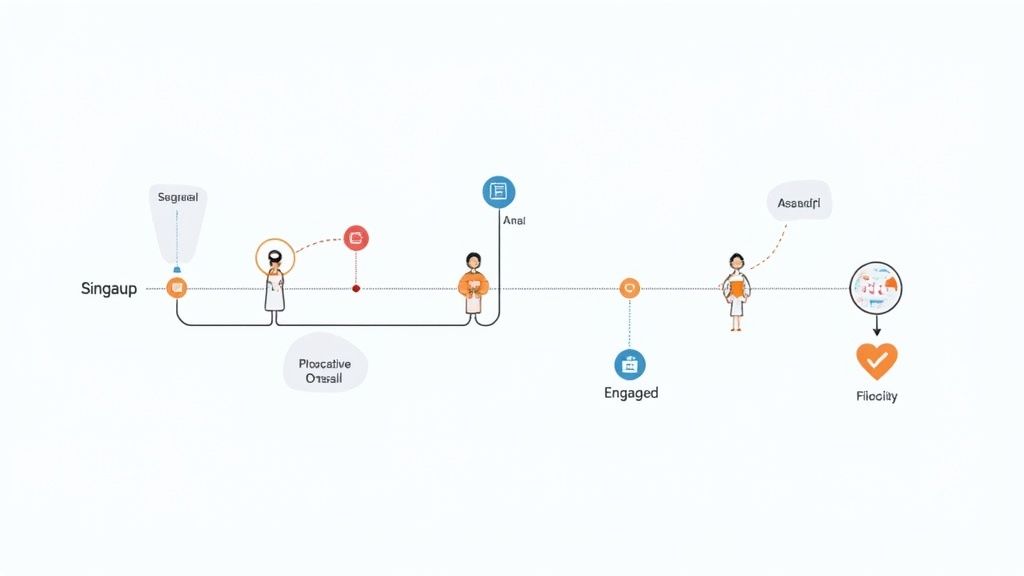
This isn't about blasting a generic "We miss you!" email to every name on your churned list. It’s about sending a targeted message that hits on their original reason for leaving and shows them you’ve actually listened and improved.
First, Figure Out Why They Left
Before you can win anyone back, you have to do some detective work. A one-size-fits-all email will get you nowhere. A customer who left because your pricing was too steep has entirely different motivations than one who left because you were missing a critical feature.
Start by sorting your churned customers into buckets based on their reason for leaving.
- Priced Out: These folks left because they found a cheaper option or felt your service was too expensive. Your pitch to them should be all about value—maybe a special discount or a nudge towards a more affordable plan that still meets their needs.
- Missing Features: This group needed something specific that you just didn't have at the time. This is a golden opportunity. The moment you launch that feature, they should be the first people you tell.
- Bad Experience: Maybe they had a rough time with your support team. A discount code isn't going to fix that broken trust. This requires a more personal touch, like an email from a customer success manager acknowledging the slip-up and explaining how you've improved your support process.
- Involuntary Churn: Sometimes it's just a simple billing issue, like an expired credit card. A friendly, automated reminder is often all it takes to get them back on board.
When you tailor your outreach to the "why," your message instantly becomes more relevant and a hundred times more effective.
Write Messages That Resonate
Once you know who you're talking to, you can craft your message. Tone is absolutely crucial here. You want to sound helpful and confident, not needy. The goal is to gently remind them of the value they once got from you and show them what they’re missing out on now.
Your win-back email isn't an apology tour; it's a value proposition. It should clearly state what has changed for the better and why it's worth their time to take another look.
Think about your subject lines. For a user who left because of a missing feature, something like this cuts right to the chase:
"Remember that integration you asked for? It's here."
It's direct, it's personal, and it immediately proves you solved their specific problem. The email itself can then show off the new feature and give them a simple, one-click way to reactivate their account.
Know When to Say Goodbye
Here’s a hard truth: not every churned customer is worth winning back. Pouring your energy into the wrong accounts is a huge drain on your resources.
Some customers were never the right fit to begin with. Bringing them back just means they'll probably churn again in a few months.
Your ideal candidates for a win-back campaign are the ones who were engaged, fit your ideal customer profile, and left for a specific reason that you’ve since fixed. If a customer was constantly causing problems, barely used the product, or was a bad fit from day one, it’s often best to wish them well and move on. Focus your efforts where they’ll have the biggest impact.
Making Customer Retention a Company-Wide Mission
Let's be clear: reducing churn isn't a task you can just hand off to one department. It's not solely the job of your support agents or your customer success managers. If you want to build real, lasting retention, it has to be a company-wide mission where every single person understands their role in the customer's journey.
Think about it. When a clunky UI designed by the product team causes a flood of support tickets, you see how interconnected everything is. The promises your marketing team makes set expectations that the product has to live up to. The conversations your sales team has from day one define the entire relationship. Every department holds a piece of the puzzle.
Break Down Those Departmental Silos
To get everyone on the same page, you have to get customer feedback—the good, the bad, and the ugly—circulating through every team. This gives everyone, from engineers to executives, a direct line of sight into what customers are actually experiencing.
A simple way to do this is to create a shared communication channel where feedback gets posted daily. This isn't about creating more noise; it's about creating shared context.
- Verbatim quotes from support tickets: Let your product team feel a customer's frustration in their own words.
- Key takeaways from exit surveys: Share the patterns with marketing so they can tweak messaging and targeting.
- Positive reviews and success stories: Celebrate the wins with the whole company. It’s a huge morale booster and reinforces what you're doing right.
When a developer sees five separate complaints about the same bug, they're much more likely to understand its urgency. This shared understanding is the bedrock of a truly customer-focused company.
Customer experience is the sum of every interaction a customer has with your business. One weak link—whether it’s in the product, marketing, or support—can snap the entire chain.
Get Everyone Aligned on What Matters
The best way to get your entire organization rowing in the same direction is to make customer experience a shared Key Performance Indicator (KPI). When metrics like Net Promoter Score (NPS) or Customer Satisfaction (CSAT) are tied to team-wide goals, retention suddenly becomes a concrete objective for everyone, not just a vague idea.
And the stakes couldn't be higher. A bad experience is a massive driver of churn. Globally, a staggering 70% of consumers will ditch a brand after just two bad experiences. In the U.S., 17% will walk away after only one. Simple annoyances, like being stuck on hold or having to repeat an issue to multiple agents, are dealbreakers for over half of all customers. This proves just how much every single interaction matters. You can discover more about these customer experience findings on Webex.com.
Ultimately, making customer retention a core part of your company's DNA requires a set of intentional and well-designed customer retention marketing strategies. This is your call to action: champion the customer at every level and build a business that people simply don't want to leave.
Your Top Questions About Customer Churn, Answered
When you're trying to get a handle on customer churn, a few key questions always seem to pop up. Let's tackle them head-on so you can start building a retention plan that actually moves the needle.
What’s a Good Customer Churn Rate, Anyway?
This is the million-dollar question, but the honest answer is: it depends. There’s no magic number that works for everyone.
For a SaaS company, anything under 5% monthly is generally considered solid. But if you’re in e-commerce or have a consumer app, the switching costs are much lower, so you might see churn rates as high as 20-30%.
The best approach is to stop worrying about universal benchmarks and start competing with yourself. Is your churn rate lower this quarter than it was last quarter? That's what really matters. A downward trend is the healthiest sign of all.
Your goal isn't perfection; it's progress. A "good" churn rate is one that's consistently getting better. Focus on beating your own historical numbers.
How Long Do I Have to Win Back a Churned Customer?
You’ve got a window, but it closes fast. The golden period for win-back campaigns is typically within the first 30-90 days post-cancellation. During this time, your service is still fresh in their mind, and a compelling offer or a fix to their original problem can genuinely bring them back.
After that 90-day mark? The odds of re-engaging them drop off a cliff. At that point, it’s wise to switch gears. Move them out of your aggressive win-back funnels and into a long-term nurturing list. You can send them major product updates or high-value content to keep the relationship warm without being pushy.
Can AI Actually Make a Dent in Churn?
Without a doubt. AI is one of the most powerful tools you have for getting ahead of churn. It helps you shift from putting out fires to preventing them in the first place.
Here’s how:
- Predictive Analytics: AI tools can crunch the numbers on product usage, support ticket history, and engagement data to flag customers who are showing early warning signs of leaving.
- Instant Support: AI-powered chatbots, like those from Yoonoo, deliver immediate answers 24/7. This stops minor frustrations from snowballing into reasons for cancellation.
By giving customers the help they need the moment they need it, you build a much stickier product experience.
Ready to see how an AI chatbot can solve customer problems before they lead to churn? Yoonoo lets you build a smart AI assistant for your website in just five minutes, with no coding skills needed. Get started for free at yoonoo.ai and start turning customer support into a retention powerhouse.