How to Increase Ecommerce Sales
Before you spend a single cent on marketing, your website has to be rock-solid. Think of your online store as your best salesperson—if it’s slow, confusing, or untrustworthy, you're going to lose sales, period. It doesn't matter how great your products are.
The digital marketplace is more crowded than ever, and a clunky site is the fastest way to send potential customers clicking over to your competition.
Build a Website That Converts Visitors Into Customers
The shift to online shopping isn't a trend; it's the standard. By 2028, ecommerce is expected to make up 22.5% of all retail sales worldwide. With the market projected to hit a staggering $6.42 trillion in 2025, the opportunity is massive. But so is the competition.
To get your slice of the pie, your site has to deliver an experience that effortlessly guides people from browsing to buying.
Simplify and Streamline Navigation
Have you ever walked into a huge store with no signs? That's what a poorly designed website feels like. People get frustrated and leave. A good rule of thumb I've always followed is the "three-click rule"—a customer should be able to find any product in three clicks or less from your homepage.
Here’s how to make that happen:
- Logical Categories: Group your products in a way that just makes sense. Use terms your customers would actually search for, not internal company jargon.
- A Great Search Bar: Your search bar needs to be front and center, especially if you have a big catalog. Make sure it's smart enough to offer suggestions and handle typos.
- Clear Calls-to-Action (CTAs): Use direct, action-oriented language like "Add to Cart" or "Buy Now." Make your buttons pop with a contrasting color so there's zero confusion about what to do next.
Craft Compelling Product Pages
This is where the magic happens. Your product page is your final pitch, the place where a browser becomes a buyer. It needs to do more than just list features; it has to tell a story and answer every single question a customer might have.
That means using high-quality photos and videos showing your product from every angle, and even better, in use. And don't skimp on the words. Your descriptions need to speak directly to your customer's problems and desires. If you want to get this right, it's worth the time spent mastering website copywriting.
A great product page anticipates and answers a customer’s questions before they even think to ask them. It builds confidence by showing, not just telling, them why your product is the solution they've been looking for.
Build Unshakable Trust and Credibility
Online, trust is everything. People are naturally wary of handing over their credit card details to a stranger. You have to make them feel safe and secure.
Here are a few non-negotiables for building that trust:
- Display Social Proof: Nothing sells like social proof. Feature customer reviews, ratings, and photos from real users right on the product page. Seeing that other people bought it and loved it is incredibly powerful.
- Showcase Security Badges: Little things make a big difference. Display trust seals from providers like Norton or McAfee and the logos of payment methods you accept, like Visa or PayPal.
- Provide Clear Policies: Don’t hide your return policy, shipping info, or privacy policy. Make them easy to find and even easier to understand. Transparency is key to reducing a customer's anxiety before they buy.
To give you a quick cheat sheet, here are the core elements you should focus on to get your site ready to sell.
Key Website Elements to Boost Sales
| Website Element | Why It Matters for Sales | Actionable Tip |
|---|---|---|
| Intuitive Navigation | If they can't find it, they can't buy it. Simple navigation reduces bounce rates and keeps shoppers engaged. | Implement a prominent search bar and organize products into clear, customer-friendly categories. |
| Compelling Product Pages | This is your virtual sales pitch. It's where you convince a shopper your product is the right choice. | Use high-quality images/videos, detailed descriptions, and customer reviews to answer all potential questions. |
| Visible Social Proof | People trust other people. Reviews and ratings build confidence and validate the purchase decision. | Feature your best customer reviews and star ratings directly on your product pages and homepage. |
| Trust Badges & Security | Shoppers need to feel their financial information is safe. Security symbols reduce cart abandonment. | Display payment logos (Visa, PayPal) and security seals (Norton, McAfee) clearly during checkout. |
Getting these fundamentals right transforms your website from a simple catalog into a powerful growth engine. For a deeper look at turning more visitors into buyers, check out our complete guide on https://yoonoo.ai/blog/website-conversion-rate-optimization.
Get in Front of Your Ideal Customers with Smart Marketing
You can have the most beautiful, user-friendly website in the world, but it won't do you any good if no one ever sees it. The real work begins when you start driving the right kind of traffic—people who are actually looking for what you sell. It’s not about sheer numbers; it's about attracting genuine potential buyers.
A solid marketing strategy meets your customers wherever they are online. And they are definitely online. Retail e-commerce in the U.S. rocketed to about $293 billion in the second quarter of 2025 alone, which was a 6.2% jump from the quarter before. That's a massive audience out there, and this data from the Census Bureau's report on U.S. e-commerce growth proves it. A smart plan is your map to finding them.
Capture High-Intent Traffic with SEO
Think of Search Engine Optimization (SEO) as the foundation for your store's long-term, sustainable growth. It's all about making your store pop up when people use search engines like Google to find products like yours. When someone types in "waterproof hiking boots for women," you want your product page to be right there at the top.
It all starts with getting inside your customer's head and figuring out what they're actually searching for.
- Go for Long-Tail Keywords: Forget broad, competitive terms like "boots." Get specific. Think "women's vegan leather ankle boots size 8." These longer phrases have way less competition and are used by shoppers who are much closer to pulling out their credit cards.
- Tune-Up Your Product Pages: Every single product page needs to be optimized for a main keyword. Weave it naturally into your product title, the description, image alt text, and even the URL.
- Build Authority with Great Content: Start a blog or create helpful guides related to your products. If you sell skincare, an article like "The Perfect Morning Skincare Routine for Oily Skin," with links to your own products, can be a game-changer.
Drive Immediate Results with Paid Advertising
While SEO is a long game, paid advertising can bring you traffic today. Platforms like Google Ads and Meta (which owns Facebook and Instagram) let you put your products right in front of a hand-picked audience. The goal here isn't just clicks; it’s all about getting a strong return on your investment (ROI).
Let's say you sell custom pet portraits. With Meta ads, you could target people who follow famous pet influencers, have shown interest in pet adoption, and live in certain cities. That kind of precision means you're not wasting your ad budget on people who will never buy.
Paid advertising is like paying for a billboard on the busiest highway on the internet. But unlike a real billboard, you get to choose exactly who sees it, ensuring every dollar is spent reaching your ideal customer.
Running a successful campaign means keeping a close eye on the results. You have to constantly track which ads are hitting the mark, which audiences are converting, and where you can tweak your spending to get the most bang for your buck.
Build a Loyal Community with Content Marketing
Content marketing is less about the hard sell and more about building real relationships. It’s about creating and sharing genuinely useful content that attracts your target audience and positions your brand as a trusted expert. When they're ready to buy, you'll be the first one they think of.
This infographic gives a great visual breakdown of how these different marketing channels typically stack up.
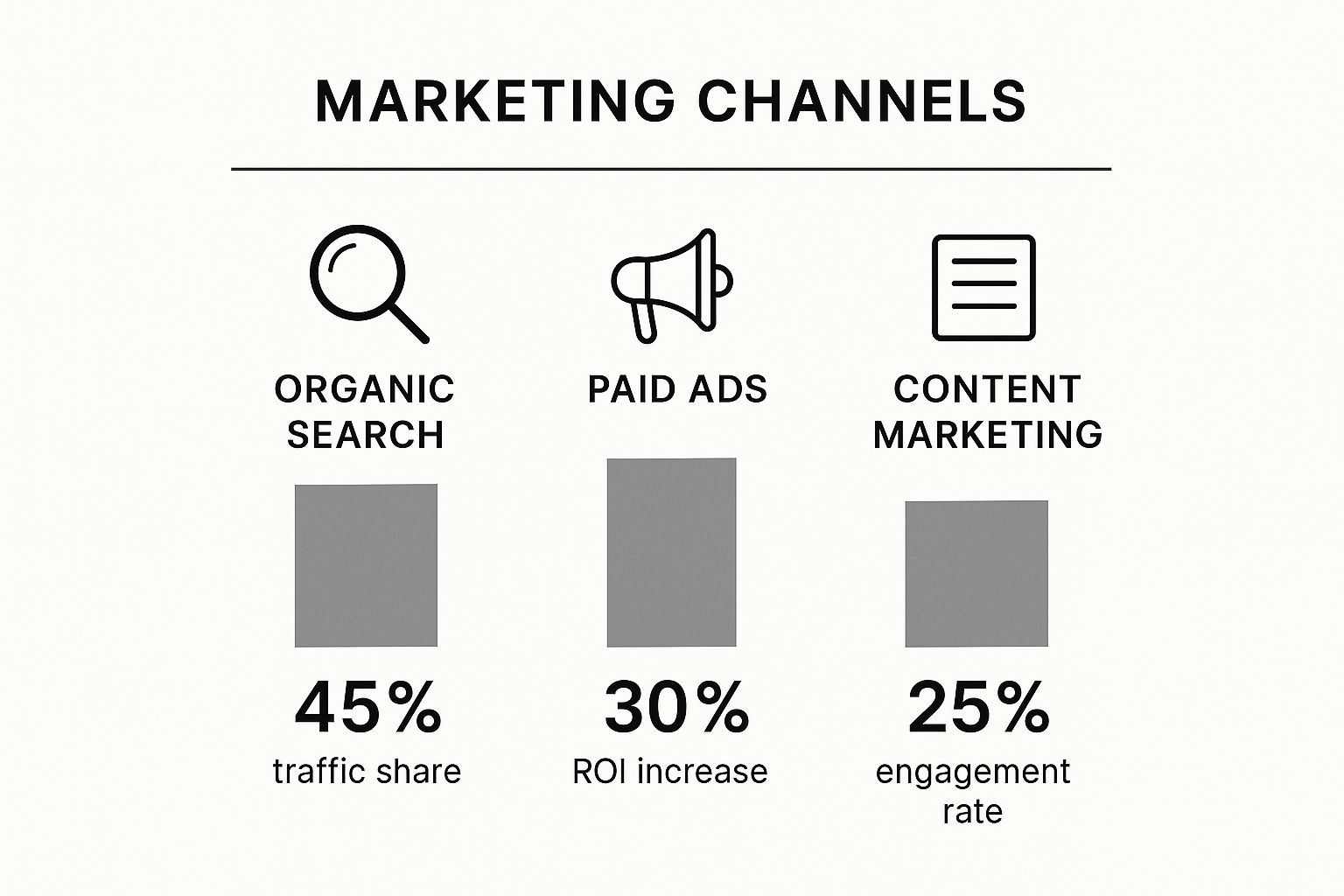
As you can see, a balanced approach is usually the most effective. SEO often drives the most overall traffic, paid ads can deliver a fantastic ROI, and content marketing is the champion of building real engagement.
For an e-commerce brand, this might look like:
- How-To Video Guides: If you sell kitchen gadgets, create short, snappy videos showing cool and creative ways to use them.
- Inspirational Blog Posts: A fashion brand could publish a post on "5 Ways to Style a Classic White T-Shirt for Any Occasion."
- User-Generated Content: Run a campaign encouraging customers to share photos of themselves using your products on social media with a unique hashtag.
This isn't just marketing; it's community building. When customers feel connected to your brand and trust your advice, they’ll choose you over a faceless competitor every time.
Choosing the right marketing channels can feel overwhelming. To simplify things, here’s a quick comparison of the most common options for e-commerce businesses.
Comparing Ecommerce Traffic Channels
| Marketing Channel | Typical Cost | Primary Benefit | Best For |
|---|---|---|---|
| SEO | Time investment; low direct cost | Sustainable, "free" organic traffic | Long-term, foundational growth |
| Paid Ads | Pay-per-click (PPC) or impression | Immediate, highly-targeted traffic | Quick sales, product launches, testing |
| Content Marketing | Time & resource investment | Brand loyalty & authority | Building a community and trust |
| Social Media | Varies (organic vs. paid) | Community engagement & brand voice | Niche products & visual brands |
| Email Marketing | Low to moderate (platform fees) | High ROI & direct customer contact | Customer retention & promotions |
Ultimately, the best strategy is rarely just one of these. A powerful marketing engine combines the long-term authority of SEO with the immediate impact of paid ads and the deep connection of content and email marketing.
10. Bring in AI and Automation to Supercharge Your Shopping Experience
Let's be honest: today's shoppers are impatient. They want answers now, not in a few hours. If they have a simple question about your shipping policy and have to wait, they'll just bounce to a competitor. This is where you can get a serious edge by smartly using AI and automation.
Think of these tools not as replacements for your team, but as super-efficient assistants. They can handle the constant, repetitive questions, freeing up your people to tackle the tricky problems that require a human touch.
Put an AI Chatbot on Your Front Lines
The fastest way to offer instant help is with a good AI chatbot. And I'm not talking about those clunky, frustrating bots from a few years ago. Today's tools can understand what people are actually asking and give helpful, accurate answers—even when you're sound asleep.
A well-trained chatbot can handle tons of common questions right away:
- "What's your return policy?"
- "Do you ship to Canada?"
- "Where's my order?"
- "Is the blue sweater in stock in a medium?"
Answering these questions on the spot gets rid of that last-minute hesitation and builds the confidence a customer needs to click "buy." For many online stores, using a chatbot for marketing and support is the single biggest step they can take toward a better customer experience.
You can get a tool like Yoonoo up and running in minutes, often without needing to write a single line of code. You just feed it your website content, and the AI learns how to answer questions based on your actual business information.
Automate Your Email Marketing
Automation isn't just for your website; it's a powerhouse for email marketing, too. Instead of manually sending out newsletters, you can build automated email "flows" that trigger based on what your customers do. These sequences are like having a marketing expert working for you around the clock.
A great automation strategy doesn't feel robotic. It feels personal and timely. When you respond to a customer's specific actions, it shows you're paying attention and delivering real value at exactly the right moment.
Here are three automated email flows that every e-commerce store needs:
-
The Welcome Series: When someone new subscribes, don't just send one "thanks!" email. Set up a three-to-five-part series that tells your brand's story, highlights your bestsellers, and maybe offers a small discount to get them to make that first purchase.
-
The Abandoned Cart Saver: It’s a wild statistic, but nearly 70% of all online shopping carts are abandoned. An automated email sequence is your best shot at winning back a huge chunk of that lost revenue. The first email can be a gentle reminder, followed by one 24 hours later that maybe offers free shipping to seal the deal.
-
The Post-Purchase Follow-Up: The sale isn't the end of the conversation. A few days after their order arrives, send an automated email asking for a review. A week later, you can follow up with smart recommendations for related products, turning a one-time buyer into a loyal customer.
These systems make sure no one gets forgotten. They create a consistent experience that builds trust and brings in more money, all without you having to constantly hit "send."
Turn First-Time Buyers Into Lifelong Fans

Getting that first sale is a great feeling, but the real magic happens when that customer comes back for a second, third, and fourth time. The truth is, it costs five times more to land a new customer than to keep an existing one. If you want sustainable growth, focusing on customer retention isn't just a good idea—it's essential.
A loyal customer does more than just buy from you again. They tend to spend more over time and often become your best advocates, telling their friends and family about your brand. The secret is making them feel genuinely appreciated well after that initial transaction is over.
Build a Loyalty Program That People Actually Want to Use
Let’s be honest, a generic "earn one point for every dollar" program isn't very exciting. It’s better than nothing, but it rarely builds true loyalty. The best programs make customers feel like they’re part of an exclusive club, with real perks for sticking around.
Try thinking in tiers, where the rewards get noticeably better as customers climb the ladder. This gives them something to shoot for.
- Bronze Tier (after 1st purchase): Early access to new product drops and a birthday discount.
- Silver Tier (after spending $500): Everything in Bronze, plus free shipping on all orders. No minimum.
- Gold Tier (after spending $1000): All the Silver perks, plus a surprise quarterly gift and access to a priority customer support line.
This kind of structure encourages people to consolidate their shopping with you. It changes the dynamic from a simple transaction to an ongoing relationship they want to invest in.
Get Personal (Beyond Just Using Their First Name)
Popping a customer's first name into an email subject line is table stakes now. Real personalization means using what you know about their shopping habits to send them things they'll actually find useful. It shows you're paying attention.
For example, say someone just bought a high-end coffee grinder from your store. Instead of lumping them into your standard weekly newsletter, you could send a targeted follow-up sequence:
- A week later: Send an email with a link to a video tutorial on "Getting the Perfect Grind."
- Three weeks later: Follow up with a curated list of your top-rated coffee beans that would be perfect for their new grinder.
- Six weeks later: Offer them a special discount on a coffee bean subscription.
This approach gives them real value and positions you as an expert they can trust. That's how you go from being just another online store to their online store.
Make Amazing Customer Service Your Superpower
You truly find out what your customer service is made of when something goes wrong. A shipping delay or a damaged product can be a disaster, or it can be a golden opportunity to win a customer for life.
A customer's problem is your chance to shine. Fixing an issue with speed, empathy, and a little generosity can turn a negative experience into a story they'll tell everyone.
When a customer gets in touch with a problem, the goal should be to solve it, fast. Give your support team the power to make things right without jumping through a bunch of hoops. If a package gets lost in transit, don't make the customer wait weeks for an "investigation." Just ship a replacement right away, on your dime.
That kind of service builds incredible trust. It shows you stand behind what you sell and that you value your customers more than a single sale. That trust is the bedrock of a loyal community that will drive your growth for years to come.
Use Data to Make Smarter Growth Decisions
Gut feelings are great for ordering lunch, but they’re a terrible way to run an e-commerce business. If you want to consistently grow your sales, you have to stop guessing what works and start knowing. Every click, every purchase, and every abandoned cart leaves a trail of breadcrumbs. Learning to follow that trail is your roadmap to smarter growth.
This isn't about getting lost in endless spreadsheets. It's about focusing on a handful of key performance indicators (KPIs) that tell you the real story of your store's health. Think of them as your business's vital signs.
Focus on the Metrics That Actually Matter
It’s way too easy to get overwhelmed by data. Instead of trying to track everything, just zero in on the three metrics that have the biggest impact on your bottom line. These are the numbers that truly define your success.
-
Conversion Rate: This is simply the percentage of visitors who actually make a purchase. If 100 people visit your site and two of them buy something, your conversion rate is 2%. It’s the single most important measure of how well your website turns traffic into money.
-
Average Order Value (AOV): This tells you how much a customer typically spends in one go. Finding ways to increase your AOV is one of the fastest ways to boost revenue without needing a single extra visitor.
-
Customer Lifetime Value (CLV): This number predicts the total profit you'll make from any given customer over time. A high CLV means you're doing a great job turning one-time buyers into loyal, repeat customers—which is the secret to long-term stability.
Your goal isn't just to make a sale; it's to build a profitable business. Focusing on Conversion Rate, AOV, and CLV shifts your perspective from short-term wins to creating sustainable, long-term growth.
Identify and Fix the Leaks in Your Sales Funnel
Your sales funnel is the path customers take from first hearing about you to clicking "buy." People will inevitably drop off along the way, but your job is to figure out where the biggest "leaks" are and plug them. This is where a tool like Google Analytics becomes your best friend.
Imagine you see a ton of traffic hitting your product pages, but very few people are actually adding items to their cart. That's a huge red flag. It tells you the problem isn't your marketing—people are getting to your products just fine. The real issue is likely on the product page itself.
This insight gives you a clear starting point. Maybe your product photos are blurry, the descriptions are confusing, or the "Add to Cart" button is buried at the bottom of the page. Without the data, you’d just be guessing. With it, you have a specific problem to solve.
Use A/B Testing to Make Evidence-Based Changes
Once you’ve sniffed out a potential problem, the next step is to test your solution. This is where A/B testing comes in. It’s a simple but incredibly powerful method for comparing two versions of a webpage to see which one performs better.
Let's stick with our product page example. You suspect your headline, "High-Quality Leather Wallet," is a bit boring. You want to test something more benefit-driven, like: "The Last Wallet You'll Ever Need to Buy."
With A/B testing, the process is straightforward:
- Create two versions of the product page: one with the original headline (Version A) and one with the new headline (Version B).
- Send 50% of your traffic to Version A and the other 50% to Version B.
- Let the test run until you have enough data to see a clear winner.
- If Version B gets significantly more "Add to Carts," you've just found a data-backed way to increase sales.
This scientific approach takes ego completely out of the equation. It’s no longer about which headline you like more; it's about which one actually puts more money in your pocket. Apply this testing mindset to everything—your checkout process, email subject lines, ad creative—and you’ll build a business that continuously improves, one data point at a time.
Your Roadmap to Sustainable Ecommerce Growth
Forget looking for a single magic bullet to boost your e-commerce sales. Real, sustainable growth comes from a much more grounded approach: making consistent, strategic improvements across every part of your business. It's about a constant cycle of refinement.
Think of it this way: every customer touchpoint, from how they navigate your website to the follow-up email they receive after a purchase, is an opportunity. Lasting success is built by creating a high-converting digital storefront, pulling in the right kind of traffic, and then working hard to keep those customers coming back.
The potential here is massive. We're looking at a global retail e-commerce market projected to hit nearly $8 trillion by 2028, a huge jump from the estimated $6 trillion in 2024. If you want a closer look at these numbers, you can check out the booming global e-commerce market on Statista. That kind of growth shows just how critical a solid game plan is.
Sustainable growth isn't a destination; it's a process. The most successful brands are those that constantly test, analyze data, and refine their approach to meet evolving customer expectations.
By zeroing in on a few key areas—website optimization, smarter marketing, AI-driven support, and building genuine customer loyalty—you create a resilient foundation. This isn't just about a quick spike in sales. It's about building a powerful engine for long-term success.
For a deeper dive, you can explore some proven strategies for increasing ecommerce sales that really work in today's market.
Got Questions? We've Got Answers
As you work on growing your e-commerce store, a few common questions always seem to pop up. Let's tackle them head-on so you can focus on what really moves the needle.
What’s the Absolute Fastest Way to Get More Sales?
Everyone wants that magic button, right? If you're looking for a quick sales jolt, your best bet is usually a well-targeted paid ad campaign on a platform like Google Shopping or Meta. Pair that with a killer, time-sensitive offer—like a flash sale—and you can definitely spark some immediate action.
But here's the real talk: that's a short-term fix. For sustainable, long-term growth, you need to pour your energy into improving your website's conversion rate and bumping up your average order value (AOV) with smart upselling and cross-selling.
A paid ad campaign can give you a fast spike in sales, but real, profitable growth comes from building a site that consistently turns visitors into buyers and encourages them to spend more.
How Can I Grow Sales if My Marketing Budget Is Tiny?
You don't need deep pockets to make a big impact. If you're working with a smaller budget, it’s all about focusing on high-leverage activities that are low-cost or even free.
- Become an SEO Pro: Getting your website and product pages optimized for search engines is like setting up a free billboard on the busiest highway online. It brings in people who are already looking for what you sell.
- Grow Your Email List: This is your owned audience. Keep them engaged with great content, exclusive deals, and personalized product suggestions. It’s one of the best ways to drive repeat purchases.
- Lean into Social Proof: Don't be shy—actively ask for customer reviews and show off photos from happy customers. Nothing sells a product better than seeing other real people enjoying it.
- Get Social (For Real): Pick one or two social media platforms where your customers actually hang out. Instead of just shouting about sales, focus on building a real community.
Which Numbers Should I Actually Be Watching for Growth?
It's so easy to get buried in data and lose sight of what's important. To keep a clear pulse on your store's health, keep your eyes on these three key metrics:
- Conversion Rate: This is the big one—the percentage of visitors who actually buy something. It tells you exactly how good your site is at turning clicks into cash.
- Average Order Value (AOV): This shows you how much the average customer spends per order. Getting people to add just one more item to their cart is a huge win for your bottom line.
- Customer Lifetime Value (CLV): This number predicts how much profit you'll make from a customer over their entire time with your brand. A high CLV is the sign of a truly healthy business built on loyalty.
Ready to give your visitors instant, 24/7 support and turn more of them into customers? Yoonoo can help. You can get a smart AI chatbot set up on your site in just 5 minutes and see your customer engagement climb. Start for free at yoonoo.ai.