How to Handle Customer Complaints Like a Pro

When a customer complains, your response needs to do three things: show you've listened, offer a sincere apology, and deliver a prompt resolution. Getting this right isn't just about damage control. It's how you turn a bad experience into a great one, building rock-solid loyalty and getting invaluable feedback in the process.
Why Handling Complaints Right Is a Business Superpower
Let's be honest, nobody likes getting a complaint. It can feel like a direct shot at all your hard work. But if you only see them as problems, you're missing the point. What if every complaint was actually a piece of incredibly valuable, unfiltered feedback? That mental shift is the first step toward turning your customer support from a cost center into a strategic advantage.
The Real Cost of Fumbling the Ball
Picture a small online shop, 'Innovate Goods,' that ships a fragile item. It arrives broken. The customer emails for help but gets radio silence for days. Frustrated, they head to social media to share their story. Suddenly, that one negative post starts to snowball, doing far more damage to the brand's reputation than the cost of a simple replacement ever would.
This isn't just a hypothetical situation; it's a huge financial risk. Poor customer service costs U.S. companies an estimated $75 billion every single year. Worse, 56% of consumers worldwide have walked away from a brand for good after just one bad experience. That’s how fast you can lose someone. If you want to dive deeper into protecting your brand's image, this ultimate reputation management guide is a great resource.
The Power of a Great Recovery
Now, let's replay that scenario. What if 'Innovate Goods' replied within an hour? They apologize sincerely, immediately ship a replacement, and toss in a small discount for a future order. The customer's frustration melts away, replaced by appreciation. They might even go back to that social media post and update it to praise the company's amazing support.
This is what’s known as the "service recovery paradox." It's a fascinating phenomenon where a customer can actually become more loyal after you fix a problem than they were before it ever happened. Why? Because you've just proven that you're reliable and that you genuinely care about them.
To get this right, it helps to understand the core principles that drive successful resolutions.
The Pillars of Effective Complaint Resolution
| Principle | Why It Matters |
|---|---|
| Speed | A fast response shows the customer they are a priority and prevents frustration from escalating. |
| Empathy | Acknowledging their feelings demonstrates that you understand the human side of the problem. |
| Ownership | Taking responsibility, even if it wasn't your direct fault, builds trust and de-escalates tension. |
| Resolution | The solution must be fair, clear, and effectively solve the customer's original problem. |
| Follow-up | Checking in after the fact confirms the issue is resolved and shows you're committed to their satisfaction. |
Mastering these elements is the key to turning negative situations into positive outcomes.
The silver lining here is powerful: a reported 67% of customer churn is preventable if you can resolve their issue during the very first interaction. That statistic alone highlights the massive opportunity hidden inside every complaint.
In the end, handling complaints effectively isn't just about putting out fires. It’s about building a stronger, more resilient business. It helps you:
- Build Unshakable Loyalty: Solving problems shows customers you value them, which is the foundation of trust.
- Gather Critical Feedback: Complaints are a direct line into your business's weak spots, telling you exactly where to improve.
- Protect Your Brand Reputation: A swift and empathetic response can stop negative word-of-mouth in its tracks.
By mastering the art of handling customer complaints, you can transform these challenging interactions into your biggest opportunities for growth.
The ACTIVE Listening Framework to Defuse Tension
When an angry customer gets in touch, those first few moments are everything. Before you even start thinking about a fix, your job is to bring the temperature down. You need to show them you’re on their side, ready to help, not just another corporate wall to talk to.
This is where having a game plan for listening really pays off. Forget vague advice like "be a good listener." You need a practical framework to guide you through the emotional minefield of a tough conversation.

We call it the ACTIVE listening framework. It’s a simple, memorable way to handle that initial, high-stakes chat and make the customer feel truly heard. Each letter guides you through a key part of turning a tense situation into a productive one.
Acknowledge and Clarify the Issue
First things first, you have to Acknowledge their frustration. This isn’t about admitting the company is wrong; it’s about recognizing how they feel. A simple, "I can see how frustrating this shipping delay has been for you," hits a lot harder than a robotic, "I understand." It shows you’re actually listening.
Next, you need to Clarify the details. Never assume you have the whole story from their first outburst. Ask open-ended questions to dig a little deeper. If a customer says their new gadget is broken, try asking, “Could you tell me a bit more about what happened when you tried to turn it on?” This avoids jumping to the wrong conclusions and proves you’re invested in getting it right.
Thank and Investigate with Purpose
This next one might feel a little strange, but it works wonders: Thank them. Seriously. A quick, “Thank you for bringing this to our attention,” instantly changes the tone. It reframes their complaint from an attack into valuable feedback, making you partners in solving the problem.
Once the initial heat has died down, you can start to Investigate. This is where you roll up your sleeves and get to work. Let them know what you’re doing by saying something like, “Let me pull up your order details so I can see exactly what’s going on here.” This simple sentence signals that you’re officially on the case.
Validate and Empathize Genuinely
Finally, you have to Validate their feelings and show some real Empathy. Validation is just confirming that their feelings make sense. Something like, “You’re absolutely right to be upset; that’s not the experience we want for our customers,” can be incredibly powerful.
Empathy is that final human touch that ties it all together. Let's imagine a customer from our fictional brand, 'Innovate Goods,' calls because their new gadget arrived with a cracked screen.
An agent using the ACTIVE framework might say: “I'm so sorry to hear the screen was damaged. It’s completely understandable that you’d be disappointed after waiting for your order, and I want to get this sorted out for you right away.”
That one response acknowledges, validates, and empathizes all at once, paving the way for a much smoother resolution. Nailing these first moments is more important than ever. In fact, customer satisfaction hit a low of 73.4 in late 2022, a clear sign that customers are demanding better, more human support. You can dive deeper into these changing expectations in this detailed report on customer service trends.
Building a Reliable Complaint Resolution Process
Listening is a great start, but a good conversation has to end with a real solution. To keep customer issues from slipping through the cracks, you need an operational backbone—a clear, repeatable process that guides every complaint from the first "hello" to the final "problem solved."
Without a system, even the best intentions can turn into chaos. You end up with missed follow-ups, frustrated customers, and a stressed-out team.
The key is consistency. It shouldn't matter if a customer emails you about a broken product or sends a DM on Instagram. The steps your team takes to fix their problem should be the same every single time. This predictability is what builds trust.
Here’s a simple flowchart that shows what an effective complaint-handling process looks like in practice.
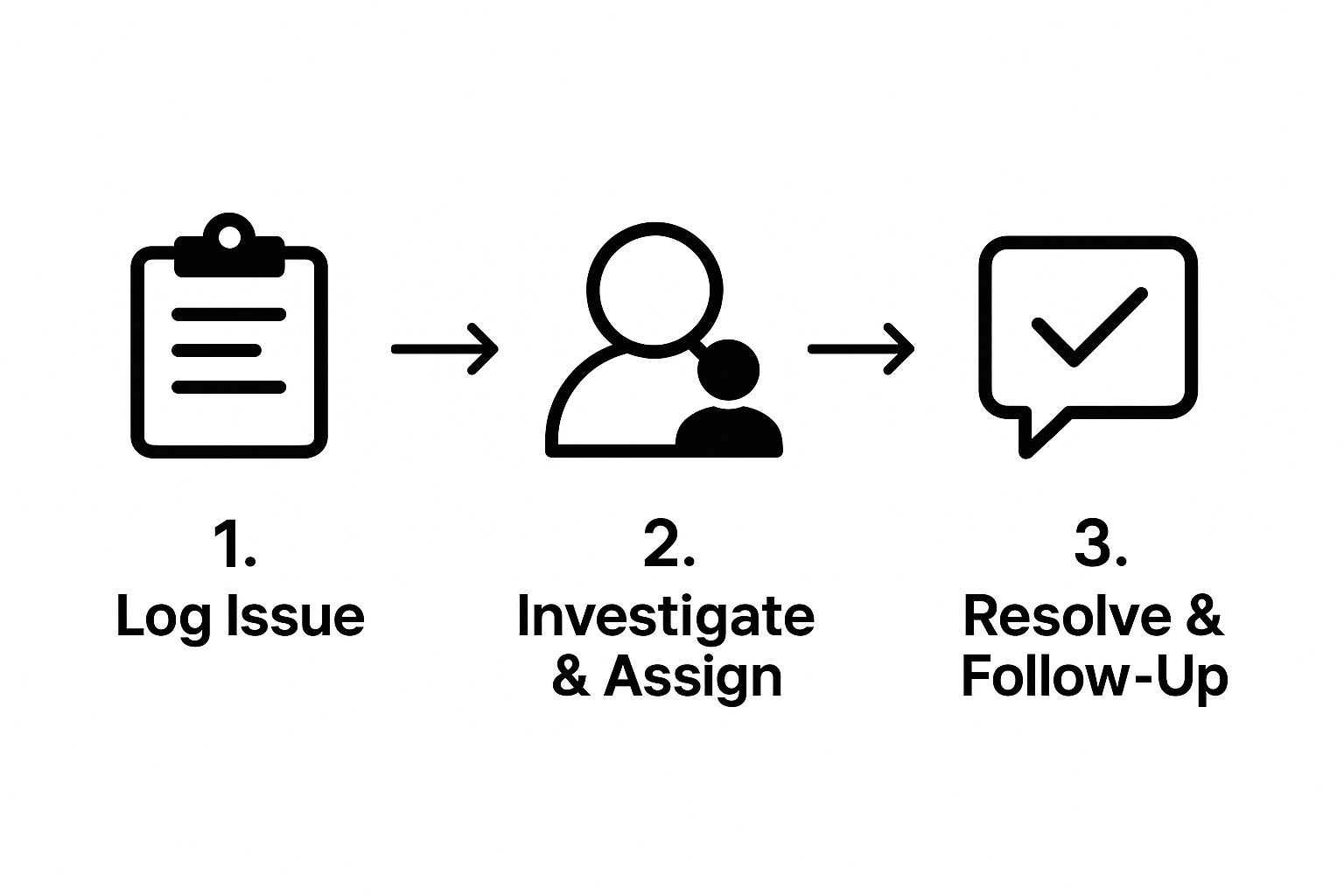
Having a visual map like this reinforces the importance of structure. Logging the issue ensures it's never forgotten, investigating and assigning it to someone creates accountability, and following up guarantees you close the loop properly.
Define Your Internal Timelines
One of the most powerful tools for creating a solid process is a Service Level Agreement (SLA). It sounds technical, but it's really just a promise your team makes about how quickly you'll respond and resolve issues. For example, your SLA might state that all new complaints get a first response within one hour and are fully resolved within 24 hours.
Setting these clear timelines is a game-changer for two big reasons:
- It manages customer expectations. Telling a customer "Our team will get back to you within the next two hours" is infinitely better than leaving them in the dark.
- It creates internal accountability. Your team knows exactly what’s expected of them, which gets rid of guesswork and pushes everyone to act fast.
Eliminate Customer Frustration Points
Think about what drives customers crazy: waiting on hold and repeating themselves over and over. Research shows that 33% of customers are most frustrated by having to wait, and another 33% hate having to explain their problem to multiple people.
In fact, a whopping 72% of customers believe that having to re-explain their issue is the hallmark of poor service. You can read more about these and other statistics on what frustrates customers from HelpScout.
A structured process solves this problem head-on by making sure the person handling the issue has all the context they need from the very beginning.
A simple ticketing system, even one managed through a shared inbox with clear labels, can be transformative. It lets you track a complaint from the initial email to the final "Is everything okay now?" message, all in one place.
Let's imagine a customer emails Yoonoo about a faulty product. That email automatically becomes a ticket and gets assigned to a specific agent. This agent is now the customer's single point of contact.
Every note—from troubleshooting steps to the tracking number for a replacement part—is logged in that ticket. The customer never has to tell their story again. That’s how you build a system that delivers a smooth, respectful, and reliable support experience every single time.
Empowering Your Team for First-Contact Resolution
Your process for handling customer complaints is only as strong as the people running it. A detailed workflow is a great start, but the real magic happens when your team feels equipped, trained, and trusted to manage tough situations with confidence.
Investing in your team's skills is a direct investment in your customer relationships.

Go Beyond Scripts With Practical Training
Response templates are useful, but they can’t prepare agents for the emotional side of dealing with a frustrated customer. True readiness comes from training that builds real-world skills in empathy and de-escalation.
This means getting out of the manual and into active learning. To make sure your team has the exact skills needed for effective complaint resolution, think about a structured approach like Competency Based Training. Role-playing scenarios are absolutely invaluable here. Have your agents practice handling everything from a simple shipping delay to a complex product failure. This builds muscle memory for staying calm and constructive under pressure.
If you're looking for a solid foundation, these customer service response templates offer great examples to build your training scenarios around.
The Game-Changing Power of Empowerment
Here’s a critical question: can your agents solve problems on their own, or do they have to ask a manager for every little thing? A reported 45% of customers say they forgive a company after a sincere apology. But that apology feels pretty hollow when it’s followed by, "I need to get my supervisor's approval."
Empowerment is all about giving your frontline team the authority to make decisions that satisfy the customer on the spot. This could mean letting them:
- Offer a partial refund for a minor issue
- Provide a discount code for a future purchase
- Issue store credit as a gesture of goodwill
- Authorize an immediate replacement for a defective item
When an agent can resolve an issue in a single interaction, it transforms the entire experience. The customer feels heard and respected, and your team feels trusted and capable. This is the core of first-contact resolution.
Let’s go back to our 'Innovate Goods' example. Imagine their agent, talking to a customer with a broken item, is empowered to act. Instead of escalating, the agent immediately says, "I am so sorry about that. I’m shipping you a replacement right now and have added a 15% discount to your account for your next order."
In that single moment, the agent turns a disappointed customer into a vocal brand advocate. They didn't just fix a problem; they delivered an exceptional experience that the customer will remember and share. That’s the true power of an empowered support team.
Turning Negative Feedback into Positive Growth
What if every complaint was actually a free piece of high-level consulting? It's a powerful shift in perspective, and it's the final, most crucial step in mastering how to handle customer complaints. Instead of just fixing individual problems, you can transform your entire complaint log from a list of fires to put out into a powerful business intelligence tool.
This is all about moving from being reactive to proactive. When you only solve one-off issues, you're constantly chasing problems. But when you start analyzing the feedback collectively, you begin to see the bigger picture.
Categorizing Feedback to Find the Gold
The first move is to stop seeing complaints as just angry emails and start treating them like valuable data points. You need a simple framework for categorizing the feedback so you can spot trends before they turn into full-blown crises.
You don't need fancy software to get started. A basic tagging system can reveal some incredibly powerful insights. Just group the complaints into logical buckets, like:
- Product Flaws: Is a specific feature constantly tripping people up? Does a particular item break more often than others?
- Shipping Issues: Are packages consistently arriving late or damaged, especially to a certain region?
- Communication Gaps: Were expectations set incorrectly by a product description or a marketing email?
By consistently categorizing feedback this way, patterns will jump out at you. You'll move beyond "a customer was upset" to "we have a recurring issue with our West Coast shipping partner." For businesses looking to systematize this, exploring different customer feedback collection tools can provide the structure you need to capture and analyze these insights effectively.
From Data Points to Actionable Change
Let's go back to our 'Innovate Goods' example. After analyzing their complaint data for a quarter, they noticed a spike in tickets about their best-selling ceramic mug arriving with a broken handle. Individually, each complaint was just a replacement order. Collectively, it was a glaring red flag.
Instead of just continuing to ship out replacement mugs, they dug deeper. They discovered the box they were using had a weak spot right where the handle sits. This single insight, born from listening to unhappy customers, led to a simple packaging redesign.
The result? Returns for that one product dropped by 40%, saving them thousands of dollars in shipping and replacement costs over the next year. That's the real power of treating complaints as opportunities.
This approach creates a positive feedback loop that can drive meaningful innovation across your entire business. When you systematically listen to what your unhappy customers are telling you, you're not just fixing their problems—you're improving the experience for every single future customer.
It's no surprise that organizations actively analyzing customer feedback have been shown to grow revenue significantly faster than those that don't. Why? Because they're letting their customers tell them exactly where to invest their time and resources for the biggest impact. The complaints you receive today are your roadmap for a better business tomorrow.
Got Questions? We've Got Answers
Even with the best system in place, some situations are just plain tricky. Let's walk through a few of the most common—and often uncomfortable—scenarios you’ll run into when dealing with customer complaints.
What if the Customer is Just… Wrong?
Ah, the classic. This happens more often than you'd think, and it's a delicate dance. Your first instinct might be to correct them, but that can quickly turn a small misunderstanding into a full-blown argument.
The trick is to validate their feelings without validating their incorrect information. Never, ever start with, "Well, actually..." or "You're mistaken."
Instead, try to gently guide them. Imagine a customer is angry because a discount code didn't work. You check and see it expired last week. Instead of pointing that out bluntly, you could say:
"I can totally see why that's frustrating. Let’s take a look at that code together... Ah, it looks like this one expired on Sunday. I know that's a bummer, but how about I find a current promotion we can apply for you right now?"
You’re not calling them out; you’re working with them to find a solution.
The goal is never to win an argument; it's to keep a customer. Shifting from "who is right" to "how can we solve this" is the most effective mindset for a positive outcome.
How Should We Handle Complaints on Social Media?
When a complaint pops up on Twitter or Facebook, you're on a public stage. The key is to respond publicly, but resolve privately. Your initial public reply needs to be fast, empathetic, and professional. Remember, it's not just for the unhappy customer—it's for everyone else watching.
A solid public response follows a simple two-step formula:
- Acknowledge and Apologize: "We're so sorry to hear about your experience. This is definitely not the standard we aim for."
- Move to a Private Channel: "We want to make this right. Could you please send us a DM with your order number so we can look into this for you?"
This strategy shows public accountability while protecting the customer’s privacy. It also pulls the conversation out of the public spotlight, stopping a small fire from turning into a PR crisis. If you handle it well, you might even get a follow-up comment from the customer praising your support.
What’s a Fair Way to Compensate Someone?
Compensation isn't one-size-fits-all. It has to match the scale of the problem. After all, a one-day shipping delay shouldn't get the same response as a customer receiving a shattered, high-value item.
Think of it in tiers:
- Minor Inconvenience: For a small hiccup (like a late delivery or a typo on the website), a heartfelt apology and a small discount on their next purchase—think 10-15%—usually does the trick.
- Significant Problem: If the product was defective or your service really missed the mark, a full refund or a replacement is the baseline. Tossing in some store credit on top of that is a great way to show you’re serious about making it right.
- Major Failure: Did your mistake cause a huge headache for the customer? This is where you go above and beyond. Think a full refund plus a generous gift card or a free high-value item.
The aim isn't just to fix the problem, but to offer a solution that feels so fair and generous it turns a bad experience into a story they'll share about your amazing customer service.
Ready to get ahead of the game and answer questions before they turn into complaints? A smart AI chatbot from Yoonoo can help. You can set one up in just five minutes to provide instant, helpful answers on your website. Get started for free at Yoonoo.