Customer Support vs Customer Service Explained

At its heart, the difference is pretty simple: customer support is reactive and technical, while customer service is proactive and relational. Support is all about fixing immediate problems with your product. Service, on the other hand, aims to build long-term value and make the entire customer journey better.
Think of it this way: support is the "how" (like fixing a software bug), and service is the "why" (making sure the customer is successful and happy in the long run).
Unpacking The Core Differences
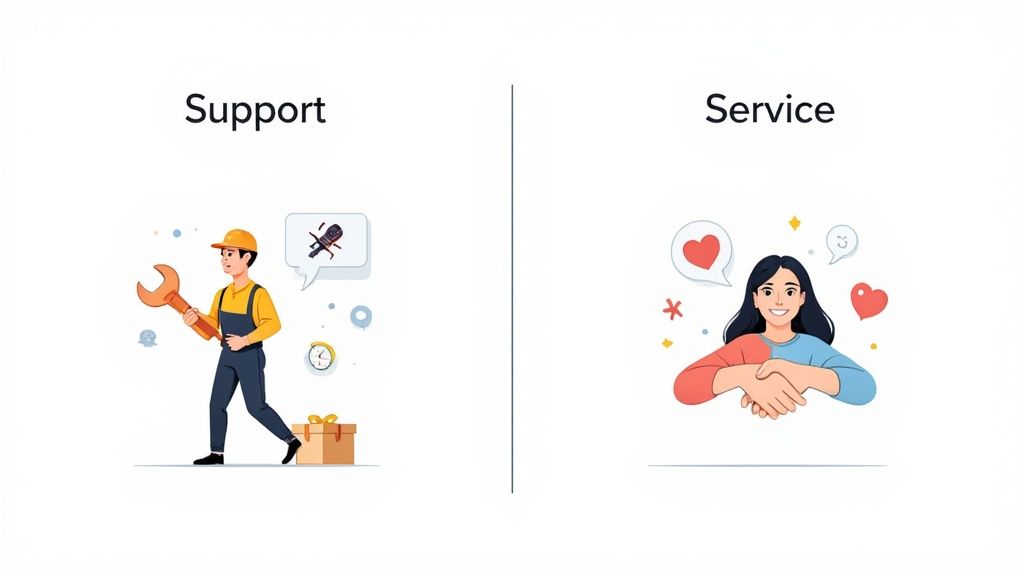
Even though people often use "customer support" and "customer service" as if they're the same thing, they’re really two different jobs with separate goals and skills. Getting this distinction right is key to building a customer experience strategy that actually works—one that handles immediate hiccups and builds lasting loyalty.
The main difference comes down to their scope and objectives. Customer support is a highly specialized, technical role focused on solving very specific problems a customer has with a product or service. Think error codes, setup issues, or feature malfunctions.
Customer service, however, covers a much wider territory. It’s about building relationships and improving the customer's overall satisfaction from start to finish. You can explore these strategic differences in more detail to see how they fit into a larger business plan.
Let’s break it down even further:
- Customer Support is transactional. The goal is to solve a specific, often technical, problem that a customer is facing right now. Once the issue is fixed, the support agent’s job is technically done.
- Customer Service is relational. It spans the entire customer lifecycle, from answering questions before a sale to following up after a purchase. The ultimate goal is to nurture satisfaction and earn their loyalty over time.
The difference between customer service and customer support is that a support team can fix a technical issue in the short term, but providing good customer service helps build relationships and establish a true partnership in the long term.
For a quick reference, this table lays out the fundamental differences between the two roles, making it easy to see how each one operates.
Support vs Service At a Glance
| Attribute | Customer Support | Customer Service |
|---|---|---|
| Focus | Reactive and Transactional | Proactive and Relational |
| Primary Goal | Resolve technical issues | Enhance overall experience |
| Scope | Product/Service functionality | Entire customer journey |
| Approach | "Break-fix" problem solving | Value-add and guidance |
| Key Skills | Technical knowledge, analytics | Empathy, communication, patience |
Seeing them side-by-side really clarifies where each function shines. Support is your tactical problem-solving squad, while service is your long-term relationship-building team.
How Each Function Measures Success
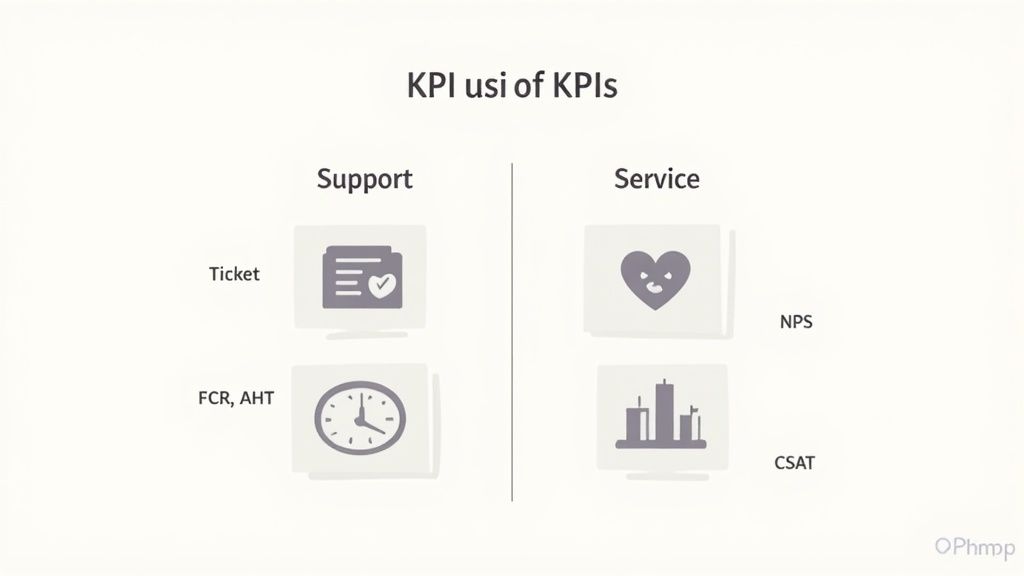
If you really want to understand the difference between customer support and customer service, just look at how they measure success. It’s a dead giveaway. Their goals are worlds apart—one is all about fixing things now, while the other is playing the long game of building relationships.
Because of this, their key performance indicators (KPIs) couldn't be more different.
For customer support, success is all about speed and efficiency. Their metrics ask one simple question: "How fast and how well did we solve that problem?"
Customer service, on the other hand, measures success through feelings and loyalty. Their metrics are trying to answer a much bigger question: "How does this person feel about our company?"
Customer Support KPIs: All About Efficiency
Support teams are driven by hard numbers that show how well they handle problems. These are tactical metrics, focusing purely on the mechanics of getting a customer's issue sorted out.
Here’s what they’re tracking:
- Average Handle Time (AHT): This is the stopwatch metric. It measures the entire interaction, from the first "hello" to the final "goodbye." A low AHT usually means the team is running like a well-oiled machine.
- First Contact Resolution (FCR): This is the big one. It's the percentage of problems solved in a single conversation—no follow-ups, no transfers, no headaches. A high FCR is the gold standard, showing your agents know their stuff and your processes are solid.
These numbers matter. A lot. Research shows that 95% of consumers say customer service is a huge part of their brand loyalty, and 45% of them fully expect to get their problem solved on the first try. Nailing that FCR doesn't just make people happy; it saves you money by cutting down on extra work. You can find more details on customer success metrics on intercom.com.
Customer Service Metrics: The Relationship Scorecard
Customer service KPIs zoom out to look at the bigger picture. They're trying to measure the health of the entire customer relationship over its full lifecycle. It's less about one ticket and more about the overall journey.
"Customer support gets the customer back on track. Customer service makes them want to stay for the journey."
These are the metrics that tell the story:
- Customer Satisfaction (CSAT): This is the immediate gut check. Usually, it's a quick survey after an interaction asking, "How did we do?" It gives you a snapshot of how that specific touchpoint went.
- Net Promoter Score (NPS): This metric gauges long-term loyalty by asking, "How likely are you to recommend us?" This simple question separates your happy customers from your potential brand ambassadors (and your unhappy detractors).
- Customer Lifetime Value (CLV): This is where service ties directly to the bottom line. CLV predicts how much revenue one customer will bring in over their entire time with your company. Great service directly pumps this number up.
So, while a support agent is high-fiving their team for closing a ticket in under five minutes (a great AHT), a service pro is celebrating turning a frustrated customer into a raving fan who just boosted the company’s NPS. That’s the difference in a nutshell. Each "win" is totally different, but both are essential for a healthy business.
Comparing Team Skills and Daily Workflows
The real difference between customer support and customer service snaps into focus when you look at what each team actually does all day. Their daily routines, the skills they rely on, and how they talk to customers are all shaped by two very different goals: one is all about fixing things, and the other is about building relationships.
A customer support agent’s day is built around a clear, step-by-step process. It’s a sprint to take a problem from a customer’s first report to a final solution, as quickly and cleanly as possible.
The typical support workflow looks something like this:
- Ticket Creation: A customer flags a specific, usually technical, problem.
- Investigation: The agent dives in, using their deep product knowledge to figure out what’s gone wrong.
- Resolution: They find a technical fix and walk the customer through it.
- Case Closed: Once the issue is resolved, the ticket is closed, and the job is done.
This kind of work demands a very particular set of hard skills. Support pros are analytical thinkers and methodical troubleshooters who know the product inside and out. Their success hinges on technical know-how.
The Service Professional’s Relational Approach
On the other hand, a customer service professional’s day is much more fluid. Their work is less about closing tickets and more about guiding the entire customer journey. This means being proactive, thinking ahead about what customers might need, and managing conversations across different channels to keep the experience positive.
Their work isn't a straight line; it's a continuous cycle of engagement. This requires a completely different toolbox of skills, with emotional intelligence and communication at its core.
A support agent’s value is in what they know about the product; a service agent’s value is in how they make the customer feel about the company.
Great customer service doesn’t happen by accident. It’s built on well-trained people, often developed through dedicated customer service training that sharpens crucial soft skills. The most important ones are:
- Empathy: The ability to truly understand and connect with how a customer is feeling.
- Active Listening: Hearing the question behind the question and picking up on the customer's tone.
- Patience: Staying cool, calm, and helpful, especially when a customer is upset.
So, while a support agent might spend their day digging through a knowledge base to squash a bug, a service agent is more likely crafting a personal follow-up email or checking in with a new customer to make sure they’re settling in well. One provides a solution; the other builds a connection. Both are absolutely essential, but their day-to-day worlds couldn’t be more different.
When to Prioritize Support or Service
Figuring out where to focus—customer support or customer service—isn't about picking one and forgetting the other. It’s a strategic decision about where to put your resources right now. The best choice really comes down to your product, your business model, and what you’re trying to achieve at this moment.
Think of it this way: a brand-new SaaS company just launching a complex beta product absolutely has to nail customer support. Early adopters are guaranteed to find bugs, get stuck on features, and need technical hand-holding. For them, fast and effective troubleshooting is a matter of survival. It’s how they’ll improve the product and keep those crucial first users happy.
On the flip side, a high-end e-commerce store selling luxury watches needs to go all-in on customer service. The product itself is simple to use, so technical problems are rare. The value here is in the experience—personalized advice, beautiful packaging, and proactive follow-ups. That’s what makes the high price tag feel worth it and turns buyers into lifelong fans.
Making the Right Strategic Call
To get this right, you have to look at your own situation. Are you trying to fix an immediate, tactical problem, or are you building a long-term, emotional connection? Your answer will tell you where to lean.
This infographic does a great job of breaking down the core differences between the two.
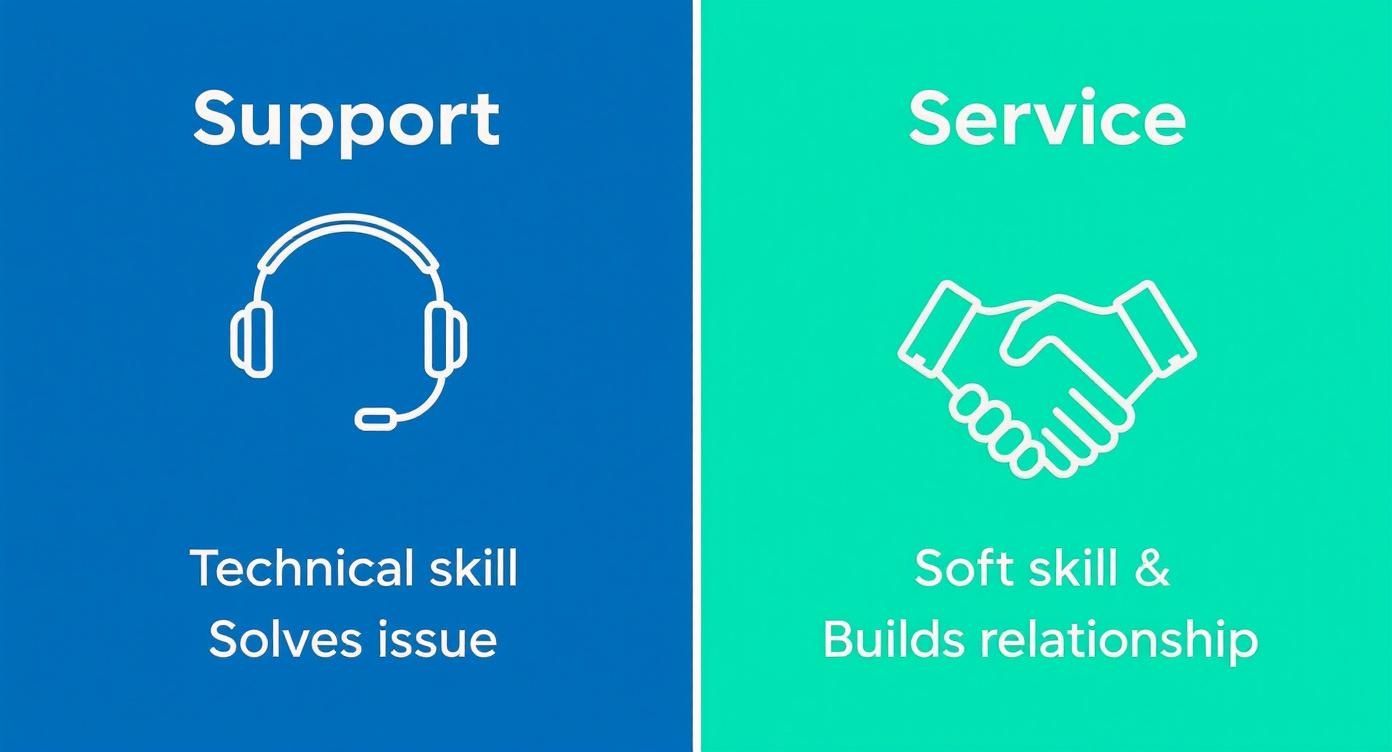
As you can see, support is all about the "how-to" of fixing things, while service is about the "why" behind building a relationship.
Your business model is the best guide. If your revenue depends on recurring subscriptions for a technical product, robust support is critical to reduce churn. If you rely on repeat purchases and brand reputation, exceptional service is your key to growth.
Ultimately, the smartest companies find a healthy balance. You might need to ramp up support during a major software update, then shift your energy back to service once everything is stable again. Being flexible is what creates a truly seamless customer experience.
Decision Matrix When to Focus on Support vs Service
To make this even clearer, this decision matrix breaks down common business scenarios and suggests where your primary focus should be. It’s a quick way to gut-check your strategy based on your current operational reality.
| Business Scenario | Primary Focus | Reasoning |
|---|---|---|
| New SaaS Product Launch | Support | Early users will encounter bugs and usability issues. Fast, technical solutions are essential for product refinement and user retention. |
| High-End Retail Brand | Service | The product is straightforward. The customer experience, relationship building, and brand perception are the key differentiators. |
| Company Experiencing a Major Outage | Support | The immediate priority is resolving the technical issue for all affected customers. Clear, quick, and accurate help is non-negotiable. |
| Hospitality Industry (e.g., Hotel, Restaurant) | Service | The entire business is built on the quality of the customer experience. Personal touches and proactive care create loyalty. |
| Mature Company with Stable Product | Balanced Approach | With a reliable product, you need efficient support for occasional issues and proactive service to nurture relationships and increase customer lifetime value. |
| Commodity Product in a Crowded Market | Service | When products are similar, the relationship and emotional connection you build with customers become your primary competitive advantage. |
This table isn't a rigid set of rules, but a guide to help you think critically. As your business grows and changes, you'll likely find yourself shifting your focus between these columns. The key is to know why you're making that shift.
Using AI to Enhance Both Functions
Artificial intelligence isn't here to replace your customer support and service teams. It’s here to make them better. The real goal is to automate the repetitive, predictable tasks so your team can dedicate their time and energy to the complex, high-touch interactions that build lasting customer loyalty.
For customer support, think of AI as a smart dispatcher. It can instantly sort incoming tickets and route them to the agent with the right expertise, which cuts down resolution times dramatically. AI can also act as a real-time assistant, pulling up relevant knowledge base articles for agents during a live chat or call.
Customer service gets a huge boost, too. AI algorithms can scan social media, emails, and reviews to gauge customer sentiment. This helps you spot at-risk customers before they leave or find perfect opportunities for proactive outreach, turning a good experience into a truly memorable one.
Augmenting Teams with Smart Automation
The biggest win with AI is its ability to augment your team, not replace it. By taking over routine questions and data crunching, AI frees up your people to use their emotional intelligence where it counts—solving unique problems and forging real relationships.
This shift is already happening. By 2025, an estimated 88% of contact centers will be using AI solutions. Yet, only 25% have fully integrated automation into their day-to-day workflows, revealing a big gap between having the tech and actually using it well. The companies that get it right see huge returns. For example, AI-powered coaching can slash call center costs by up to 19% and improve agent performance evaluation by 28%. You can dig into more of these customer service statistics on amplifai.com.
The true power of AI in the customer support vs. customer service discussion is its ability to handle the transactional, freeing up humans to be more relational. It makes support faster and service smarter.
If you’re ready to dive deeper into practical applications, this complete guide to customer service automation is a great resource for streamlining customer interactions.
Practical AI Integration Examples
You don't need a massive overhaul to start integrating AI. Even simple tools can make a big impact on both your support and service operations.
- For Support: An AI customer support chatbot can handle common questions like "Where is my order?" or "How do I reset my password?" This deflects a ton of simple tickets, letting your human agents focus on more technical troubleshooting.
- For Service: AI-powered analytics can build rich customer profiles. This helps your service reps offer personalized recommendations or promotions that feel genuinely helpful, not just like another sales pitch.
Using technology this way ensures that the reactive needs of support and the proactive goals of service are both met more effectively. The end result is a much smoother and more satisfying journey for your customers.
Creating a Unified Customer Experience
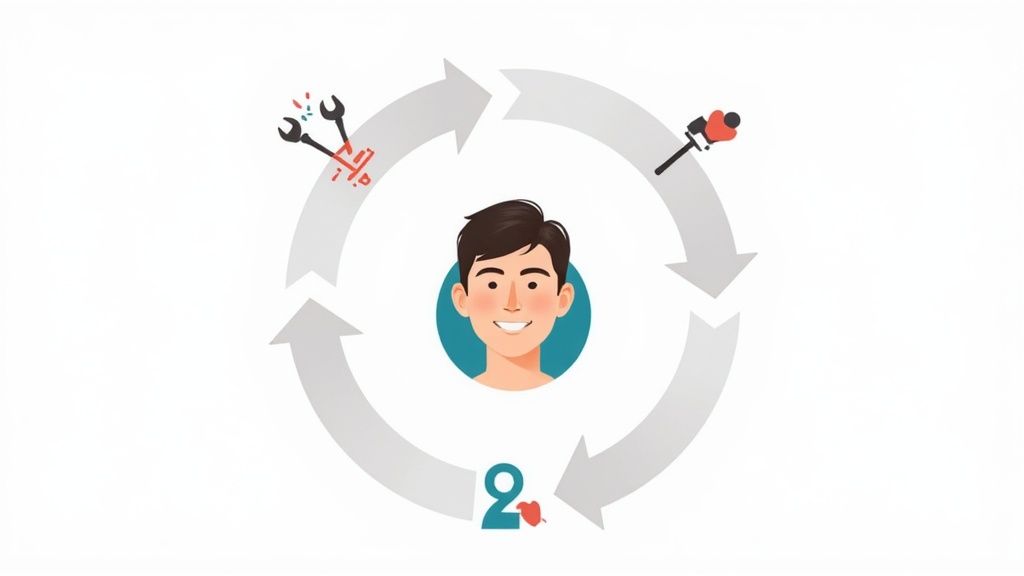
All this talk about customer support vs customer service often misses the main point. The best companies know these two functions aren't competing against each other. They're two sides of the same coin, essential parts of a single, fluid customer journey. It's not about picking one over the other; real success comes from weaving them together.
When you take this unified approach, you stop thinking about isolated transactions and start looking at the entire customer lifecycle. Everyone wins when support and service teams are in sync. Imagine a support agent fixes a technical bug and then passes that info to the service team. That team can then proactively check in with the customer, transforming a moment of frustration into a genuine, loyalty-building moment. This kind of cohesive process is the heart of effective customer experience management.
Forging a Collaborative Strategy
To truly unify these teams, you need a shared vision and the right structure in place. It all starts with tearing down the walls that keep them separate and pointing them all toward the same North Star: creating long-term customer value.
Here are a few practical steps to build this integrated system:
- Establish Shared KPIs: Stop looking at separate metrics like Average Handle Time (AHT) for support and Net Promoter Score (NPS) for service. Instead, rally both teams around shared goals like Customer Lifetime Value (CLV) and overall retention rates—metrics they both directly impact.
- Implement Integrated Tools: Give your teams a single source of truth, like a CRM that has helpdesk capabilities built-in. This gives everyone a 360-degree view of every customer's history, making every conversation consistent and context-aware.
- Foster a Collaborative Culture: Get people talking. Set up regular joint meetings and shared Slack channels. When a support agent gets what the service team is trying to achieve (and vice versa), they can work together to head off problems before they even start.
The key takeaway is simple: effective support solves an immediate problem, while excellent service ensures the customer feels valued and understood throughout the process.
Ultimately, this integration is about shifting your company's mindset from just fixing problems to actively building lasting relationships. When you combine the technical skill of support with the human connection of service, you build a powerful engine for customer loyalty and real, sustainable growth.
Frequently Asked Questions
Even when you nail down the theory of customer support vs. customer service, putting it into practice brings up a whole new set of questions. How should you structure your teams? What are the right tools for the job? Let's tackle some of the most common questions that pop up.
Think of this as a quick-start guide to help you move from understanding the concepts to actually applying them in your day-to-day operations.
Can a Single Person Handle Both Support and Service?
Absolutely, especially in a small business or a startup that's just getting off the ground. It’s pretty common for a founder or an early employee to troubleshoot a technical bug one minute and then send a proactive check-in to a new customer the next. When your customer volume is low, this jack-of-all-trades approach works just fine.
But as you grow, you'll hit a wall. The skills needed for support (deep technical problem-solving) and service (empathy and relationship-building) are genuinely different. Asking one person to master both is a recipe for burnout and can cause the quality of both to suffer. Specializing allows your team members to develop real expertise.
The real question isn't if one person can do both jobs, but for how long they can do them well. To scale effectively and keep your standards high, you eventually need to create specialized roles for both support and service.
What Tools Are Best for Each Team?
While there’s some overlap, you'll get much better results by picking tools built for the specific job at hand.
- For Customer Support: You need a solid help desk or ticketing system. These platforms are engineered to organize, track, and resolve customer issues with maximum efficiency. Look for features like ticket routing, an internal knowledge base for your agents, and metrics like First Contact Resolution (FCR) and Average Handle Time (AHT).
- For Customer Service: A Customer Relationship Management (CRM) platform is non-negotiable. A good CRM gives you a complete picture of the entire customer journey, logging every interaction, purchase, and email. This context is everything when it comes to building lasting relationships and delivering a personalized experience.
How Do You Decide the Right Level of Automation?
Finding the right balance depends entirely on your business goals and what your customers expect. A great place to start is by automating the simple, high-volume questions that eat up your team's time.
For example, an AI chatbot can instantly handle things like password resets or checking on an order status. This frees up your human support agents to dig into the tricky technical problems that actually require their expertise.
On the service side, automation can help you send personalized welcome emails or trigger satisfaction surveys after a conversation. The goal isn’t to replace the human touch; it's to make it more powerful by ensuring consistent, timely communication at all the right moments.
Ready to automate the routine questions and empower your team to focus on what matters most? Yoonoo lets you build a smart AI chatbot in just five minutes, no coding required. Start for free and see how Yoonoo can elevate your customer communication.