Boost Customer Service Quality Assurance Today

Customer service quality assurance (QA) is like scheduling a routine check-up for your support team. It’s a structured way to review customer conversations and make sure every interaction reflects your company’s standards. Think of it as monitoring, assessing, and improving your agents’ performance across calls, chats, and emails.
What Is Customer Service Quality Assurance Really
Imagine a Michelin-star kitchen. The head chef tastes and inspects each dish before it leaves the line. In customer service QA, you apply the same level of scrutiny to support interactions, so every customer gets a great experience.
This approach flips the script on reactive support. Rather than waiting for complaints to stack up, QA helps you catch hiccups early, coach more effectively, and tweak processes before small issues become big problems.
The Core Pillars Of A QA Program
An effective QA program stands on four key pillars:
- Interaction Monitoring: Listening to calls and reviewing chats or emails to see real service in action.
- Evaluation Criteria: Grading each interaction with a clear rubric around accuracy, empathy, and resolution speed.
- Feedback And Coaching: Giving agents data-backed insights and practical tips to sharpen their skills.
- Continuous Improvement: Spotting trends in QA data and refining training, workflows, or policies accordingly.

The dashboard above highlights First Contact Resolution (FCR) and Customer Satisfaction (CSAT) scores. You’ll often see a clear link: as FCR climbs, CSAT follows suit. That tells you exactly where to focus your coaching efforts.
Summary Of QA Pillars
Here’s a quick overview of the QA pillars you’ll encounter in any solid program:
| Pillar | Purpose | Key Benefit |
|---|---|---|
| Interaction Monitoring | Observe real agent-customer conversations. | Gain unfiltered insight into service delivery. |
| Evaluation Criteria | Score interactions against a consistent rubric. | Ensure objective, data-driven performance reviews. |
| Feedback And Coaching | Provide agents with targeted, example-based guidance. | Drive skill development and boost motivation. |
| Continuous Improvement | Analyze QA trends and adjust processes. | Enhance efficiency and lift overall CX quality. |
By keeping these pillars in harmony, you transform QA from a compliance exercise into a powerful driver of better customer experiences and stronger team performance.
Getting to Grips with the Basics
Imagine a car being built on an assembly line. At every single station, someone checks the work. Does the door fit perfectly? Are the electronics wired correctly? This isn't about blaming the worker at the previous station; it's about making sure the final car is perfect before it ever leaves the factory.
That's exactly what a good customer service quality assurance program does. It doesn't wait for angry customer emails to roll in. Instead, it systematically checks interactions—calls, emails, chats—to ensure your team is consistently hitting the mark on accuracy, helpfulness, and tone. This isn't about playing "gotcha" with your support agents. It's about building a reliable, high-quality experience that customers can count on every single time.
QA vs. Quality Control: What’s the Difference?
People often use the terms quality assurance (QA) and quality control (QC) as if they mean the same thing, but they play very different roles. Getting this right is crucial for building a program that actually works.
Quality assurance is all about being proactive. It's the process side of things. Think of it as writing the perfect recipe for a cake and training your bakers on every single step. QA involves setting the standards, creating the playbooks, and training your agents to prevent problems from ever happening.
Quality control, on the other hand, is reactive. It looks at the finished product—the output. QC is like taste-testing the cake after it comes out of the oven to see if it meets your standards. It involves reviewing past interactions to spot mistakes after they’ve already happened.
A truly effective customer service quality assurance strategy needs both. QA creates the blueprint for success, and QC gives you the real-world data to see if that blueprint is working, creating a cycle of constant improvement.
The Magic of a Feedback Loop
This brings us to one of the most powerful ideas in QA: the feedback loop. When a quality check flags an issue—maybe an agent fumbled a key troubleshooting step—that insight doesn’t just get filed away in a spreadsheet. It gets fed right back into the system.
This feedback could trigger a few different things:
- One-on-One Coaching: A team lead sits down with the agent to work on that specific skill.
- Refreshed Training: If lots of agents are making the same mistake, maybe the training materials need an update.
- Smarter Processes: Perhaps the troubleshooting script itself is confusing and needs to be rewritten.
This loop turns individual mistakes into valuable learning opportunities for the entire team. Instead of just pointing out what went wrong, you improve the whole system, making it easier for every agent to deliver great service. That’s how you get real, lasting improvements.
It’s All About a Proactive Mindset
At its heart, quality assurance is about making a fundamental shift. You move away from constantly putting out fires and toward a more strategic, proactive approach to service. You get your whole team on the same page about what a "great" interaction looks like before they ever pick up the phone or type a reply.
By setting clear expectations and checking performance against them, you build a culture where excellence is the standard. This shared understanding is the foundation for everything else. Before you start worrying about metrics, scorecards, or software, make sure everyone is bought into this way of thinking. It’s what ensures you’re all pulling in the same direction to build the kind of customer trust that lasts.
Measuring Success With Key Metrics
You can't improve what you don't measure. It's an old saying, but it’s the absolute truth in customer service. Without the right metrics, "better service" is just a vague idea. Quality assurance metrics are your compass—they turn those fuzzy goals into concrete, trackable targets that show you exactly where you're headed.
Think of it this way: flying blind is a terrible strategy. With clear metrics, you can spot where your team is excelling and pinpoint opportunities for coaching. It’s how you prove the value of your QA program and make every improvement effort count.
Core Metrics For Every QA Program
While you could track dozens of data points, it’s easy to get lost in the noise. The most successful QA programs I've seen focus on a handful of core metrics that truly move the needle. This keeps everyone focused on what actually matters to the customer and the business.
Here are the essentials you should start with:
- First Contact Resolution (FCR): What percentage of customer problems get solved on the very first try? A high FCR is a huge win. It means your team is efficient, and your customers aren't getting frustrated by having to call back again and again.
- Customer Satisfaction (CSAT): This is the classic "How did we do?" survey. CSAT gives you direct, in-the-moment feedback on a specific interaction from the customer's point of view. It's your most direct line to their perception of quality.
- Average Handling Time (AHT): How long does an average interaction take from start to finish? While a lower AHT can point to efficiency, you have to watch it carefully. If it drops while FCR and CSAT also fall, your agents are likely rushing and sacrificing quality for speed.
- Internal Quality Score (IQS): This is your grade for an interaction, based on your own QA scorecard. It measures things like accuracy, tone, and whether the agent followed the right processes. You can see how IQS fits into the bigger picture by exploring other key customer service performance indicators.
Setting Benchmarks And Tracking Trends
Just having the numbers isn't enough—you need context. That's where benchmarks come in. By comparing your performance against industry standards or even your own past performance, you can set realistic goals and see if you're actually getting better over time.
A sudden dip in your CSAT scores might flag an issue with a new product, while a steady climb in FCR after a training session proves your coaching is working. This is more than just number-crunching; it’s about reading the story your data is telling you.
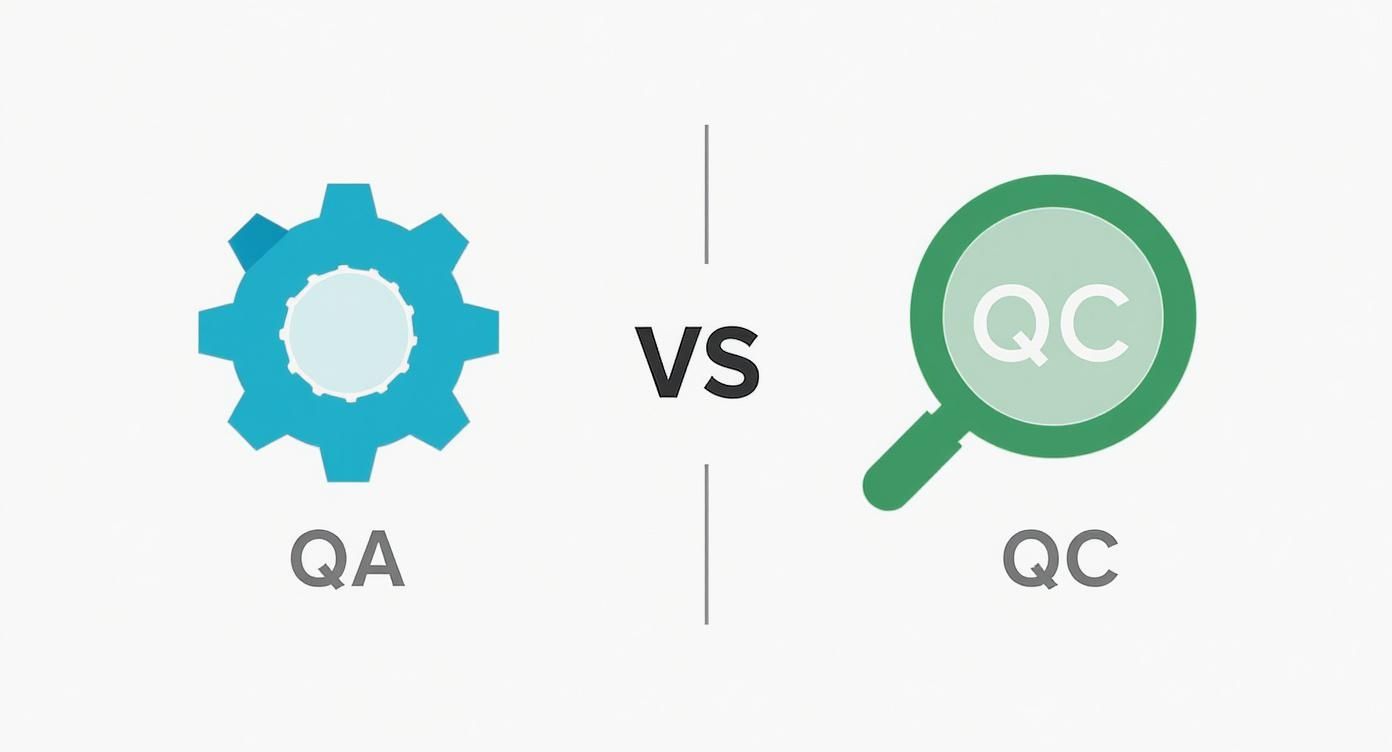
The infographic above highlights a crucial point: QA is about improving the process, not just inspecting the final product. Your metrics should reflect this, helping you measure the health of your entire service operation.
For more on turning data into actionable insights, this practical guide to measure customer experience is a fantastic resource.
Comparison Of QA Metrics
To help you get started, here are some of the most common metrics and what good looks like across different industries.
| Metric | Industry Benchmark |
|---|---|
| First Contact Resolution (FCR) | 70-75% is a common target, though top performers can exceed 85%. |
| Customer Satisfaction (CSAT) | Varies by industry, but a score of 80% or higher is generally considered good. |
| Average Handling Time (AHT) | Highly variable, from 3 minutes for simple queries to 15+ for tech support. |
| Internal Quality Score (IQS) | Most organizations aim for an average score of 90-95% across all agents. |
Keep in mind that these are just starting points. The best benchmarks are the ones you set for your own team based on your unique goals and customer base.
Connecting Metrics To Business Goals
Here’s the secret to getting real buy-in from leadership: connect your QA metrics to the company's bottom line. Don't just report on CSAT scores; show how a 5% increase in CSAT correlates with a 10% drop in customer churn.
When you can clearly demonstrate that your QA program isn't just a cost center but a powerful engine for revenue and retention, you’ll get all the resources you need to build a truly world-class customer service team.
Building A Customer Service QA Program
So, you're ready to build a quality assurance program from the ground up. The good news is, you don't need a complicated blueprint. A great QA program starts with clear goals and a straightforward plan that reflects what your brand is all about.
Start with Your Brand Values
Before you write a single rule, think about your company’s core principles. What makes you you? Your evaluation criteria should flow directly from those values.
For example, if your brand is built on empathy, you’ll want to reward agents for their warm, polite tone, even if it takes a little longer to solve a problem. Speed might be less important than making a genuine connection.
Your scoring rubric is where this comes to life. Make sure it:
- Defines clear categories like tone, accuracy, and problem resolution.
- Assigns points to each category based on what you value most.
- Includes real-world examples of what a great interaction looks like (and what a not-so-great one looks like, too).
This rubric isn't just a checklist; it's your North Star for fair and consistent feedback. For instance, a retailer promising speedy service might make resolution time worth 40% of the total score. Your rubric should be a practical tool that reflects your brand promise in every interaction.
Get the Right People in the Room
Your next step is to assemble your team of evaluators. You don't need an army—a small, dedicated group of 5 to 10 people who really get your customers is perfect. Think about pulling from team leads, experienced agents, or even peer reviewers.
Once you have your team, training is everything. Focus on:
- Calibration sessions: Have everyone score the same interaction and discuss their reasoning. This is crucial for getting everyone on the same page.
- Practice runs: Use role-playing with sample calls and chats to build confidence.
- Feedback coaching: Teach evaluators how to give feedback that helps agents grow, rather than making them feel criticized.
“Consistent calibration sessions can reduce scoring differences by up to 30%. That’s a huge boost in making sure everyone trusts the QA results.”
Keep the team sharp with weekly check-ins to review tough cases together. This builds a shared sense of what "good" truly means.
Make Monitoring and Feedback a Habit
A QA program only works if it's a living, breathing part of your weekly routine. You need a regular schedule for monitoring interactions and sharing what you've learned. Most teams find that weekly or biweekly review meetings work best.
Here’s a simple flow that works well:
| Step | Purpose |
|---|---|
| Select Interactions | Choose a mix of calls, chats, or emails from different areas of the business. |
| Score With Rubric | Use your rubric to evaluate each interaction objectively. |
| Review Scores | Get your evaluators together to compare notes and ensure consistency. |
| Provide Feedback | Sit down with agents to share specific, actionable tips and examples. |
Imagine you're a retail brand. You could aim to review 20 calls each week. From there, you can group agents for coaching sessions tailored to their performance. This creates a powerful feedback loop where scores turn into real, measurable improvement.
Turn Resistance into a Growth Opportunity
Let’s be honest: when you first introduce a QA program, some agents might feel like they’re being watched. It's your job to frame it as a tool for development, not a way to catch people making mistakes.
Here’s how to get everyone on board:
- Talk openly about how QA can help them build skills and advance their careers.
- Share success stories of agents who used QA feedback to get promoted.
- Show leadership the bottom-line impact. A 15% jump in CSAT after just three months of QA is a powerful argument.
Celebrate the wins! When an agent boosts their personal CSAT score by 10% after a few coaching sessions, make sure everyone knows about it. This kind of positive reinforcement helps shift the entire team’s mindset from seeing QA as a chore to seeing it as an opportunity.
As you grow, expand your QA efforts. You might start with phone calls, but don't forget to add chat, email, and even social media to the mix.
Stay Transparent and Keep Improving
Your QA program should never feel like a secret. Create a team dashboard where everyone can see trends and collective progress. This builds trust and gets everyone pulling in the same direction.
Try these simple habits:
- Send out a monthly summary of QA scores to the whole team.
- Post the top three improvement goals for the month somewhere visible.
- Give shout-outs to agents who are consistently hitting their quality targets.
Finally, remember that your QA program isn't set in stone. Revisit your rubric and evaluation criteria every quarter. Did you launch a new product? Did a company policy change? Your QA program needs to evolve with your business to stay relevant and effective.
Use AI Chatbots To Enhance QA

Let's be honest: manually reviewing every customer interaction is impossible. As your support requests pile up, your human QA team can only ever scratch the surface. They might review a small fraction of conversations, which means you're missing out on a huge amount of valuable feedback.
This is where AI chatbots and automation are completely changing the game for quality assurance.
Think of an AI tool as more than just a chatbot—it’s your team’s tireless QA assistant, working around the clock. It can analyze 100% of your customer conversations, not just a random 2-5% sample. This gives you a complete, unbiased picture of your service quality, turning your QA program from a spot-checking exercise into a strategic, data-backed operation.
Automating The Evaluation Process
The first big win with AI is automating the most tedious parts of QA. Instead of an analyst spending hours listening to call recordings, an AI can score interactions against your custom criteria in an instant.
It all starts with teaching the AI what "good" looks like for your team. You train it to spot specific behaviors, keywords, and outcomes that match your brand’s voice and service goals.
Here’s what that looks like in practice:
- Flagging Deviations: The AI can instantly catch when an agent forgets a required step, like a compliance disclosure, and flag the interaction.
- Sentiment Analysis: It tracks the emotional tone of a conversation, pinpointing moments of customer frustration or delight that a human might easily miss.
- Trend Identification: AI can analyze thousands of interactions to spot recurring problems, like a bug multiple customers are reporting, far faster than any person could.
This automated approach means every single interaction gets checked against your quality rubric. It brings a level of consistency to your QA that's almost impossible to get with manual reviews alone.
Real-Time Coaching And Agent Support
This is where things get really interesting. One of the most powerful ways to use AI in QA is to give agents real-time support while they're in the middle of a customer conversation. It’s a huge shift from after-the-fact feedback to in-the-moment guidance.
Imagine an AI listening to a call and detecting that a customer's tone is becoming frustrated. It can immediately send a private tip to the agent's screen: "Customer sounds upset. Try offering a discount or escalating to a supervisor."
By providing immediate, contextual coaching, AI helps agents correct their course during a live interaction, improving the outcome for both the customer and the agent. This proactive support builds agent confidence and reduces the need for lengthy post-call review sessions.
This is more important than ever. With 87% of support teams saying customer expectations have climbed over the past year, you need every tool you can get to keep your quality high. And yet, many companies have been slow to adopt these technologies, leaving a huge opportunity on the table.
Balancing Automation With A Human Touch
While AI is brilliant at sifting through mountains of data, it can’t replace the nuanced understanding of a human expert. The best QA programs use a hybrid approach: let the AI do the heavy lifting, and let your people provide the strategic oversight.
AI can score 100% of your interactions and then bubble up the most critical ones—like those with very low sentiment scores or major compliance issues—for human review. This frees up your QA analysts to focus their time where it matters most: deep-dive analysis and personalized coaching.
This balanced approach is the key to success. For any business ready to get started, the first step is understanding how to build and deploy these tools. You can explore the fundamentals by checking out our guide on the benefits of an https://yoonoo.ai/blog/ai-customer-support-chatbot.
To really round out your tech stack, it’s also worth looking into some of the best AI-powered help center software solutions available.
Overcoming Implementation Challenges
Of course, bringing AI into your QA workflow has its hurdles. The most common ones are training the AI model correctly and, just as importantly, getting your agents on board.
To set yourself up for success, start by clearly defining your quality standards. Then, use a large set of your own customer interactions to train the AI. It's also critical to be transparent with your team. Frame the AI as a supportive co-pilot designed to help them succeed, not as a big-brother tool watching their every move.
When you position AI as an assistant, you create a culture where people and technology work together to deliver truly exceptional service.
Keeping the Quality Engine Running: Best Practices for QA
Getting a customer service quality assurance program off the ground is a great start. But the real work? That's about keeping it going strong for the long haul. Think of it less like a project with a finish line and more like tending a garden—it needs constant attention, care, and the right conditions to flourish.
To truly embed excellence, you have to build habits and systems that make quality a daily reflex, not a monthly report. It’s about creating a culture where getting better is just part of the job, ensuring your service doesn't just meet expectations but consistently wows your customers.
Foster a Culture of Continuous Learning
The bedrock of any great QA program is a team that’s always learning. This doesn't just happen on its own. It's about creating a space where feedback is seen as a tool for growth, not criticism, and where agents support each other.
A fantastic way to bring this to life is with peer reviews. Let agents listen in on each other’s calls and offer up helpful tips. This creates a powerful sense of shared ownership over quality. Plus, agents often spot practical, in-the-trenches details that a manager might overlook. When the whole team is invested in helping each other improve, everyone wins.
A culture of continuous learning shifts quality assurance from a top-down chore to a shared mission. When teams are genuinely invested in each other's success, performance just naturally improves. In fact, some companies see their internal quality scores jump by as much as 15%.
This collaborative approach keeps your team sharp and engaged. It proves you trust their expertise and believe they are the ones who truly know what excellent service looks like.
Put Performance on Display with Dashboards
You can't improve what you can't see. Transparency is a huge motivator, and when agents have a real-time view of their performance, they're much more likely to take control of their own development. This is where public performance dashboards come in.
Try displaying key metrics like Customer Satisfaction (CSAT), First Contact Resolution (FCR), and Internal Quality Scores (IQS) on a screen for the whole team to see. The point isn't to call anyone out. It's about celebrating wins, spotting trends as a group, and fostering a little friendly competition. Imagine the buzz when the team sees its average CSAT score tick up a few points week after week.
Making performance data visible builds a sense of accountability and trust. It turns QA from a private, behind-the-scenes evaluation into a shared goal everyone is working toward.
Run Regular Audits on Your QA Program
Your agents need consistent feedback, and so does your QA program. To make sure it’s still doing its job effectively, you need to give it a thorough check-up at least once or twice a year.
When you audit your program, ask yourself some tough questions:
- Is our scorecard still relevant? Does it actually measure what matters to our customers and our business today?
- Are our graders on the same page? When was the last time we held a calibration session to make sure everyone is scoring consistently?
- Is the feedback actually working? Are we seeing real improvement in the skills we're coaching?
Audits like these keep your program from getting stale. They ensure your customer service quality assurance efforts grow and change right along with your business, whether you're launching new products, opening new support channels, or serving a different type of customer.
Weave in Direct Customer Feedback
Your internal QA scores tell you how well you’re sticking to your own standards. But what do your customers actually think? The best QA programs bridge the gap between these two perspectives. Don't just rely on your internal scores; pull customer survey results and direct comments right into your coaching sessions.
It's one thing to tell an agent their "empathy" score was low. It's a whole lot more powerful to show them that score alongside a customer comment saying, "The agent seemed rushed and didn't really listen to me." That kind of direct feedback is impossible to ignore and provides crucial context. It creates a crystal-clear link between your internal standards and how customers feel, driving home the importance of every single conversation.
Still Have Questions? Let's Clear Things Up
Even the best-laid plans for a customer service quality assurance program can bring up a few questions. Let's tackle some of the most common ones that teams face when they're just getting started or looking to improve their QA process.
We're Starting From Zero. Where Do We Even Begin With QA?
Staring at a blank slate can feel overwhelming, but the key is to start small and build from there. Don't try to boil the ocean. Instead, focus on defining what a truly great customer interaction means for your brand.
- Figure Out Your "Why": First, decide what you're trying to accomplish. Are you aiming for a higher CSAT score, solving more problems on the first try, or just making sure every agent provides a consistent experience?
- Sketch Out a Simple Scorecard: You don't need a 50-point checklist. Start with a basic evaluation form built around 3-4 core ideas, like accuracy of information, genuine empathy, and effective problem-solving.
- Start Reviewing, But Not Everything: Begin by manually checking just 5-10 conversations for each agent every month. This is manageable and gives you enough material to spot coaching opportunities.
This slow-and-steady approach helps you build momentum and show the value of QA without burning out your team.
What's the Real Difference Between Manual and Automated QA?
It really boils down to two things: scale and efficiency. Think of it like this: manual QA is like having a human analyst personally read a handful of letters to understand the writer's tone and intent. It provides deep, nuanced feedback, but it’s slow and can only ever cover a tiny fraction of the mail.
Automated QA, on the other hand, uses AI to scan 100% of the letters, instantly flagging keywords, checking for politeness, and spotting trends.
Automated systems are fantastic for getting a bird's-eye view, catching big issues, and ensuring everyone follows the rules. Manual reviews are where the magic of deep, personalized coaching happens. The smartest teams use a mix of both.
How Do I Make AI Chatbots and Human Reviewers Work Together?
The best way to think about it is as a partnership. Let AI be your tireless front-line worker. Use AI chatbots and automation to do the heavy lifting—scoring every single interaction, tracking customer sentiment, and spotting patterns you’d never see otherwise.
This frees up your human experts to do what they do best. They can now focus their time on the things that require a human touch and sharp judgment:
- Diving into the complex or emotionally-charged conversations that the AI flags.
- Holding meaningful coaching sessions using the insights the AI has already gathered.
- Fine-tuning the AI’s scoring rules to make sure they perfectly match your brand’s voice and values.
This tag-team approach gives you the best of both worlds: complete coverage from the AI and the insightful, human-centered coaching needed to really drive improvement.
Ready to supercharge your customer communication? Yoonoo helps you build and deploy a smart AI chatbot in just five minutes, no coding required. Start your free trial today and see how easy it is to provide instant, intelligent support.