Top Customer Satisfaction Measurement Methods
Understanding your customers is the ultimate business advantage. Simply hoping they are happy isn't a sustainable strategy; you need concrete, data-driven insights to guide your decisions. But with so many options available, how do you choose the right approach to gauge sentiment effectively? This guide is designed to cut through the noise, providing a practical playbook on the most effective customer satisfaction measurement methods.
We will break down each technique, moving beyond abstract theories to offer actionable steps. You'll learn the core mechanics, see real-world applications, and get implementation tips to help you transform customer feedback into your most powerful growth engine. From the quick pulse checks of NPS and CSAT to the deep qualitative insights from customer interviews, you'll discover how to build a comprehensive system for listening, understanding, and delighting your customers at every touchpoint. For a more comprehensive look at these and other methods, consider reviewing these seven essential methods for measuring customer satisfaction to get a broader perspective.
This article provides a clear, structured overview to help you select and implement the right tools to measure what truly matters to your audience. Let's dive into the methods that will help you stop guessing and start knowing.
1. Net Promoter Score (NPS)
Net Promoter Score, or NPS, is a widely used metric that measures customer loyalty by asking one simple yet powerful question: "On a scale of 0 to 10, how likely are you to recommend our company/product/service to a friend or colleague?" This question gauges overall sentiment rather than satisfaction with a single transaction, making it a strong indicator of long-term brand health and growth potential. It's one of the most direct customer satisfaction measurement methods for understanding advocacy.
Based on their response, customers are segmented into three categories:
- Promoters (9-10): Your most enthusiastic and loyal customers. They are brand advocates who fuel growth through word-of-mouth referrals.
- Passives (7-8): Satisfied but unenthusiastic customers who are vulnerable to competitive offerings. They don't actively promote or detract from your brand.
- Detractors (0-6): Unhappy customers who can damage your brand and impede growth through negative word-of-mouth.
The final NPS is calculated by subtracting the percentage of Detractors from the percentage of Promoters, resulting in a score ranging from -100 to +100.
When to Use NPS
NPS is ideal for measuring overall customer loyalty and predicting business growth. Use it after key moments in the customer journey, like post-purchase, after a support interaction, or on a quarterly basis to track long-term trends. Companies like Apple and Amazon leverage NPS to maintain their market leadership by consistently monitoring and acting on customer feedback.
The infographic below provides a quick reference for the NPS framework, including the scoring segments, formula, and industry benchmarks.
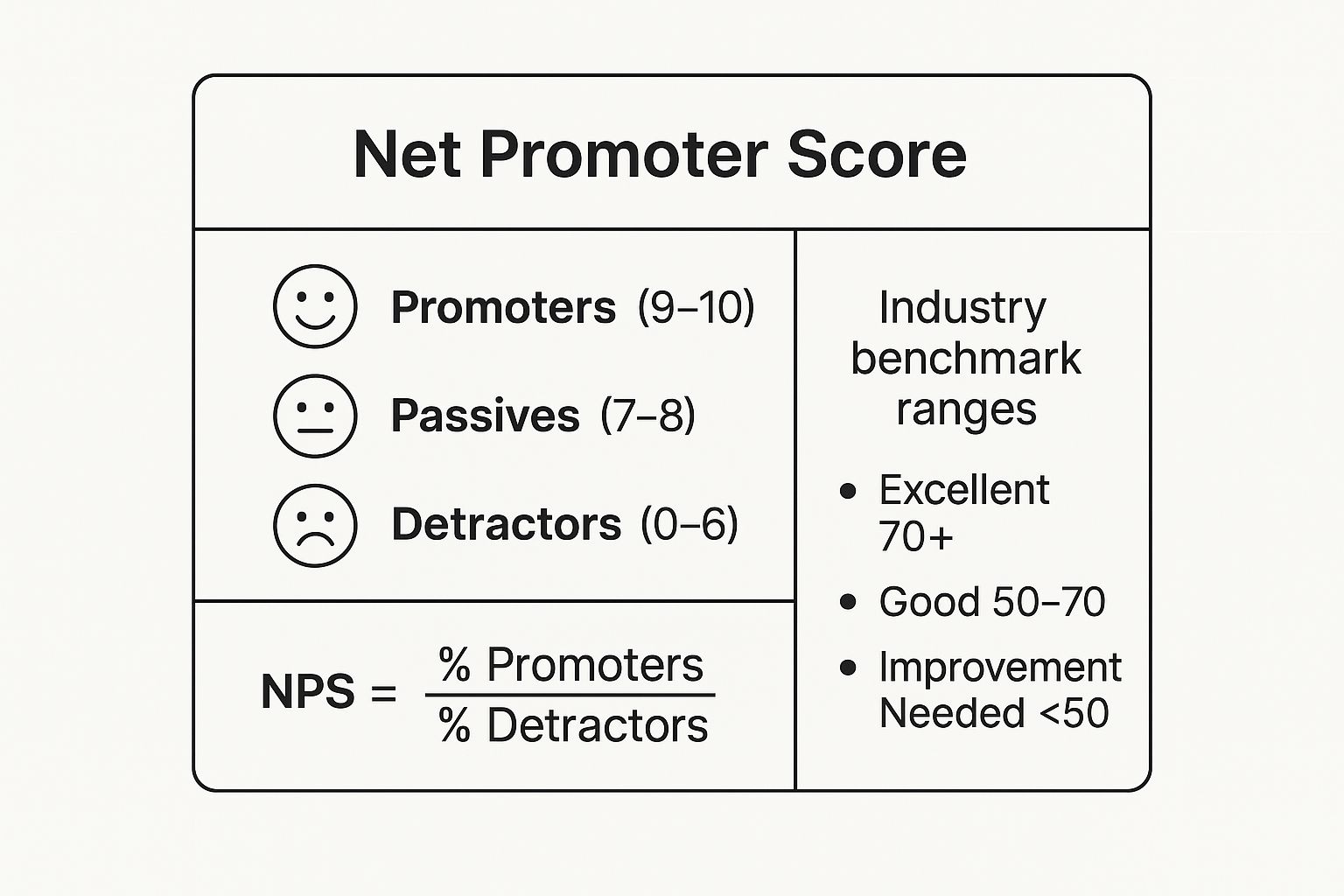
This visual guide helps you quickly classify respondents and understand where your score stands against general performance standards.
How to Implement It Effectively
Getting meaningful data from NPS requires more than just asking the core question.
- Ask a Follow-Up Question: Always include an open-ended follow-up question like, "What is the primary reason for your score?" This qualitative feedback is crucial for understanding the why behind the numbers.
- Close the Loop: Create a process to respond to feedback. Thank Promoters for their support and address Detractors' concerns directly to resolve their issues. This shows customers you value their input and can turn a negative experience around.
- Segment Your Data: Analyze NPS scores by customer demographics, purchase history, or specific touchpoints. This helps identify patterns and pinpoint areas for improvement within different segments of your audience.
2. Customer Satisfaction Score (CSAT)
Customer Satisfaction Score, or CSAT, is a straightforward metric that measures a customer's happiness with a specific product, service, or interaction. It directly asks customers to rate their satisfaction, typically with a question like, "How satisfied were you with your experience today?" This makes CSAT one of the most immediate and transactional customer satisfaction measurement methods available.

The responses are usually collected on a scale, most commonly 1 to 5. The final CSAT score is then calculated as the percentage of satisfied customers (those who responded with a 4 or 5) out of the total number of responses. The formula is:
(Number of Satisfied Customers / Total Number of Responses) x 100 = % CSAT Score
For example, if 80 out of 100 respondents give a rating of 4 or 5, your CSAT score is 80%. This simplicity makes it an easy-to-understand KPI for teams across the organization.
When to Use CSAT
CSAT is most effective for gathering in-the-moment feedback on specific touchpoints in the customer journey. Use it immediately after a customer support call, following a purchase, or after a feature is used in a software app. Companies like Uber use it after every ride to gauge immediate satisfaction, while Microsoft often deploys a CSAT survey after resolving a support ticket to measure the effectiveness of the interaction.
How to Implement It Effectively
To get the most value from your CSAT surveys, you need a strategic approach to deployment and analysis.
- Ask Immediately: Timing is critical. Deploy the CSAT survey right after the interaction occurs, while the experience is still fresh in the customer's mind.
- Keep It Short: The best CSAT surveys are brief, often just two or three questions. Stick to the core satisfaction question and add one open-ended follow-up like, "What could we have done to improve your experience?"
- Automate Triggers: Set up automated workflows to send surveys after key events. More importantly, create alerts for your team when a low score is received so they can follow up immediately to address the customer's issue.
- Maintain Consistent Scales: If you use CSAT across multiple touchpoints, ensure the rating scale (e.g., 1-5) is consistent. This allows you to accurately compare performance between different departments or stages of the customer journey.
3. Customer Effort Score (CES)
Customer Effort Score (CES) is a transactional metric that measures how easy it was for a customer to get an issue resolved, a request fulfilled, or a question answered. The core idea, popularized by research from Gartner, is that reducing customer effort is a more reliable predictor of loyalty than simply delighting customers. This is one of the most effective customer satisfaction measurement methods for pinpointing and eliminating friction.
The survey typically asks a direct question like, "To what extent do you agree or disagree with the following statement: The company made it easy for me to handle my issue?" Customers respond on a 7-point scale ranging from "Strongly Disagree" to "Strongly Agree." A higher score indicates a lower-effort, more positive experience.

When to Use CES
CES is most powerful when deployed immediately after a specific interaction or transaction, especially service-related ones. Use it after a customer support call, a product return, or completing a process like opening a new account. Companies like American Express and Zendesk use CES to evaluate the efficiency of their support channels, identifying where customers struggle and streamlining those processes to improve retention.
The goal is to measure the effort associated with a particular task. This makes CES an excellent diagnostic tool for operational improvements, as it directly highlights friction points in the customer journey that need attention.
How to Implement It Effectively
A low-effort experience drives loyalty, so implementing CES correctly is key to identifying and fixing problems.
- Deploy Immediately: Ask for feedback right after the interaction has concluded while the experience is fresh in the customer's mind. This provides the most accurate and relevant data.
- Focus on Specific Processes: Unlike NPS, which measures overall loyalty, CES should be tied to a specific action. Frame the question around the task the customer just completed, not their general feeling about your brand.
- Ask for Context: Just like other metrics, include an open-ended follow-up question. Ask, "What made this interaction easy or difficult for you?" to understand the reasons behind the score.
- Analyze and Act: Use the feedback to identify high-effort processes. If customers consistently report difficulty with your checkout process or finding support information, those are clear priorities for improvement.
4. Customer Interviews and Focus Groups
While quantitative metrics provide the "what," qualitative methods like customer interviews and focus groups uncover the crucial "why." These direct conversations offer in-depth, nuanced insights into customer experiences, needs, and perceptions that surveys alone cannot capture. They are among the most effective customer satisfaction measurement methods for understanding emotional drivers and contextual details.
These methods involve structured or semi-structured discussions to explore topics in detail.
- Customer Interviews: Typically one-on-one sessions, either in-person, over the phone, or via video call. They allow for deep, personal exploration of an individual's journey and pain points.
- Focus Groups: Small group discussions (usually 6-12 participants) led by a moderator. The group dynamic can spark new ideas and reveal shared sentiments or points of contention among different customer types.
Both formats provide rich, unfiltered qualitative data straight from the source, helping you build empathy and a more profound understanding of your user base.
When to Use Interviews and Focus Groups
These methods are ideal for exploratory research when you need to dig deeper than surface-level metrics. Use them during product development to validate ideas, after a product launch to understand initial user experiences, or when a quantitative metric (like a drop in CSAT) signals a problem that needs further investigation. For example, Procter & Gamble regularly uses customer interviews to refine product features, while Netflix often relies on focus groups to test and gather feedback on new interface designs before a full rollout.
How to Implement It Effectively
To get the most value from these qualitative conversations, a structured approach is essential.
- Prepare but Remain Flexible: Develop a guide with open-ended questions, but don't be afraid to deviate to explore interesting points that arise. Questions like "Walk me through the last time you used our product" are more effective than simple yes/no questions.
- Create a Neutral Environment: Ensure participants feel comfortable sharing honest feedback without fear of judgment. A relaxed setting, whether physical or virtual, encourages more candid responses.
- Record and Analyze: With permission, record the sessions to ensure you capture every detail accurately. Transcribe and analyze the conversations to identify recurring themes, pain points, and opportunities.
- Diversify Your Participants: Recruit a representative sample of your customer base, including new users, loyal customers, and even former customers, to get a well-rounded perspective on their satisfaction.
5. Mystery Shopping
Mystery shopping is a market research technique where trained evaluators, known as "mystery shoppers," pose as regular customers to assess service quality, employee performance, and overall brand experience. These shoppers follow a predetermined script or a set of tasks, such as making a purchase or asking specific questions, and then provide detailed, objective feedback on their experience. This method offers a real-world snapshot of what customers actually encounter, making it a powerful tool among customer satisfaction measurement methods.
Mystery shopping provides an unbiased view of your front-line operations. The evaluators are trained to look for specific details that a regular customer might overlook, giving you granular insights into:
- Service Quality: Was the staff friendly, helpful, and knowledgeable?
- Operational Compliance: Are employees following company standards for greetings, upselling, or store cleanliness?
- Product Knowledge: Can employees accurately answer questions about products and services?
- Overall Ambiance: Does the physical or digital environment align with brand expectations?
The goal is to identify gaps between the intended customer experience and the one being delivered.
When to Use Mystery Shopping
Mystery shopping is most effective for businesses with physical locations or direct customer interaction points, like retail stores, restaurants, banks, or hotels. It's ideal for auditing operational consistency across multiple branches, verifying the implementation of new training programs, or evaluating the sales process from a customer's perspective. For example, Marriott uses "mystery guests" to ensure their high standards for hospitality are met consistently across all properties, while Best Buy uses this method to assess its sales and customer support processes on the store floor.
How to Implement It Effectively
To get the most value from a mystery shopping program, a structured approach is essential.
- Define Clear Objectives: Be specific about what you want to measure. Are you focused on speed of service, sales skills, or brand messaging? Create a detailed evaluation scorecard based on these goals.
- Use Diverse Shopper Demographics: Your mystery shoppers should reflect your actual customer base. Using a variety of shoppers ensures your feedback isn't skewed by a single demographic's perspective.
- Provide Detailed Scenarios: Equip shoppers with clear, specific instructions and scenarios. This ensures consistency in evaluations and allows for accurate comparisons across different locations or employees.
- Share Feedback Constructively: Use the findings as a coaching tool, not a punitive one. Share insights with your team to highlight areas of excellence and identify opportunities for training and improvement.
6. Social Media Monitoring and Sentiment Analysis
Social media monitoring involves systematically tracking and analyzing what customers are saying about your brand, products, or services across various platforms. By using sentiment analysis, this raw data is categorized as positive, negative, or neutral, offering a real-time pulse on public perception and satisfaction. It's one of the most proactive customer satisfaction measurement methods for tapping into unsolicited, candid feedback.
This method goes beyond simple surveys by capturing conversations as they happen, providing authentic insights into the customer experience. It helps you understand brand health, identify emerging issues, and discover what customers truly love about your offerings.
When to Use Social Media Monitoring
This method is invaluable for brands with an active online presence who want to manage their reputation and engage with customers in real time. Use it continuously to monitor brand health, measure the impact of marketing campaigns, and quickly identify service issues. For example, American Airlines tracks social media to address flight delays and baggage problems, while Nike uses social listening to gauge public reaction to new product launches and ad campaigns. This proactive approach helps manage crises before they escalate.
How to Implement It Effectively
To get the most out of social media listening, you need a structured approach that combines technology with a human touch.
- Monitor Comprehensively: Don't just stick to one platform. Use tools to track mentions across Twitter, Facebook, Instagram, Reddit, and relevant forums. Each platform attracts different demographics and conversation styles.
- Set Up Smart Alerts: Configure alerts for keywords, brand mentions, and significant shifts in sentiment. This allows your team to respond quickly to both negative feedback and positive opportunities.
- Respond Promptly and Authentically: Acknowledge customer comments, especially negative ones, in a timely manner. A quick, empathetic response can turn a disgruntled customer into a loyal advocate. Integrating AI can help manage the volume, and you can explore how AI-powered customer service automation works to streamline this process.
- Combine with Other Metrics: Integrate social sentiment data with other metrics like CSAT or NPS. This provides a holistic view, connecting unstructured social feedback with structured survey data to uncover deeper insights into customer satisfaction.
7. Voice of Customer (VoC) Programs
Voice of Customer, or VoC, is not a single metric but a comprehensive program designed to capture, analyze, and act on customer feedback from across all touchpoints. This systematic approach centralizes customer insights from surveys, reviews, social media, and support tickets into a unified view. It’s one of the most holistic customer satisfaction measurement methods because it creates a continuous feedback loop that drives company-wide improvements.
A VoC program works by systematically gathering customer expectations, preferences, and aversions. This data is then analyzed to uncover key trends and insights, which inform strategic decisions from product development to customer service enhancements. It provides a deep, qualitative, and quantitative understanding of the customer experience.
Key components of a VoC program often include:
- Direct Feedback: Surveys (NPS, CSAT), feedback forms, and interviews.
- Indirect Feedback: Social media comments, online reviews, and website behavior analytics.
- Inferred Feedback: Support ticket data, purchase history, and product usage patterns.
When to Use VoC Programs
VoC programs are ideal for mature organizations committed to embedding customer-centricity into their culture. Use a VoC program when you need to move beyond single-metric tracking to build a complete, 360-degree view of your customer. Companies like Adobe use VoC to integrate feedback across their vast product suite, ensuring that customer insights directly influence feature roadmaps and support strategies.
How to Implement It Effectively
A successful VoC program requires organizational commitment and a structured approach. To truly build a comprehensive Voice of Customer program, it's essential to understand how to approach identifying customer pain points that drive dissatisfaction.
- Secure Executive Sponsorship: Gain buy-in from leadership to ensure the program has the resources and authority needed to drive change across departments.
- Integrate Multiple Feedback Sources: Don’t rely on one channel. Combine survey data with insights from social media, support interactions, and online reviews for a richer understanding.
- Focus on Closing the Loop: Create clear processes for acting on feedback and communicating changes back to customers. This shows you are listening and builds trust.
- Establish Clear Governance: Define roles and responsibilities for collecting, analyzing, and acting on feedback to ensure accountability and consistent follow-through.
7 Methods of Customer Satisfaction Measurement Compared
| Method | Implementation Complexity | Resource Requirements | Expected Outcomes | Ideal Use Cases | Key Advantages |
|---|---|---|---|---|---|
| Net Promoter Score (NPS) | Low | Minimal (single-question survey) | Measures customer loyalty, simple score | Tracking overall customer loyalty | Easy to implement, industry benchmarking |
| Customer Satisfaction Score (CSAT) | Low | Minimal (short surveys) | Direct measure of satisfaction | Measuring satisfaction after interactions | Quick feedback, flexible scale |
| Customer Effort Score (CES) | Low to Moderate | Minimal to moderate | Predicts loyalty based on effort | Evaluating ease of specific processes | Actionable for process improvements |
| Customer Interviews & Focus Groups | High | High (time, skilled moderators) | Deep qualitative insights | In-depth exploration of customer needs | Rich context, captures emotions |
| Mystery Shopping | Moderate | Moderate to High (trained shoppers) | Unbiased operational feedback | Service quality and compliance checks | Real-world perspective, competitive benchmarking |
| Social Media Monitoring & Sentiment Analysis | Moderate to High | Moderate (tools and analysts) | Real-time unsolicited feedback | Monitoring brand sentiment publicly | Large data volume, rapid issue detection |
| Voice of Customer (VoC) Programs | High | High (cross-channel integration) | Comprehensive customer insights | Enterprise-wide customer experience management | Systematic, drives organizational change |
Turning Customer Insights into Action
You now have a comprehensive toolkit of powerful customer satisfaction measurement methods, from the quick-pulse checks of Net Promoter Score (NPS) and Customer Satisfaction Score (CSAT) to the deep, qualitative insights gathered from customer interviews and Voice of Customer (VoC) programs. We've explored how each method offers a unique lens through which to view your customer experience, whether it's the transactional ease measured by Customer Effort Score (CES) or the unfiltered feedback found through social media monitoring.
However, the key to unlocking sustainable growth isn't choosing just one of these methods. The most successful businesses create a cohesive strategy that blends quantitative data with qualitative stories, building a truly 360-degree view of their customers.
From Measurement to Momentum: Your Action Plan
Data without action is just noise. The ultimate goal of measuring satisfaction is to drive meaningful improvements that foster loyalty and advocacy. Here’s how you can turn these insights into a powerful engine for growth:
- Synthesize Your Findings: Don't let your NPS results live in one dashboard and interview notes in another. Combine insights from different methods to spot overarching themes. For example, a low CES score on your checkout process might be explained by specific frustrations you uncover during a customer interview.
- Prioritize with Impact: You can't fix everything at once. Use your data to identify the highest-impact areas for improvement. A recurring complaint that directly correlates with customer churn should take precedence over a minor suggestion from a few happy customers.
- Empower Your Teams: Share customer feedback across your entire organization. Let your product team hear what users are saying, give your support agents the context behind customer frustrations, and show your marketing team what language resonates most with your audience. When everyone is aligned with the customer's voice, you build a truly customer-centric culture.
The Real Value: Building a Proactive Strategy
Mastering these customer satisfaction measurement methods shifts your business from a reactive state (fixing problems as they arise) to a proactive one (anticipating needs and preventing issues before they happen). When you consistently listen, analyze, and act on feedback, you stop guessing what customers want and start building a business that is fundamentally aligned with their expectations.
This continuous feedback loop does more than just improve a metric; it fuels innovation, refines your processes, and ultimately builds unbreakable relationships with the people who matter most. Start by implementing one or two of these methods, integrate your findings, and commit to making the voice of the customer the most influential voice in every room.
Ready to streamline your feedback collection and provide instant support? Yoonoo uses advanced AI to engage customers, gather initial feedback through CSAT and NPS surveys, and resolve common issues automatically. This frees up your team to focus on the deep analysis and strategic actions that turn customer satisfaction into your biggest competitive advantage. Explore how Yoonoo can transform your customer feedback strategy today.