7 Key Benefits of AI Chatbots for Business
Customers expect instant answers, any time of day. For many businesses, providing this level of immediate, round-the-clock service feels like an impossible challenge. This is precisely where artificial intelligence transforms customer communication. Modern AI chatbots are far more than simple auto-reply tools; they are essential for business growth, improving efficiency, and building stronger customer relationships.
This guide moves beyond theory to provide a practical breakdown of the most significant benefits of AI chatbots. We will explore seven key advantages that can give your business a tangible competitive edge. You'll learn how these tools can reduce operational costs, enhance customer satisfaction, and scale your support efforts effortlessly.
We will cover exactly how you can implement these strategies to see real results. From providing 24/7 availability to generating high-quality leads, each point is designed to be actionable. You'll see how platforms like Yoonoo empower you to deploy a sophisticated chatbot, helping you capitalize on these benefits without needing any technical expertise. Let's dive into how you can start supercharging your business communication.
1. 24/7 Customer Support Availability
One of the most significant benefits of AI chatbots is their ability to provide uninterrupted, 24/7 customer support. Unlike human teams that operate within fixed business hours, chatbots are always online. They can instantly assist customers across different time zones, day or night, without needing breaks or holidays. This constant availability ensures that a customer's query never goes unanswered, eliminating long wait times and boosting satisfaction.
By leveraging natural language processing (NLP), these bots can understand and respond to customer inquiries immediately. This means a potential buyer browsing your e-commerce store at 3 AM can get help with product questions, or a client can check their account balance without having to wait until morning.
Why It Matters
In today's global marketplace, your customers are not just local. Providing round-the-clock service meets the expectations of a modern, international audience. This constant support directly impacts customer loyalty and can prevent potential sales from being lost due to a lack of immediate assistance. Many industries, like banking and finance, have seen huge success with this model. For an in-depth look at how AI chatbots provide continuous support, particularly in the BFSI sector, see this article on 24/7 Support Chatbots in BFSI.
Real-World Examples
- Bank of America: Their chatbot, Erica, has handled over a billion client interactions since its launch, assisting with tasks like balance inquiries and transaction searches at any hour.
- Domino's Pizza: The Dom chatbot lets customers place orders via Facebook Messenger anytime, making the process quick and convenient without human intervention.
- KLM Royal Dutch Airlines: Their bot provides 24/7 flight information, booking assistance, and boarding passes, ensuring travelers have constant support.
How to Implement It Effectively
To make the most of your always-on chatbot, follow these actionable tips:
- Communicate Availability: Clearly state on your website that chatbot support is available 24/7.
- Set Up Smart Routing: Program the chatbot to recognize when an issue is too complex and create a ticket or escalate it to a human agent for follow-up during business hours.
- Monitor Off-Hours Performance: Regularly check conversation logs from nights and weekends to identify common issues or areas where the chatbot struggles.
- Provide an Escape Hatch: Always include a clear and easy option for users to request contact with a human support agent if they need it. This builds trust and prevents frustration.
2. Significant Cost Reduction
Another of the key benefits of AI chatbots is their dramatic impact on operational expenses. By automating repetitive and high-volume customer service tasks, chatbots significantly reduce the need for large human support teams. They can handle countless routine inquiries, answer frequently asked questions, and process basic transactions simultaneously, allowing businesses to serve more customers with fewer resources. This frees up human agents to focus on high-value, complex interactions that require genuine empathy and problem-solving skills.
The financial upside is substantial. Instead of scaling your support staff linearly with customer growth, a single chatbot can handle an ever-increasing workload. This automation translates directly into lower salary costs, reduced training expenses, and minimized overhead associated with a large support department. As Juniper Research projects, this efficiency will lead to businesses saving an estimated $11 billion annually by 2025.
This bar chart visualizes the stark difference in cost per interaction between a chatbot and a human agent, highlighting the direct savings.
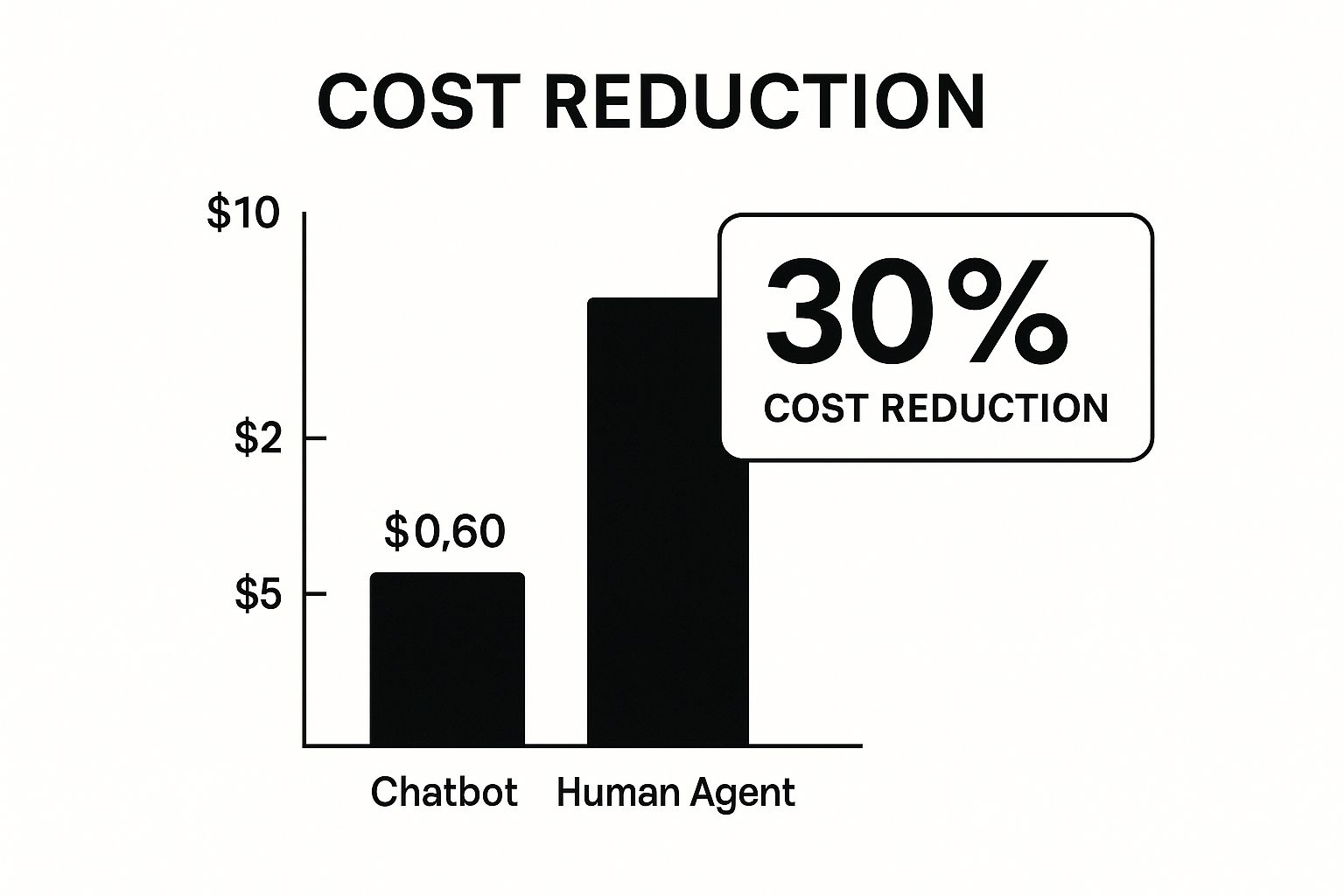
The visualization clearly shows that leveraging a chatbot can lead to a considerable reduction in per-interaction costs, underscoring the powerful ROI of this technology.
Why It Matters
Reducing operational costs is a universal business goal. For startups and small businesses, these savings can be the difference between profitability and failure. For large enterprises, it means reallocating significant budget toward innovation, marketing, or product development. By automating the front lines of customer service, companies can achieve greater efficiency and scalability without compromising on service quality for routine issues.
Real-World Examples
- Amtrak: Its chatbot, "Ask Julie," successfully answers around 5 million questions annually, saving the company over $1 million in customer service costs each year.
- Vodafone: The TOBi chatbot handles a massive 75% of customer queries, resulting in millions of dollars in support cost savings and improved operational efficiency.
- Autodesk: The software giant reduced its customer service expenses by a staggering $15 million after implementing chatbot automation to handle common support requests.
How to Implement It Effectively
To maximize cost savings from your AI chatbot, focus on a strategic implementation:
- Start Small: Begin by automating high-volume, low-complexity inquiries. Analyze your support tickets to identify the most common questions and use them as the foundation for your chatbot's knowledge base.
- Calculate Total Cost: Factor in all costs, including initial development, platform subscription, and ongoing maintenance, to accurately measure your return on investment.
- Phase Your Rollout: Implement the chatbot in stages. Start with a single channel or a specific customer segment to manage costs and minimize disruption to your existing workflow.
- Analyze for Savings: Use chatbot analytics to identify which automated tasks are providing the most significant cost savings and double down on optimizing those conversation flows.
3. Enhanced Customer Experience and Satisfaction
One of the core benefits of AI chatbots is their power to significantly enhance the overall customer experience. They achieve this by delivering instant, accurate, and personalized responses that align perfectly with modern consumer expectations for speed and convenience. A well-designed chatbot doesn't just answer questions; it creates a smoother, more engaging journey for the user.
By integrating with your business systems, chatbots can access customer preferences, purchase history, and past conversations. This allows them to offer contextually relevant assistance, transforming a generic interaction into a seamless and personalized experience. Instead of a customer having to repeat their issue, the chatbot already knows who they are and what they need, which is a key driver for building loyalty and satisfaction.

Why It Matters
In a competitive market, customer experience is a powerful differentiator. A positive, frictionless interaction can turn a one-time buyer into a loyal advocate. Chatbots help eliminate common points of frustration, such as long wait times or repetitive questions. By providing immediate and helpful support, you show customers you value their time, which directly boosts their perception of your brand and increases satisfaction rates.
Real-World Examples
- Sephora: Their chatbot on Kik provides personalized beauty recommendations and makeup tutorials, which increased customer engagement by 11%.
- Starbucks: The "My Starbucks Barista" bot allows customers to place their coffee orders through a simple messaging interface, streamlining the process and making it more convenient.
- Lyft: The company’s chatbot helps users with ride support, lost items, and payment questions, improving customer satisfaction scores by 10% through instant resolutions.
How to Implement It Effectively
To use a chatbot to truly elevate your customer experience, consider these actionable strategies:
- Design Natural Conversations: Create conversational flows that feel human-like and intuitive, avoiding robotic or clunky language.
- Integrate with Your CRM: Connect your chatbot to your Customer Relationship Management (CRM) system to access user data for true, deep personalization.
- Use Sentiment Analysis: Program the bot to detect user frustration through sentiment analysis and create a clear path to escalate the conversation to a human agent when needed.
- Incorporate Your Brand Voice: Infuse your chatbot's responses with your brand's unique personality and tone to create a consistent and memorable experience.
4. Scalability and Handling High Volume
One of the most powerful benefits of AI chatbots is their unparalleled scalability. They can handle thousands, or even millions, of conversations simultaneously without any decline in response speed or quality. Unlike human support teams, which require extensive hiring, training, and infrastructure costs to scale, chatbots accommodate massive traffic spikes instantly. This ensures consistent, high-quality service during peak seasons, product launches, or unexpected events.
This capability to manage high volume means your business can grow without its customer support becoming a bottleneck. Whether you experience a sudden surge from a viral marketing campaign or the predictable rush of a Black Friday sale, a chatbot provides a reliable front line. As your user base expands, understanding how to leverage dedicated AI customer service software for SaaS growth becomes indispensable for scaling support and managing escalating ticket volumes efficiently.
Why It Matters
In a digital world, traffic is unpredictable. The ability to scale on demand prevents system overloads, long customer wait times, and lost revenue. For businesses aiming for rapid growth, this scalability is not just a convenience; it's a core operational requirement. It ensures that every customer receives immediate attention, regardless of how many others are contacting you at the same time, maintaining satisfaction and brand reputation during critical periods.
Real-World Examples
- Facebook Messenger: Chatbots on the platform handle over 20 billion messages between businesses and users each month, showcasing immense scalability.
- Retail during Black Friday: Many e-commerce chatbots successfully manage a tenfold increase in normal traffic during sales events without any performance issues.
- World Health Organization (WHO): Its COVID-19 health alert chatbot served 12.5 million users in multiple languages, demonstrating how bots can handle global-scale information dissemination.
How to Implement It Effectively
To ensure your chatbot can handle high volume seamlessly, consider these actionable strategies:
- Choose Cloud-Based Solutions: Opt for a cloud-native chatbot platform that offers elastic scalability, automatically adjusting resources based on traffic.
- Load Test Before Peaks: Before an anticipated traffic surge like a holiday or marketing launch, run load tests to identify and fix potential performance bottlenecks.
- Implement Smart Queuing: For issues that require human escalation, set up an intelligent queuing system to manage requests efficiently during high-volume periods.
- Plan Infrastructure Capacity: Maintain a buffer in your infrastructure capacity, planning for at least 50% more than your anticipated peak traffic to handle unexpected surges.
5. Data Collection and Customer Insights
One of the most powerful, yet often overlooked, benefits of AI chatbots is their role as a first-party data collection engine. Every conversation a customer has with your chatbot is a goldmine of information, capturing their preferences, common questions, pain points, and behavioral patterns in their own words. This direct feedback provides invaluable, actionable business intelligence.
By analyzing these interactions, businesses can gain a deep and unfiltered understanding of what their customers truly want and need. This data is not based on assumptions but on real-time conversations, allowing you to improve products, refine marketing messages, and make strategic, data-driven decisions that enhance the entire customer experience.
Why It Matters
In a competitive market, understanding your customer is the ultimate advantage. Chatbot data helps you move from reactive problem-solving to proactive improvements. By identifying recurring issues or popular requests, you can address them at the source, whether that means updating your website's FAQ section, tweaking a product feature, or developing new services. This continuous feedback loop is crucial for staying relevant and customer-centric.
Real-World Examples
- Whole Foods: Their chatbot on Facebook Messenger collects data on user recipe searches, helping the company identify trending ingredients and popular dietary preferences to inform in-store promotions and content strategy.
- Lufthansa: The airline analyzes chatbot conversations to pinpoint friction points in the booking process and common travel-related anxieties, allowing them to streamline their services and improve customer communication.
- Spotify: Data from chatbot interactions about music discovery and playlist creation helps Spotify refine its recommendation algorithms and understand user listening habits more deeply.
How to Implement It Effectively
To leverage your chatbot as a powerful data tool, follow these actionable tips:
- Integrate with Analytics: Connect your chatbot to platforms like Google Analytics or Mixpanel to track conversation flows, conversion rates, and user engagement metrics.
- Use NLP for Thematic Analysis: Employ natural language processing tools to automatically tag and categorize conversations, extracting key themes, sentiment, and emerging trends from unstructured text.
- Create Customer Segments: Group users based on their chatbot interaction patterns, such as the types of questions they ask or the products they inquire about, to enable more personalized marketing.
- Review Conversation Logs: Regularly and manually review chatbot transcripts to uncover nuanced insights that automated systems might miss. For more on this, explore these effective customer feedback collection tools.
- Ensure Transparency: Be clear with users about your data collection practices and obtain consent where necessary to build trust and comply with privacy regulations.
6. Lead Generation and Sales Support
AI chatbots are powerful tools for more than just support; they are active contributors to revenue growth. By engaging website visitors proactively, they act as a tireless front-line sales force, qualifying leads and guiding prospects through the sales funnel 24/7. They can ask targeted questions to determine a visitor's needs, provide personalized product recommendations, and answer critical pre-purchase questions instantly.
This immediate engagement prevents potential customers from leaving your site and captures valuable lead information. Once a prospect is qualified, the chatbot can seamlessly hand them off to a human sales agent or schedule a meeting, making the entire sales process more efficient and effective.

Why It Matters
In a competitive market, speed is crucial. AI chatbots engage leads the moment they show interest, a critical advantage when sales teams are busy or offline. This immediate interaction significantly improves conversion rates by nurturing prospects with relevant information at the right time. By automating the initial qualification process, chatbots free up human sales agents to focus on high-value, closing activities instead of repetitive screening tasks.
Real-World Examples
- Drift: Many B2B companies using Drift's conversational marketing platform report that their chatbot generates over 60% of their qualified leads.
- Casper: The mattress company's chatbot helped increase online sales conversions by 30% by engaging users in friendly, helpful conversations.
- Duolingo: The language-learning app used a chatbot tutorial to guide new users, which successfully increased conversions to paid subscriptions by 15%.
How to Implement It Effectively
To turn your chatbot into a lead generation machine, apply these actionable strategies:
- Use Behavioral Triggers: Program the bot to initiate conversations at key moments, such as when a visitor spends a certain amount of time on a pricing page.
- Design Conversion-Focused Flows: Create conversation paths that naturally guide users toward a sales goal, like booking a demo or requesting a quote. For more on crafting these flows, explore how to use automated direct messages for outreach.
- Integrate with Your CRM: Connect your chatbot to your Customer Relationship Management (CRM) software to automatically pass qualified lead data to your sales team.
- A/B Test Your Approach: Experiment with different qualifying questions, opening lines, and calls to action to see what performs best.
- Train on Objections: Equip your chatbot with scripted responses to handle common sales objections and concerns.
7. Multilingual Support and Global Reach
One of the most transformative benefits of AI chatbots is their ability to dismantle language barriers, offering businesses an instant gateway to global markets. By providing support in multiple languages, these bots allow companies to serve a worldwide customer base without the massive overhead of hiring multilingual support staff for every region. This democratizes global expansion, making it accessible even for small businesses.
Advanced natural language processing (NLP) and integration with services like Google Translate or DeepL empower chatbots to understand and respond fluently in dozens of languages. They can often detect a user's language automatically and switch context seamlessly, delivering a truly localized and comfortable experience for the customer.
Why It Matters
In an interconnected world, your next customer could be anywhere. Offering support in a customer's native language is a powerful way to build trust and show respect. It removes friction from the buying process, increases conversion rates, and significantly improves customer satisfaction. This capability allows you to compete on a global scale, providing personalized service that resonates with diverse cultural and linguistic backgrounds.
Real-World Examples
- Booking.com: Their chatbot assists travelers with bookings and inquiries in their native tongue across more than 220 countries, making global travel logistics smoother.
- AliExpress: The e-commerce giant uses multilingual chatbots to bridge the communication gap between Chinese sellers and millions of international buyers, facilitating seamless global trade.
- Duolingo: This language-learning app uses its own multilingual bots to help users practice having conversations in over 30 languages, enhancing the learning experience.
How to Implement It Effectively
To effectively deploy a multilingual chatbot, consider these actionable steps:
- Start Strategically: Begin by identifying your top 5-10 customer languages based on website traffic and sales data to focus your quality assurance efforts.
- Review and Refine: Use native speakers to review the chatbot's translations and conversational flows. Automated translation is good, but human oversight ensures cultural nuance and accuracy.
- Localize Beyond Language: Adapt elements like currency, date formats, and regional idioms. For example, the Spanish used in Spain differs from that in Mexico.
- Monitor Performance by Language: Track customer satisfaction scores for each language. This helps you quickly identify and fix any languages where the bot may be underperforming.
Key Benefits Comparison of 7 AI Chatbot Features
| Feature | 24/7 Customer Support Availability | Significant Cost Reduction | Enhanced Customer Experience and Satisfaction | Scalability and Handling High Volume | Data Collection and Customer Insights | Lead Generation and Sales Support | Multilingual Support and Global Reach |
|---|---|---|---|---|---|---|---|
| Implementation Complexity | Moderate: Requires NLP and fallback routing to human agents | High: Upfront development, integration, ongoing maintenance | Moderate: Needs CRM integration and personalization logic | High: Demands robust cloud infrastructure and load balancing | Moderate: Integration with analytics & data privacy setup | Moderate to high: CRM & marketing tool integrations required | High: Advanced NLP, translation quality assurance needed |
| Resource Requirements | Continuous operation without human agents; monitoring and updates needed | Development team, AI specialists, maintenance resources | Data sources for personalization, sentiment analysis tools | Cloud resources, auto-scaling, load balancers | Analytics platforms, security and compliance infrastructure | CRM, marketing platforms, calendar, payment tools | Multilingual NLP models, native speakers for QA |
| Expected Outcomes | Instant, consistent 24/7 support; reduced wait times; improved satisfaction | Up to 30-50% reduction in support costs; scalable operations | 20-40% customer satisfaction improvement; personalized service | Handles thousands+ conversations simultaneously without lag | Actionable business intelligence; trend and customer insight | 10-30% conversion increase; better qualified leads | Seamless global support in 50+ languages; expands market reach |
| Ideal Use Cases | Businesses needing constant customer assistance globally | Organizations with large routine inquiry volumes seeking savings | Companies focused on customer retention and personalized support | Businesses expecting high traffic peaks or rapid growth | Companies aiming to leverage chatbot data for strategic gains | Sales-driven organizations wanting automated lead qualification | Global companies targeting multilingual customers |
| Key Advantages | No staffing costs for off-hours; competitive global service | Predictable, lower operating costs; reduces employee burnout | Consistent, quick, personalized engagement; multi-language support | Eliminates peak bottlenecks; scales instantly without hires | Converts conversations to structured data; predictive analytics | Captures and qualifies leads 24/7; integrates with sales tools | Removes language barriers; localized cultural adjustments |
| Main Limitations | Struggles with complex/emotional cases; customer preference for humans | High initial cost; requires AI expertise; potential job concerns | Limited emotional intelligence; risk of impersonal interactions | Requires significant infrastructure; complex queries need backup | Data privacy concerns; compliance overhead; data management load | May seem pushy; misses nuanced signals; requires CRM integration | Translation accuracy varies; cultural nuances can be lost |
Ready to Unlock These Benefits? Start Your AI Chatbot Journey Today
As we've explored, the journey from traditional customer service to an AI-powered future is not just about adopting new technology; it's about fundamentally transforming how your business operates, communicates, and grows. The benefits of AI chatbots are no longer a distant vision but a tangible reality for businesses of all sizes, offering a powerful toolkit to enhance efficiency and customer delight.
Let's quickly revisit the game-changing advantages we've covered. You now have a clear path to providing instant, 24/7 support, ensuring no customer query goes unanswered, regardless of the time or day. This constant availability directly translates into a significant reduction in operational costs by automating repetitive tasks and freeing up your human team to focus on high-value, complex issues that truly require their expertise.
From Good to Great: Elevating the Customer Experience
The impact on your customer relationships cannot be overstated. By delivering quick, accurate, and personalized responses, you actively boost customer satisfaction and loyalty. Imagine a world where your business can effortlessly scale its support capabilities during peak seasons or marketing campaigns without a single hiccup, handling thousands of conversations simultaneously. This level of responsiveness was once the exclusive domain of corporate giants.
Furthermore, AI chatbots are your front-line intelligence gatherers. They meticulously collect valuable data and unlock deep customer insights with every interaction, providing you with a direct line to your audience's needs and pain points. This intelligence fuels smarter marketing, better product development, and a more effective sales funnel, where chatbots act as tireless agents in generating and qualifying leads. Finally, the ability to offer seamless multilingual support breaks down geographical barriers, opening your business to a global marketplace.
Your Actionable Next Step
The evidence is clear: implementing an AI chatbot is one of the most strategic moves you can make to future-proof your business. It’s an investment in efficiency, intelligence, and, most importantly, in your customer relationships. The question is no longer if you should adopt this technology, but how soon you can start reaping its rewards. Don’t let complexity be a barrier. The path to unlocking these benefits is simpler and faster than you think.
Key Takeaway: The benefits of AI chatbots compound over time. They create a virtuous cycle where better support leads to happier customers, which generates richer data, leading to smarter business decisions and sustainable growth.
Ready to see these benefits in action? With Yoonoo, you can deploy a powerful AI chatbot trained on your own website content, documents, or help center in just minutes. Stop letting valuable customers slip away and start building smarter, more efficient customer relationships today.
Start your free trial with Yoonoo and transform your customer communication!